
The Chinese University of Hong Kong is stepping up its efforts to attract international students and researchers as it begins implementing its 2026 to 2030 Strategic Plan, with global talent, multidisciplinary education and cross border collaboration at the centre of its next phase of development.
The university has identified Talent Attraction and Development as one of five core priorities in the new five year blueprint. Among the initiatives is the creation of CUHK’s 10th college, a new residential college designed specifically for postgraduate students and intended to give the university’s growing international community a stronger academic and social base.
CUHK Vice Chancellor and President Dennis Lo Yuk ming said the idea for a dedicated postgraduate college was influenced in part by his own experiences at the universities of Oxford and Cambridge.
“I realized the collegiate system is actually excellent when I studied at both Oxford and Cambridge, which have dozens of colleges each,” Lo said, recalling his time at Green Templeton College, a graduate college at the University of Oxford.
He later visited Cambridge University’s Darwin College to examine how its postgraduate collegiate system operates. The experience helped shape CUHK’s plans for its own new college.
Located near the planned Pak Shek Kok MTR station, the college is intended to extend CUHK’s distinctive collegiate model beyond undergraduates. Rather than grouping students solely according to their academic disciplines, the residential system will bring people from different fields together in the same community.
Lo described the college as a “home away from home”, where students from different academic backgrounds can exchange ideas, develop friendships and establish relationships that may last well beyond their university years.
The approach also has a practical purpose. International students can face challenges when adjusting to a new city, education system and social environment. A dedicated residential community could provide a more immediate support network while giving overseas students greater opportunities to interact with classmates from Hong Kong and elsewhere.
That international component is becoming increasingly important for CUHK.
Applications from non local students rose by about 20 percent this year compared with the previous year. The increase was even more pronounced among applicants from outside the mainland, where applications climbed by 75 percent. Southeast Asia and the Middle East accounted for a large share of the applicants.
Lo welcomed the Hong Kong government’s decision to raise the enrolment ceiling for non local self financing undergraduate students at public post secondary institutions. The ceiling will increase from 40 percent to 50 percent from the 2026 to 2027 academic year.
For students who choose CUHK, accommodation will be part of the university’s effort to make Hong Kong a more attractive study destination. Lo said non local students would receive two years of guaranteed on campus accommodation during their four year undergraduate studies.
The university is also looking for additional sites where new hostels could be built as it prepares for further growth in its international student population.
Taking CUHK abroad to the world
Recruitment efforts are not limited to applications. CUHK has also been using its Counsellor Fly in Programme to build relationships with leading secondary schools overseas.
Under the programme, school counsellors from selected countries and regions are invited to visit CUHK. The university sponsors their trips, giving counsellors an opportunity to see the campus, understand its programmes and gain first hand knowledge of the educational environment before advising prospective students.
The strategy reflects a broader shift in how universities compete for international students. Reputation remains important, but prospective students and their families also want a clear sense of what an institution offers, how students live and what opportunities they will have after graduation.
CUHK’s new plan seeks to address those questions through a combination of international recruitment, residential education and new academic programmes.
One example is CU Medicine Plus, which expands on the university’s Global Physician Leadership Stream. The programme is designed to expose more students to disciplines beyond traditional medical training.
For Lo, that direction reflects a larger change in higher education and the workplace.
“The future is multidisciplinary,” he said.
The university plans to introduce programmes that bring together subjects and skills that traditionally sat in separate academic departments. Areas mentioned by Lo include data analytics, space technology, flight technology and earth analytics.
The underlying idea is that many of the problems facing governments, businesses and researchers cannot be addressed through a single academic discipline. Medicine increasingly relies on data and artificial intelligence. Environmental research depends on computing and earth observation. Space and aviation require expertise spanning engineering, physics, computer science and data analysis.
CUHK intends to build more programmes around those intersections.
A one brand, two campuses strategy
Another major element of the university’s plan is the continued development of its “one brand, two campuses” structure linking CUHK’s Hong Kong campus with The Chinese University of Hong Kong, Shenzhen.
Lo said CUHK would make greater use of the two campuses to create programmes in which students spend two years in Hong Kong and two years in Shenzhen.
The model gives students exposure to two cities within the Greater Bay Area while allowing the university to draw on the different academic and economic strengths of each location.
“In the coming five years, you will see more of these programs, more of this two plus two, and whatever subject plus X [another subject],” Lo said.
The reference to “subject plus X” captures the university’s intention to encourage students to combine a main field of study with another area of expertise.
For students entering a job market increasingly shaped by technology, such combinations could provide a broader foundation than a conventional single subject degree.
Building strength in health technology, AI and quantum science
Talent development is only one side of CUHK’s five year strategy. The university also plans to strengthen research in areas it sees as strategically important, particularly health technology, artificial intelligence and quantum science.
Lo said CUHK would continue to contribute to the national scientific research and innovation system through these fields.
Quantum science is receiving particular attention.
“Quantum science is a frontier technology for the country and a highly strategic and important field,” Lo said.
CUHK launched the State Key Laboratory of Quantum Information Technologies and Materials last year, establishing a dedicated platform for research in an area that is expected to influence computing, communications, sensing and other advanced technologies.
The university also sees major opportunities in life sciences and medicine as development continues in Hong Kong’s Northern Metropolis.
For health research, one of the most important resources is not simply laboratory equipment but the availability of large and diverse datasets and biological samples.
Lo pointed to sample size as a major consideration in medical research. Large scale studies require extensive data if researchers are to identify meaningful patterns and produce reliable findings.
This is where cross border collaboration could become increasingly important.
CUHK’s Faculty of Medicine is already involved in the establishment of a biobank in the Hetao Shenzhen Hong Kong Science and Technology Innovation Cooperation Zone. The facility could support research requiring access to biological samples and larger datasets, strengthening cooperation between researchers on both sides of the boundary.
“I believe that with the development of the Northern Metropolis, these initiatives will only continue to grow,” Lo said.
The development of the wider Greater Bay Area is also influencing CUHK’s plans for its physical expansion.
Watching the next university town
CUHK is monitoring plans for the future Hung Shui Kiu and Ha Tsuen University Town, including the proposed HK$10 billion loan fund for campus development.
Lo said the university would study the terms of the fund before determining how it could fit into CUHK’s longer term expansion strategy.
Hung Shui Kiu could offer particular advantages because of its potential links with Qianhai in Shenzhen.
“The advantage of Hung Shui Kiu is that its future synergy with Qianhai will be highly attractive,” Lo said.
CUHK has already sought to deepen ties between academia and industry through its InnoHub for New Quality Industries, launched in March. The initiative is intended to strengthen research cooperation with companies and support innovation across the Greater Bay Area.
The university’s interest in the area therefore extends beyond simply acquiring additional space. Its plans involve connecting research, industry, technology and education across the wider regional economy.
The scientist who looks to art
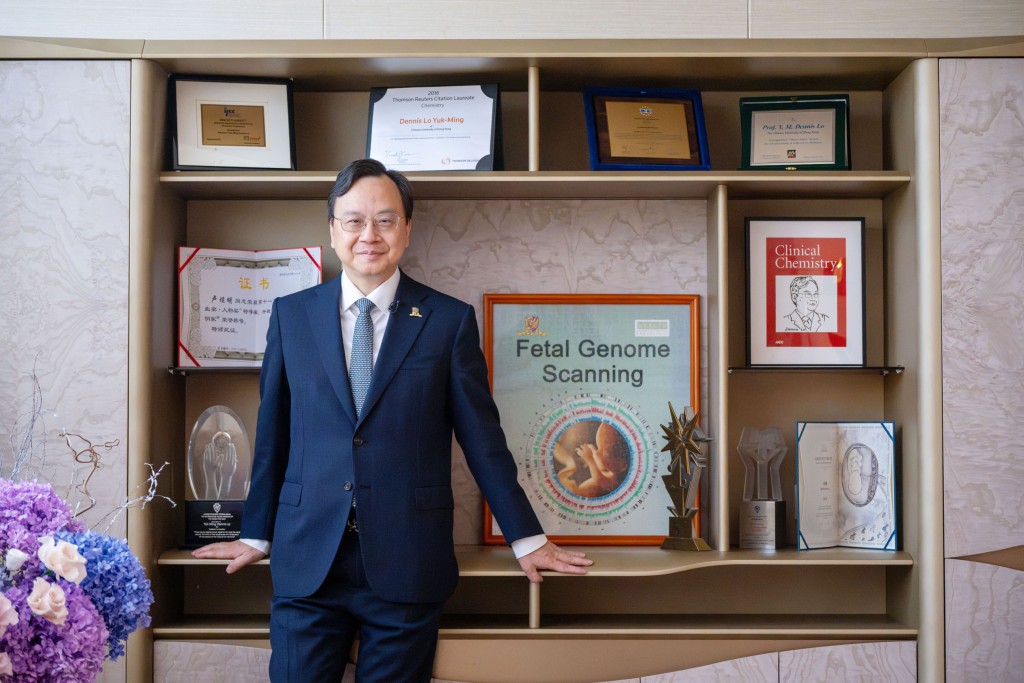
Lo’s scientific career has placed him among the best known researchers associated with CUHK. In 1997, he discovered fetal DNA in maternal blood, a breakthrough that helped transform non invasive prenatal testing.
He has described that discovery as one of the most memorable moments of his career.
Yet his interests extend well beyond medicine and laboratory science.
Asked about figures who fascinate him, Lo pointed to Leonardo da Vinci, whose work combined scientific inquiry, engineering and art centuries before modern universities began promoting multidisciplinary study.
Lo recently encountered some of da Vinci’s original work during a visit to the French Academy of Sciences in Paris. He was particularly struck by the artist and scientist’s use of mirrored writing.
“He is really an unparalleled genius,” Lo said.
The connection between science and art also emerged when Lo was asked what he would choose to study if he were a CUHK student today.
His answer was not medicine or science. He said he would choose either art or law.
Away from his administrative and scientific responsibilities, Lo said he has a favourite place on the CUHK campus where he can step back from his work.
The Pavilion of Harmony, located higher up the campus, offers views towards Tolo Harbour. On a clear, sunny day, he said, it is an ideal place to relax and take in the surroundings.
His description of the location offers a glimpse into the personal side of a university leader whose professional life has been closely associated with research and discovery.
But his broader message to prospective students is tied to the university’s ambitions for the next five years.
“CUHK is a place that makes dreams come true,” Lo said.
For the university, turning that aspiration into reality will mean competing for talent far beyond Hong Kong, expanding its postgraduate community, creating programmes that cross traditional academic boundaries and building stronger links between its Hong Kong and Shenzhen campuses.
The new five year plan puts those goals on a defined timetable. The test now will be whether CUHK can translate its growing international demand, research strengths and Greater Bay Area connections into programmes and opportunities that give students and researchers compelling reasons to choose the university.