

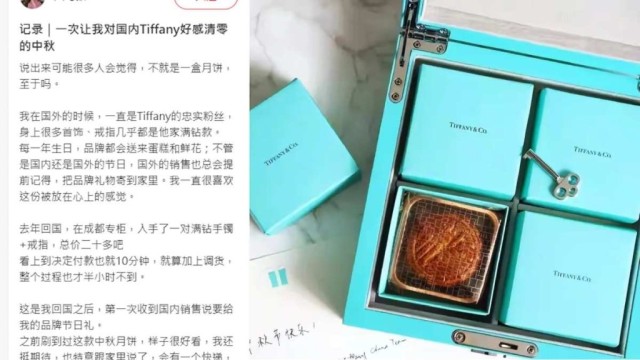
A dispute involving Tiffany & Co. in China has drawn widespread attention after a customer said she did not receive the Mid Autumn Festival mooncakes she was expecting from the luxury jewellery brand and was later offered a small box of peach pastries as compensation.
The customer, who said she had spent more than 200,000 yuan (HK$226,000) at Tiffany’s Chengdu store, described the handling of the incident in online posts. She said the mooncakes had been sent to the wrong address and that staff told her another customer had received two sets of the festive gift.
According to her account, Tiffany staff initially said she would need to wait until another set of mooncakes became available. The customer said she had been a longtime Tiffany client and had previously received festive gifts from the company while living or travelling overseas.
The dispute has since developed into a wider argument online over customer service, compensation, privacy and the way complaints involving major luxury brands are handled.
Customer says mooncakes were sent to wrong address
The customer said the problem began when she was expecting Tiffany’s seasonal Mid Autumn Festival gift but discovered that the mooncakes had not reached her.
She was subsequently told that the gift had been delivered to another customer. According to her posts, staff explained that another client had received two sets of mooncakes and that she would have to wait for the company to have another gift available.
The incident appears to have frustrated the customer in part because of her longstanding relationship with the brand. She said she had previously received Tiffany’s festive gifts while overseas, suggesting that seasonal gifts had become a familiar part of her relationship with the company.
Rather than simply being a dispute over the value of a box of mooncakes, the complaint became tied to the customer’s expectations of service after a substantial purchase history.
The customer later said Tiffany employees repeatedly apologised for what had happened. However, she claimed that the alternative offered to her was a selection of locally made peach pastries valued at about 20 yuan.
That offer became one of the most discussed elements of the dispute online. The customer had said she had spent more than 200,000 yuan at the Chengdu store, while the replacement gift she described was worth only a small fraction of that amount.

Online dispute grows beyond the original complaint
The disagreement did not remain limited to communication between the customer and Tiffany.
The customer said some of her social media posts about the dispute were restricted or deleted. She subsequently created more than 20 chat groups to discuss the matter and said those groups attracted more than 10,000 people who supported her complaint.
The growing number of people involved transformed an individual customer service dispute into a much larger online discussion.
Such disputes can quickly gain attention on Chinese social media, particularly when they involve well known international luxury brands and questions about how high spending customers are treated. In this case, the customer’s claims about the value of her purchases and the compensation offered became central to the discussion.
The customer also raised a separate concern over her personal information.
She said Tiffany staff later sent flowers and peach pastries to her privately. While she appeared to view the gesture as an attempt to resolve the disagreement, she questioned how the company had obtained her home address.
That question introduced a privacy issue into the dispute. The customer wanted to know how her address had been accessed and used to send the additional items.
The available account does not establish whether the address was obtained through Tiffany’s customer records, delivery information or another source. It also does not establish whether the company breached any privacy rules.
Social media reaction becomes divided
Public reaction to the dispute has not been uniformly supportive of the customer.
Some online users expressed sympathy with her complaint, particularly over the reported mix up involving the mooncakes and the difference between the value of her purchases and the replacement pastries.
Others, however, criticised the way she pursued the dispute after it moved onto social media.
One commenter wrote that defending her rights was reasonable but argued that the way she handled the dispute was inappropriate.
Another user questioned why she was continuing to focus on the matter after the Mid Autumn Festival had already ended.
The criticism shows how the online discussion moved beyond Tiffany’s customer service response and began examining the customer’s own conduct.
There were also claims of online harassment involving employees connected to the dispute. Those allegations have contributed to the divided reaction, with some users arguing that a complaint should not result in individuals being targeted online.

A wider question for luxury brands
The incident has also raised broader questions about how luxury companies manage customer relationships when relatively small promotional gifts become part of a much larger purchasing relationship.
Mooncakes are commonly exchanged during the Mid Autumn Festival, and luxury brands in China often use seasonal gifts and limited edition items as part of customer engagement. For high spending clients, such gestures can carry significance beyond their retail value because they form part of the service and relationship associated with the brand.
That can make a mistake involving a gift more sensitive than the monetary value of the item itself.
In this case, the customer’s complaint centred on more than simply failing to receive mooncakes. Her account raised questions about whether the company dealt with the mistake appropriately, whether the replacement was satisfactory, how customer information was handled and whether the dispute was managed effectively once it became public.
At the same time, the online reaction demonstrates the difficulty of resolving a private customer complaint after thousands of people become involved.
For Tiffany, the dispute places attention on its customer service practices in China, particularly how stores respond when a promotional gift is mistakenly delivered to the wrong person. For customers, it raises another question: what information should a company provide when personal data is used to arrange a private delivery or settlement?
The case also illustrates how quickly a routine service problem can become a public controversy when social media enters the dispute.
Tiffany has not, in the material provided, publicly addressed all of the customer’s claims, including her questions about how her address was obtained. The customer’s allegations should therefore be distinguished from independently established facts.
For now, the central issues remain the reported delivery error, the compensation offered, the handling of the customer’s personal information and the escalation of the dispute online.
Should luxury brands offer more transparent explanations when customer service disputes move into the public eye?