

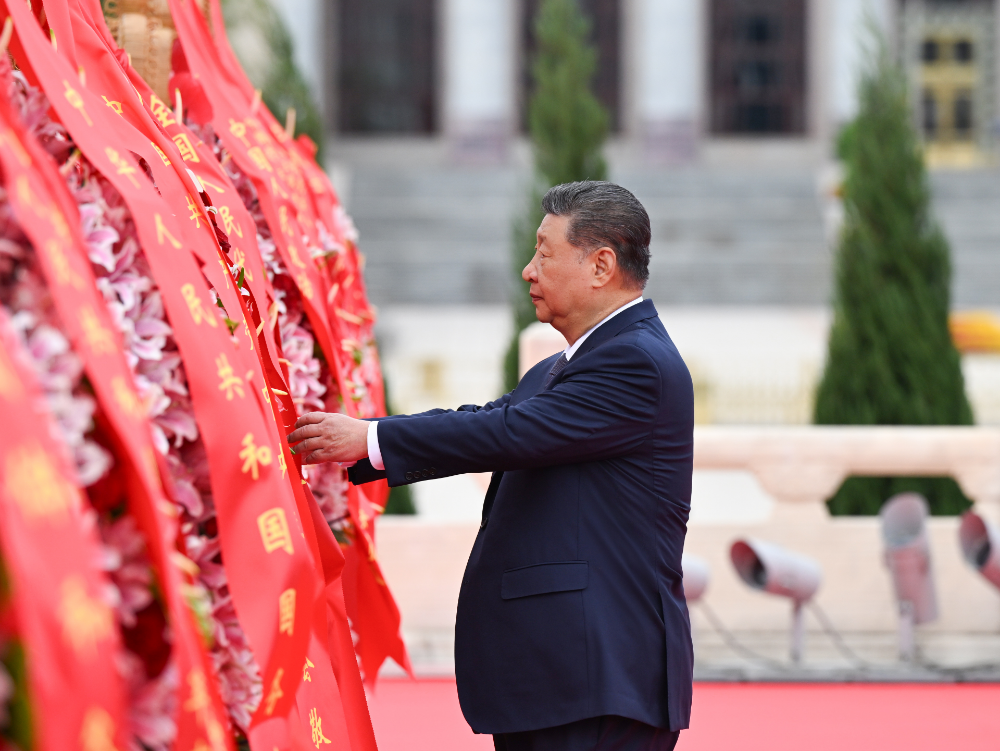
Chinese President Xi Jinping joined senior Party and state leaders at Tian’anmen Square on Wednesday to honor those who died for China’s national independence and development, marking the country’s annual Martyrs’ Day ceremony one day before National Day.
The ceremony began at 10 a.m. at the Monument to the People’s Heroes, where nine large flower baskets were placed in tribute to fallen national heroes. Xi and other senior officials later approached the monument, where Xi straightened the ribbons on the baskets before walking around the monument with other leaders to pay their respects.
The annual event has become a fixed part of China’s public commemorations since Martyrs’ Day was formally established in 2014. Sept. 30 was designated as the national day of remembrance, placing it immediately before Oct. 1, China’s National Day. The observance is intended to honor people who died in struggles associated with national independence, liberation and the development of the People’s Republic of China.
National leaders attend annual ceremony
Xi attended the ceremony in his three official capacities as president of China, general secretary of the Communist Party of China Central Committee and chairman of the Central Military Commission.
Premier Li Qiang, Zhao Leji, Wang Huning, Cai Qi, Ding Xuexiang, Li Xi and Vice President Han Zheng were also present, according to the official account of the event. Representatives from different sectors of society joined the leaders at Tian’anmen Square.
The ceremony followed a formal sequence. Participants first sang China’s national anthem. They then observed a moment of silence for those who lost their lives in the country’s revolutionary struggles and in the development of the People’s Republic of China.
The nine flower baskets were presented on behalf of major Party, state and social institutions. They represented the Communist Party of China Central Committee, the Standing Committee of the National People’s Congress, the State Council, the National Committee of the Chinese People’s Political Consultative Conference and the Central Military Commission.
Additional baskets represented non-Communist parties, the All-China Federation of Industry and Commerce and people without party affiliations, as well as people’s organizations and representatives from different walks of life. Veterans, retired senior officials, relatives of martyrs and the Chinese Young Pioneers were also represented.
Each basket carried ribbons bearing the words “Eternal Glory to the People’s Heroes.”
Yin Li, a member of the Political Bureau of the CPC Central Committee and secretary of the CPC Beijing Municipal Committee, presided over the ceremony.

Martyrs’ Day comes before National Day
The timing of the ceremony gives it a prominent place in China’s annual calendar of national commemorations.
Martyrs’ Day falls on Sept. 30, while National Day is observed on Oct. 1. The arrangement places a formal remembrance of fallen heroes immediately before celebrations marking the founding of the People’s Republic of China in 1949.
China’s top legislature approved the establishment of Martyrs’ Day in 2014. Since the first observance, Xi has attended ceremonies paying tribute to fallen national heroes on the occasion.
The Tian’anmen ceremony also forms part of a wider pattern of official commemorations devoted to people who died during periods of war, revolution and national development. Similar ceremonies have been held at the square every year since the national observance was established.
The Monument to the People’s Heroes, where Wednesday’s ceremony took place, is one of the most prominent memorial sites in central Beijing. The monument stands at the southern end of Tian’anmen Square and commemorates those who died in the struggles that shaped modern China.
Ceremony coincides with major historical anniversaries
This year’s Martyrs’ Day observance carries additional historical significance because 2026 marks several major anniversaries in China’s official calendar.
The year marks the 105th anniversary of the founding of the Communist Party of China. The anniversary was formally commemorated in Beijing in July, when Xi and other senior officials attended a gathering at the Great Hall of the People.
2026 also marks the 77th anniversary of the founding of the People’s Republic of China.
Another major anniversary is connected to the Long March, the military retreat and movement undertaken by the Red Army between 1934 and 1936. This year marks 90 years since its completion.
The Long March occupies a central place in the historical narrative of the Communist Party of China. According to official Chinese accounts, Red Army forces crossed difficult terrain during the campaign, including major rivers, snow-covered mountain ranges and grasslands. Some participants travelled as far as 12,500 kilometres.
The march began in 1934 and ended in 1936 after forces moved through large areas of China. Chinese official histories describe the campaign as an important stage in the eventual victory of the Chinese revolution.
A commemorative exhibition marking the 90th anniversary of the Long March is being held at the Military Museum of the Chinese People’s Revolution in Beijing this year.

Remembering those who died
The Martyrs’ Day ceremony is designed around remembrance rather than celebration. The silence observed at the Monument to the People’s Heroes gives the event its central moment, while the flower baskets provide a formal expression of respect.
Xi’s action of straightening the ribbons before walking around the monument has also appeared in previous Martyrs’ Day ceremonies. Official reports from earlier years show similar ceremonies taking place at Tian’anmen Square, including in 2024 and 2025.
The 2026 ceremony therefore continued an established annual practice rather than introducing a new form of commemoration.
The list of institutions represented by the nine baskets also reflects the broad range of groups included in the official ceremony. Alongside the Party and central government, the tribute included representatives of veterans, martyrs’ families, social organizations, young people and people from different sectors of society.
That structure places the memory of fallen national heroes within the country’s wider public commemorative calendar.
A ceremony before China’s National Day
The event in Tian’anmen Square came as Beijing prepared for National Day on Oct. 1. With Martyrs’ Day observed immediately beforehand, the two dates create a sequence linking remembrance of the dead with celebrations marking the founding of the People’s Republic of China.
For Chinese authorities, the annual ceremony also connects contemporary state institutions with historical events that shaped the country during the 20th century.
In 2026, that historical focus is particularly visible because of the 105th anniversary of the CPC, the 77th anniversary of the People’s Republic and the 90th anniversary of the Long March’s conclusion.
The flower baskets will remain at the Monument to the People’s Heroes as a public symbol of the day’s observance, while the ceremony itself marks Sept. 30 as a day dedicated to remembering those whom China officially recognizes as national heroes.
How should countries preserve the memory of those who made sacrifices during defining moments in their history?