

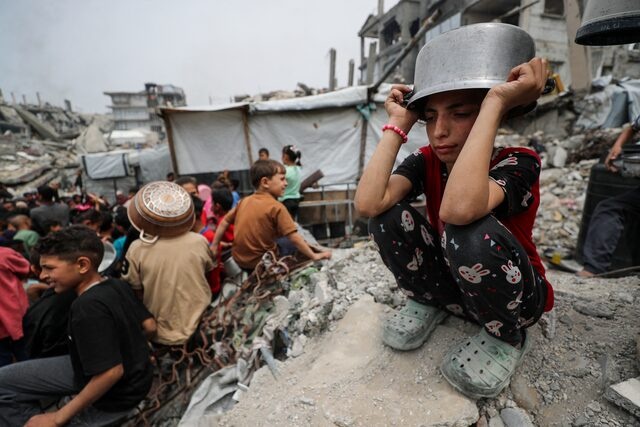
Palestinian filmmaker Hosam Abu Dan has taken a story from everyday life in Gaza to the Toronto International Film Festival, using the experiences of a 13 year old girl entering puberty to explore family, privacy and the struggle to find normality during war.
Thirteen in Gaza, which had its world premiere at TIFF on Tuesday, follows Raghad, a teenage girl living with her father in the Gaza Strip. Her story centres on a stage of life that is normally filled with questions, embarrassment and the need for reassurance, but becomes far more difficult when home, privacy and safety have been stripped away.
The 77 minute Palestinian drama was filmed entirely inside Gaza and marks Abu Dan’s feature directorial debut. It was selected for TIFF’s Centrepiece programme and is being presented as a portrait of a father and daughter trying to manage ordinary life in a displacement camp.
For Abu Dan, telling that story from inside Gaza was central to the project.
“I used to always say that people could always tell your story, but when you tell it your way, in your own language, it's different,” he told Reuters. “That is something that's very important.”
A Teenage Girl at the Centre
Raghad is not presented simply as a character living through a war. She is a 13 year old girl confronting puberty at a time when the normal boundaries of childhood have been disrupted.
The film places her relationship with her father at the centre of the story. According to the film’s festival description, Raghad has lost her home and most of her family in a bombing and is living with her father in a displacement camp. There, she faces the physical and emotional changes of adolescence while living without the privacy and security normally associated with growing up.
The subject allows Abu Dan to approach Gaza from a different angle. Instead of building the story around military operations or political speeches, the film concentrates on a family dealing with ordinary needs in extraordinary circumstances.
Puberty becomes part of that reality. So do questions about personal space, care and the relationship between a daughter and her father.
The setting matters because the conditions surrounding Raghad shape even the most private parts of her life. A young person who would ordinarily have space to ask questions, seek reassurance or simply be alone instead has to grow up in a crowded environment shaped by displacement.
That contrast gives the film its central tension.
Filmed Inside Gaza
Making the film was itself a demanding undertaking. Abu Dan and his team filmed the production entirely in Gaza, working with a small crew because of the practical difficulties involved in moving around the territory.
In an interview with Reuters, Abu Dan said the crew was deliberately kept small enough for everyone to travel in a single car.
“Usually, a film crew is quite large, but we deliberately kept ours very small so we could all fit into a single car and move around easily,” he said.
The production took 12 days, according to the filmmaker.
Other reporting on the production has described the conditions as exceptionally difficult. Screen reported that the film was made with a local Palestinian cast and crew during wartime and described it as the first fiction feature shot entirely in Gaza in 12 years. The publication also reported that a crew member was seriously injured after a bombing occurred near a filming location.
The circumstances placed practical limits on how the production could operate. A large film set requires equipment, transport, personnel and time, all of which become harder to manage in a territory affected by war and displacement.
Abu Dan instead worked with a compact team and relied on people already in Gaza.
That decision also shaped the film's identity. The people making it were not arriving from outside to recreate Gaza for the screen. They were filming in the place where the story was set.
A Film Made From Inside the Story
Abu Dan's comments about telling the story “in your own language” point to one of the film's defining features.
Stories about Gaza are frequently produced by journalists, filmmakers and organisations outside the territory. Abu Dan wanted his film to come from someone who had lived there and understood the setting personally.
That perspective does not remove the political context surrounding the story. Instead, it places that context behind the experiences of individual characters.
Raghad's life is affected by the war, but she is also dealing with the concerns of a teenager. Her father is not only trying to survive. He is trying to care for his daughter and provide some sense of security while living through conditions that make ordinary parenting difficult.
The result is a story built around small human problems.
Where can a teenage girl find privacy in a crowded displacement camp? How does a parent respond when his child needs emotional support but the family has lost much of its normal life? What happens to the ordinary milestones of adolescence when a child is surrounded by displacement and uncertainty?
Those questions give the film a focus that reaches beyond the immediate events of the war.
Gaza’s War Shapes the Film’s Context
The film arrives at TIFF against the backdrop of the war that began after Hamas militants attacked Israel on October 7, 2023. The attack killed about 1,200 people in Israel, according to Israeli tallies cited by Reuters, with most of those killed civilians. Israel then launched its military campaign in Gaza.
The resulting conflict has caused extensive destruction and a large number of Palestinian deaths, while repeated displacement and severe humanitarian conditions have affected the population across the Gaza Strip. Reuters reported that tens of thousands of Palestinians, most of them civilians, have been killed during Israel's military assault.
The film does not need to recreate every element of that conflict to show its consequences. Its focus on one family allows the effects of war to appear through daily routines, relationships and the loss of personal space.
That approach also distinguishes Thirteen in Gaza from a conventional war film.
The central question is not simply what happens on the battlefield. It is what happens to ordinary people when the conditions of daily life are repeatedly disrupted.
Toronto Premiere Without the Director
Although the film has reached one of North America's major film festivals, Abu Dan was unable to travel to Toronto for the premiere.
He spoke to Reuters from his home in Gaza, where restrictions on international travel prevented him from attending the festival in person.
His absence creates an unusual contrast. The film was physically made in Gaza, then travelled to Toronto while its director remained behind.
For Abu Dan, the festival screening nevertheless represents an opportunity for the story to reach audiences far beyond the territory where it was filmed.
The film's Toronto selection also places a Gaza made production alongside international cinema in the festival's Centrepiece programme. Screen reported that it was the first fiction feature shot entirely in Gaza in 12 years.
The production has also attracted international industry attention. MAD World acquired worldwide sales rights before the Toronto premiere, according to Screen.
More Than a Story About War
Abu Dan says he wants audiences to see something beyond destruction when they think about Gaza.
“Many people may assume that Gaza has nothing left to offer, so we have to keep reminding them: no, we deserve life, we have dreams, and we have everything,” he said. “What we truly want is to live normal lives, just like everyone else in the world.”
That idea runs through the premise of Thirteen in Gaza. The film is set during an extraordinary period, but its central character is dealing with something universal: growing up.
Raghad's concerns are not limited to the conflict around her. She needs care. She has questions about her changing body. She wants privacy. She needs a parent who can listen to her.
Those needs do not disappear because a war is taking place.
For Abu Dan, putting such an ordinary experience on screen is part of telling a fuller story about Gaza. The territory is not only a place of destruction and political conflict. It is also home to families, children, artists and people trying to maintain relationships and routines under conditions they did not choose.
The film's journey from Gaza to Toronto places that perspective before an international audience.
Thirteen in Gaza is now part of the Toronto festival programme, carrying with it not only a story about a teenager entering adulthood but also the perspective of a filmmaker who made the film inside the place he was describing. For audiences watching it, the question is simple: can cinema help people see the everyday lives behind the headlines?