


Asia’s wealthiest families are approaching philanthropy differently from many of their counterparts in other parts of the world, with newer fortunes, continued control of family businesses and close ties to communities shaping where and how they direct their money.
A new study by The Bridgespan Group, based on an analysis of 186 wealthy individuals and families across 20 economies in Asia, Africa, Europe and the Americas, found that about 94 percent of the wealth held by Asia’s richest families belongs to first or second generation wealth holders. Around 95 percent of those families also continue to control the companies that created their fortunes.
Those figures help explain why philanthropy in Asia is often closely linked to family stewardship, business ownership, succession planning and long term relationships with communities and governments.
The findings come as a major transfer of private wealth approaches. An estimated US$74 trillion is expected to pass between generations over the next 20 to 25 years, increasing attention on how wealthy families manage their fortunes and decide what social causes to support.
New wealth shapes giving decisions
The Bridgespan research, titled High Impact Family Philanthropy: What Makes Family Giving Distinctive, examines how wealthy families organise their charitable activities, what issues they support and the methods they use to pursue social change.
The report forms part of Bridgespan’s High Impact Philanthropy series and is supported by a Funders Council comprising the Institute of Philanthropy, The Rockefeller Foundation and the Gates Foundation. Contributions also came from the Financial Services Development Council and the Wealth Management Institute.
Xueling Lee, a co author of the research and a partner at Bridgespan, said the study provides insight into an area that has received comparatively less attention.
She said the research comes at a significant moment for family philanthropy as private wealth continues to increase, while the way families organise their giving and pursue impact remains less understood.
Asia’s wealth stands apart in one important respect: much of it is relatively new.
About 94 percent of wealth held by the region’s wealthiest families sits with first or second generation wealth holders. That compares with roughly 85 percent among wealthy families in high income economies outside Asia.
The age of a family fortune can affect more than the identity of the person making charitable decisions. It can determine how much wealth remains tied up in operating companies, how much liquid capital is available for philanthropy and how closely family members remain involved in business decisions.
For many Asian families, the person making a major philanthropic commitment may also be an active business owner, company leader or successor preparing to take greater responsibility for the family enterprise.
That overlap can influence both the priorities and structure of giving.
Family businesses remain firmly under control
The study found another major difference between wealthy families in Asia and those elsewhere.
Approximately 95 percent of Asia’s wealthiest families continue to control the businesses that generated their fortunes. Outside Asia, the figure is about 68 percent.
The distinction matters because business ownership can place philanthropy alongside a wider set of family decisions. These can include succession, relationships with governments, corporate reputation and the future direction of the family enterprise.
Bridgespan’s previous research into corporate giving also points to the strong presence of family linked companies in Asia.
Eleven of the 20 largest corporate funders in Asia are connected to founders or families. Globally, only four of the world’s 20 largest corporate funders have similar founder or family links.
Brian San, secretary general of the Institute of Philanthropy, said wealthy families can bring a combination of long term commitment, personal involvement and relationships built across different sectors.
He pointed to the continuing importance of family owned businesses in Asia and their connection with philanthropy and community engagement.
For families that have spent decades building businesses and relationships, charitable giving can become part of a broader approach to family responsibility rather than an activity managed separately from commercial interests.

Education and health remain leading priorities
Despite the regional differences, wealthy families across the world tend to support many of the same causes.
Education, healthcare and assistance for marginalised or vulnerable groups rank among the most commonly supported areas.
There are, however, differences in the causes receiving greater attention in Asia.
Asian families are more likely than wealthy families in other regions to support elderly care, religion and sports. Wealthy families outside Asia more frequently direct funding towards science and technology initiatives, including projects connected with artificial intelligence.
The differences reflect the circumstances and traditions surrounding family philanthropy in different markets.
Religious giving, community responsibilities and support for local institutions can carry particular weight for Asian families, while other donors may place greater emphasis on scientific research or emerging technologies.
The research does not suggest that one approach produces better results than another. Instead, it shows that family giving often reflects the history, business interests and social relationships surrounding the family itself.
Measuring results remains a weakness
One of the clearest findings from the research concerns how families report the results of their giving.
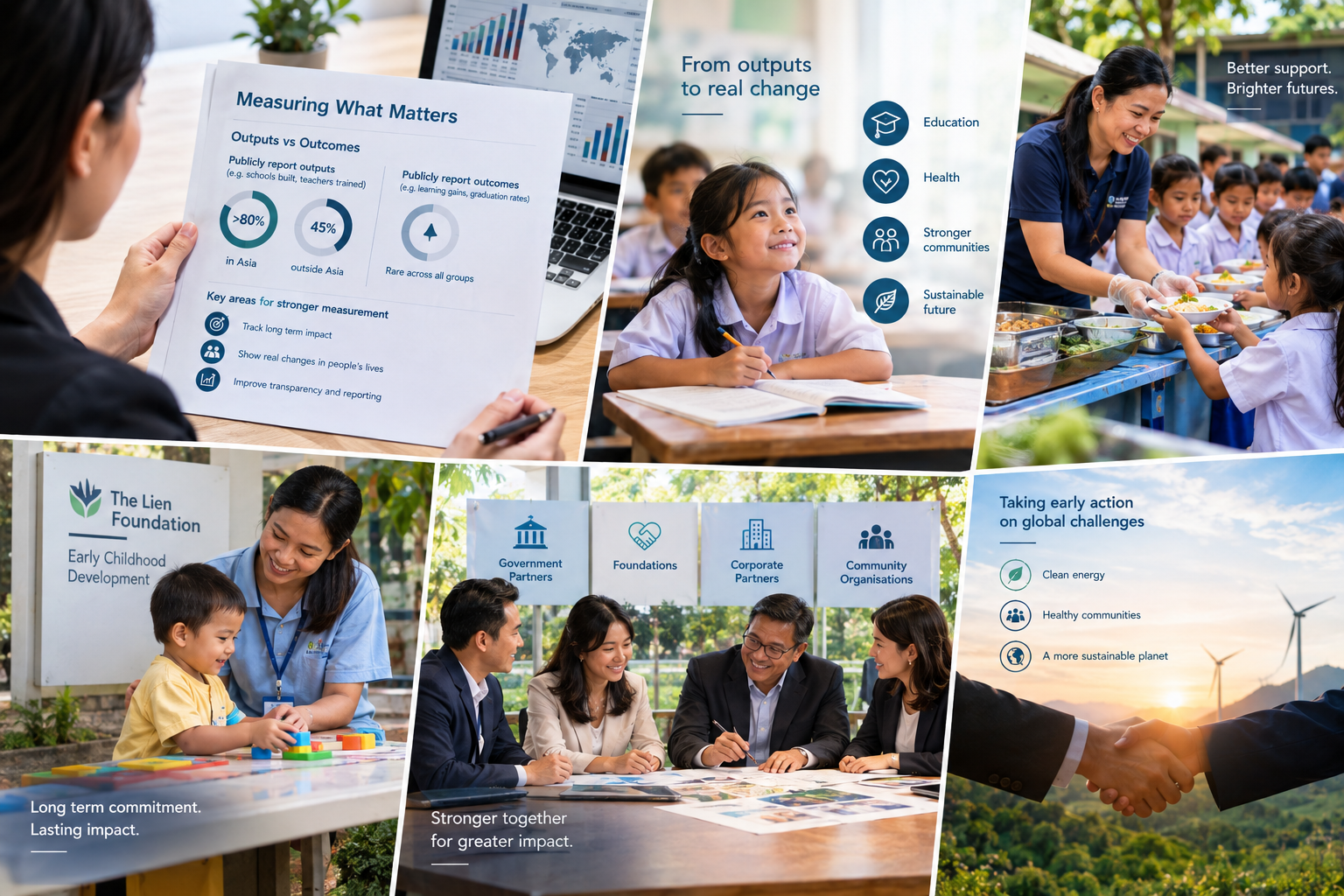
More than 80 percent of wealthy families in Asia publicly report outputs from their philanthropic activities. These can include tangible measures such as the number of schools built or teachers trained.
That figure falls sharply when the focus moves from outputs to outcomes.
Only about 45 percent of high income families outside Asia publicly report comparable information, while outcome reporting remains uncommon across all groups.
The distinction is important.
A charity can report that it built a school, trained teachers or delivered a programme to a particular number of people. Those figures show what an organisation did. They do not necessarily show whether students learned more, whether graduation rates improved or whether a community experienced lasting benefits.
The research suggests that wealthy families have considerable room to strengthen the way they assess and communicate the results of their philanthropy.
Better measurement could also help families determine whether long term commitments are producing the changes they originally intended.
Families can take risks other funders avoid
The companion report, How the World’s Wealthiest Families Give, looks beyond where families donate money and examines how they use their financial independence, relationships and decision making authority.
One advantage identified by the research is the ability to support ideas that other funders may be unwilling to back at an early stage.
Family philanthropies can sometimes move from a decision to funding more quickly than institutional or corporate donors because they do not face the same layers of external approval.
The Lien Foundation in Singapore provides one example.
The foundation spent a decade supporting early childhood development, at a time when relatively few organisations were strongly committed to the sector. Its sustained work with government and other stakeholders contributed to wider development in the field.
The example illustrates how a family foundation can stay with an issue for years rather than shifting priorities after a short funding cycle.
Bringing different groups together
Wealthy families can also use relationships developed through business, philanthropy and community activities to bring organisations together.
The Bridgespan report points to the Jollibee Group Foundation, led by Tony and Grace Tan Caktiong, as an example.
In 2024, the foundation partnered with the Provincial Government of Basilan, the Zuellig Family Foundation and the League of Corporate Foundations to expand a school feeding programme.
The partnership supports nutritious meals for nearly 25,000 children across 250 schools.
Such collaborations allow family philanthropies to contribute more than money. Their networks can help connect government agencies, foundations, companies and community organisations that might otherwise operate separately.
Deepali Khanna, senior vice president and head of Asia at The Rockefeller Foundation, said family philanthropies have supported some ambitious research and social initiatives because they can commit early and accept risks that larger institutions may struggle to take.
She cited the Global Energy Alliance for People and Planet as an example of a programme that emerged from family philanthropies making early joint commitments when no single institution could have carried the effort alone.
Philanthropy can extend beyond charitable donations
Another finding concerns the range of financial tools available to wealthy families.
Families with authority over both philanthropic and investment decisions may be able to shift capital between different forms of funding without going through the same number of external negotiations, board approvals or fiduciary requirements faced by institutions with outside investors.
That can allow a family to combine grants, investments and other forms of financial support when pursuing a particular social objective.
For families that continue to own and control major businesses, the distinction between philanthropy, investment and broader family strategy can therefore be less rigid.
This also raises questions about governance and accountability, particularly as family fortunes pass from one generation to the next.
A major transition for Asian wealth
The findings arrive as a large generational transfer of wealth begins to take shape around the world.
With an estimated US$74 trillion expected to move between generations over the next two to three decades, decisions made by wealthy families today could influence charitable funding for years.
In Asia, that transition may be especially significant because so many major fortunes remain with founders or second generation owners and because families continue to control the companies behind their wealth.
The next generation will therefore inherit not only financial assets but also businesses, philanthropic institutions, community relationships and decisions about what causes deserve sustained support.
Bridgespan’s research shows that Asian family philanthropy is already being shaped by these connections. The challenge now is to turn financial resources, long term relationships and freedom to act into measurable improvements for the people and communities those families seek to support.