

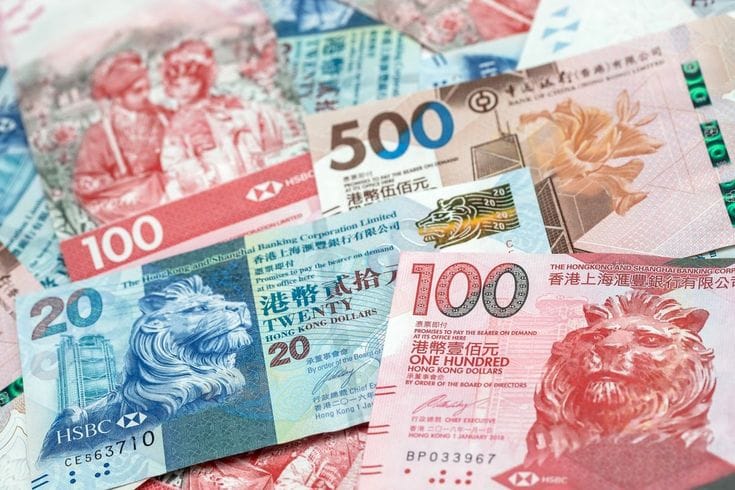
The Hong Kong Monetary Authority reaffirmed its "absolute commitment" to the linked exchange rate system on Tuesday, following a four-week episode of speculative pressure during which the Hong Kong dollar repeatedly tested the weak end of its permitted trading band at 7.85 to the US dollar. The authority deployed 28.3 billion US dollars in currency market operations, selling US dollars and buying Hong Kong dollars to defend the band, before speculative pressure abated and the currency appreciated to trade near 7.78 per dollar.
The Mechanics of the Defence
The linked exchange rate system, in operation since October 1983, requires the HKMA to buy or sell Hong Kong dollars at the 7.75 and 7.85 limits of the band, using the Exchange Fund's foreign currency reserves as the firepower for market interventions. The Exchange Fund holds approximately 490 billion US dollars of foreign currency assets, representing more than 130 percent of the Hong Kong dollar monetary base, providing an exceptionally robust buffer against speculative attacks.
When the HKD approached 7.85, the HKMA's automated intervention system triggered purchases of Hong Kong dollars at the weak-side convertibility undertaking, withdrawing Hong Kong dollar liquidity from the interbank market and driving up the Hong Kong Interbank Offered Rate (HIBOR). The overnight HIBOR spiked as high as 4.8 percent during the most intense period of the intervention, making the carry trade that motivated much of the speculative positioning unprofitable and triggering the unwinding of short HKD positions.
The HKMA deployed $28.3 billion in market operations to defend the HKD peg, with the Exchange Fund's $490B reserves providing a robust defence buffer.
Sources of Speculative Pressure
The speculative pressure was attributed by market analysts to three converging factors. First, the differential between US dollar interest rates and Hong Kong dollar rates, while narrowing, remained sufficiently attractive to fund a carry trade selling HKD and investing in USD instruments. Second, concerns about Hong Kong's economic outlook related to property market weakness and reduced IPO activity earlier in the year prompted some investors to reduce Hong Kong dollar exposure. Third, a small group of macro hedge funds, including at least two that took large positions explicitly betting on a devaluation or peg abandonment, amplified the speculative pressure.
HKMA Chief Executive Eddie Yue was dismissive of the devaluation thesis, noting that the authority has defended the peg through 14 episodes of speculative pressure since 1983 and that "the structural fundamentals supporting the linked exchange rate remain unambiguous." Hong Kong's current account surplus of approximately 8 percent of GDP, the Exchange Fund's massive reserve position, and the peg's legal entrenchment in the Exchange Fund Ordinance all reinforce the system's durability.
Historical Context
The most significant previous test of the peg was during the Asian financial crisis of 1997 and 1998, when the HKMA famously used Exchange Fund resources to purchase Hang Seng Index constituent stocks directly, simultaneously defending the currency peg and the stock market against coordinated speculative attacks. The strategy was controversial at the time but proved successful, with the HKMA subsequently making a profit on its equity positions.
The HKMA has defended Hong Kong's linked exchange rate through 14 episodes of speculative pressure since 1983, each time successfully.
Economic Implications of the Peg
Academic and market economists periodically debate whether the linked exchange rate system remains optimal for Hong Kong's economic structure, given that it imports US monetary policy regardless of domestic economic conditions. The sustained period of high US interest rates in recent years, designed to combat US inflation but not relevant to Hong Kong's economic cycle, has imposed a contraction in credit conditions that would not have occurred under an independent monetary policy.
However, the consensus among policymakers, leading financial economists, and the business community remains strongly supportive of the peg system, citing its role as the bedrock of monetary stability, its contribution to Hong Kong's status as an international financial centre, and the systemic risk that any managed transition to an alternative framework would entail. The question of peg reform is not on any policy agenda, and the HKMA has indicated no intention of reconsidering the framework.