

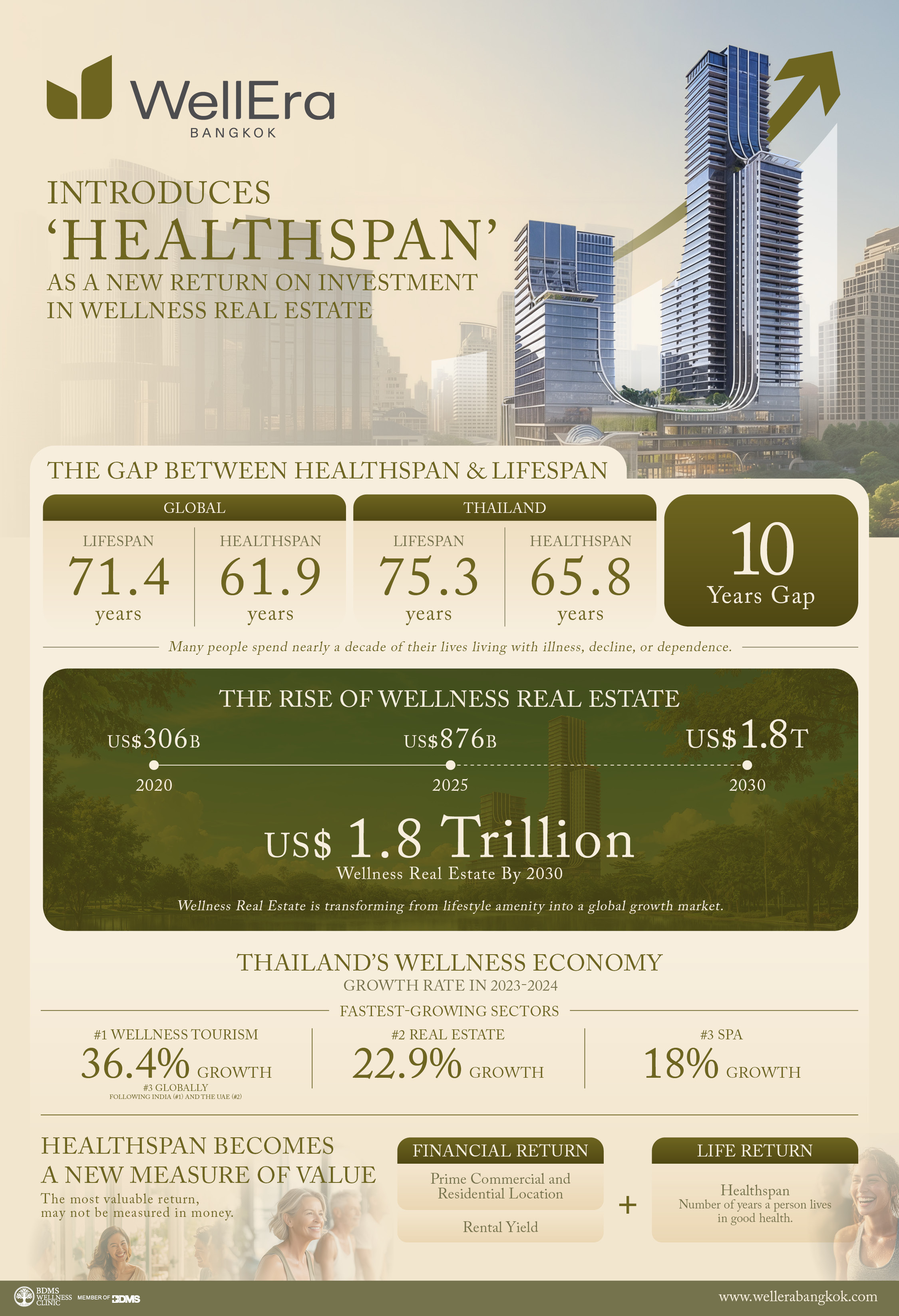
The idea comes as wellness real estate expands rapidly around the world. The global market reached an estimated US$876 billion in 2025, up from US$246 billion in 2019, and is projected to reach US$1.8 trillion by 2030.
Thailand is becoming an increasingly significant part of that growth. The country's wellness economy is valued at more than US$42.7 billion, while wellness real estate recorded growth of 22.9%, making it Thailand's second fastest growing wellness sector.
For decades, property investment has largely been assessed through familiar measures: location, price appreciation, rental income, design and lifestyle appeal. WellEra is seeking to add another consideration to that calculation.
Can a home also be an investment in how long and how well its residents live?
Moving the focus from lifespan to healthspan
WellEra, developed by BDMS, has introduced the concept of healthspan as part of its approach to residential investment and everyday living.
Healthspan refers to the number of years a person spends in good health, without chronic illness, serious disability or major physical decline. It differs from lifespan, which simply measures the total number of years a person lives.
The distinction has become more important as populations around the world live longer. According to the figures cited by WellEra, the global average lifespan is 71.4 years, while the average healthspan is 61.9 years. That leaves a difference of nearly 10 years between the length of life and the period spent living in relatively good health.
The question, therefore, is no longer limited to how people can live longer. Increasingly, attention is turning towards whether people can remain healthy, independent and physically capable for more of those years.
WellEra says this shift should also influence how people think about their homes.
Rather than treating wellness as an additional residential feature, the development integrates the expertise of BDMS Wellness Clinic in scientific wellness, preventive healthcare and personalised health management into the residential environment.
The concept is designed around the idea that health is influenced not only by medical treatment and genetics, but also by the conditions people experience every day, including the air they breathe, the light they are exposed to and the quality of their sleep.
A home designed around everyday environmental conditions
Dr. Tanupol Virunhagarun, Chief Executive Officer of Group 8, which includes BDMS Wellness Clinic, BDMS Wellness Resort and BDMS Silver under Bangkok Dusit Medical Services Public Company Limited, said residential environments could play an increasingly important role in supporting long term health.
"Scientific evidence shows that our health is shaped not only by genetics or medicine, but also by the environments we experience every day," Dr. Tanupol said.
"The future of investment may not be defined solely by financial returns, but by the ability of our homes and communities to help us live longer, healthier, and better lives."
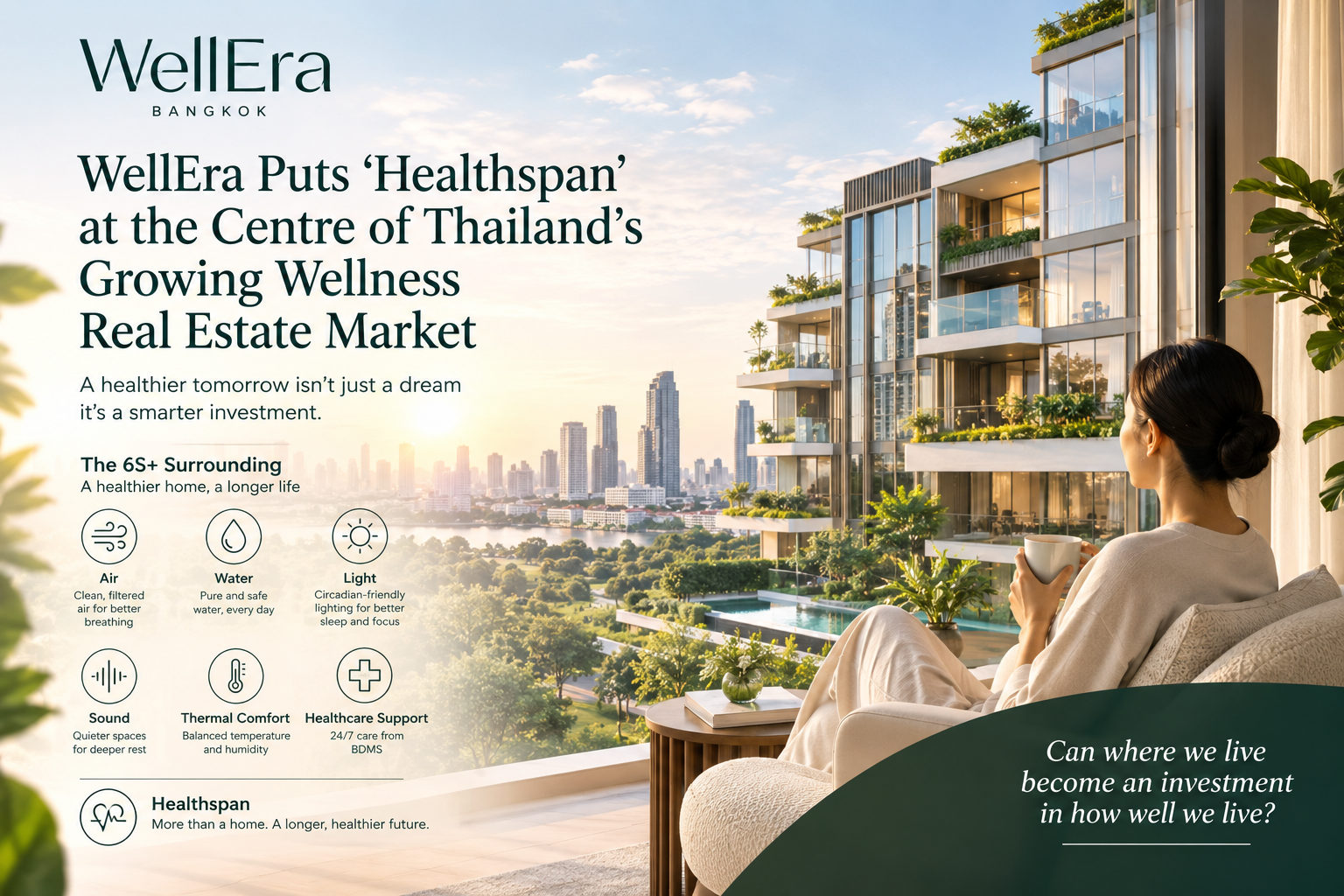
WellEra translates that approach into its residential design through what it calls the 6S+ Surrounding framework.
The framework focuses on key elements of the indoor environment, including air, water, light, sound and thermal comfort. These are combined with healthcare support from BDMS.
The approach reflects growing research into the relationship between living conditions and physical and mental wellbeing. Indoor air quality, for example, has been linked to cognitive performance. Exposure to light can influence circadian rhythms and sleep patterns, while environmental noise can affect sleep and cardiovascular health. Indoor temperature and humidity can also influence comfort and health.
WellEra has incorporated a number of technical specifications into its design in response to these concerns.
Its air filtration system uses MERV 14 filters, which the company says can achieve up to 95% efficiency in filtering PM2.5 particles. The residences also use advanced water filtration and ultraviolet treatment.
Lighting has been designed to support circadian rhythms, with a Unified Glare Rating, or UGR, of 16 or below. The development also uses STC 60 acoustic systems to reduce unwanted noise between spaces.
Indoor relative humidity is maintained at between 50% and 65%, according to the company.
These details move the discussion beyond the visible features usually associated with wellness properties.
Beyond spas, gyms and green spaces
Wellness real estate has often been associated with amenities such as fitness centres, spas, green areas and recreational facilities. Those features remain popular, but WellEra argues that they represent only part of the connection between a person's living environment and their wellbeing.
The company's model places greater emphasis on the conditions residents experience continuously, including air quality, lighting, temperature, water and sound.
Healthcare services also form part of the approach.
Through BDMS healthcare support, WellEra residents have access to 24 hour nursing and medical assistance, personalised health management and emergency services.
The combination of environmental design and healthcare access is intended to create what the company describes as a residential ecosystem focused on supporting long term health and quality of life.
For property investors, the concept raises a broader question about what residential value may mean in the years ahead.
A property can generate rental income and rise in market value. It can offer access to transport, schools, business districts and entertainment. It can also be judged by its architecture, views and facilities.
WellEra is arguing that the ability of a home to support healthier living should also become part of that assessment.
Thailand's expanding wellness economy
The timing is significant for Thailand, where wellness has become a growing part of the wider economy.
With the country's wellness economy valued at more than US$42.7 billion and wellness real estate growing by 22.9%, demand for properties connected to health and wellbeing is becoming an increasingly important part of the sector.
The growth also reflects changing expectations among residents and investors. As populations age and people become more conscious of preventive healthcare, residential developments are facing pressure to offer more than conventional amenities.
This does not necessarily mean every home will become a healthcare facility. Instead, developments such as WellEra are exploring how medical expertise and environmental design can be incorporated into residential communities without separating daily living from health management.
The result is a different way of viewing the return generated by a property.
Financial performance remains important. Location still matters. Rental demand and capital appreciation continue to influence investment decisions.
But WellEra is proposing that another form of return should be considered: whether the place where people spend much of their lives can help support their physical health, sleep, comfort and independence over time.
A new measure of residential value
WellEra's approach positions healthspan as a potential measure of long term residential value.
The company is seeking to move the conversation beyond properties marketed primarily through luxury facilities and visual design. Its focus instead is on integrating scientific wellness, preventive healthcare and the physical conditions of the home into one residential model.
That approach may appeal to buyers who are increasingly considering how their homes affect their daily routines and long term wellbeing, particularly as longer lifespans make the quality of later years a growing concern.
The projected expansion of the global wellness real estate market to US$1.8 trillion by 2030 suggests that this type of thinking is likely to become more prominent across the property sector.
For WellEra, the central argument is straightforward: a residential investment should not be measured only by what it earns or what it is worth when sold.
The next question for buyers and investors may be just as important: Can the home you invest in also help you invest in the years you spend living well?