

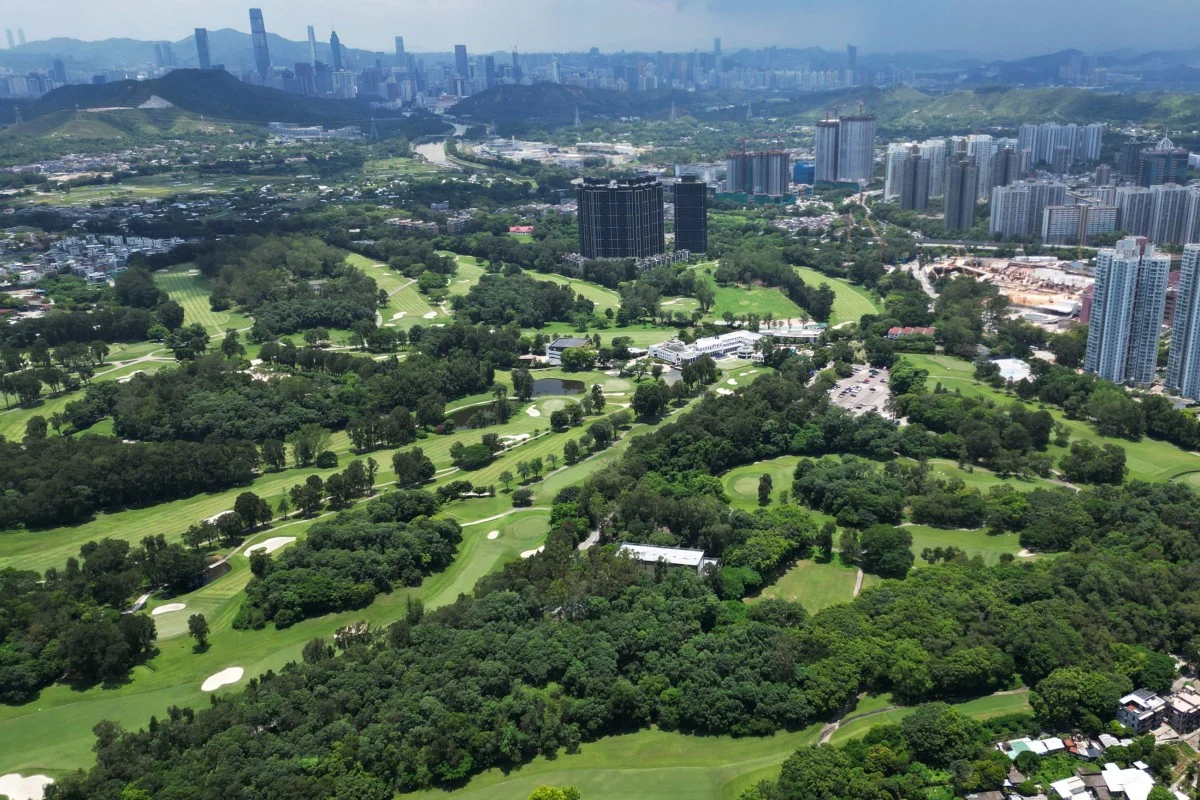
Hong Kong’s Court of Appeal has rejected the Environmental Protection Department’s attempt to overturn a legal challenge concerning a proposed public housing project at part of Fanling Golf Course, leaving the government facing another legal setback over its plans for the site.
The court dismissed the department’s appeal on Monday after finding that the environmental assessment process for the proposed development had fallen short of procedural requirements. The ruling upholds an earlier judgment that questioned both the adequacy of the environmental information considered by officials and the way supplementary material was handled during public consultation.
The dispute centres on the government’s decision to take back 32 hectares of the Fanling Golf Course in 2023. Under the development plan, 9.5 hectares of the site’s Old Course were earmarked for a large public housing project.
The government has argued that the development would help address Hong Kong’s long standing shortage of affordable housing. The project, however, has faced legal opposition from the Hong Kong Golf Club, which operates the course and has argued that the environmental consequences of building on the site have not been properly assessed.
Golf Club challenged environmental approval
The latest court battle followed the Club’s successful judicial review of the Environmental Impact Assessment report for the proposed housing development.
The report had received conditional approval from the authorities. The Golf Club challenged that decision, arguing that the assessment underestimated the likely environmental damage associated with developing the Old Course.
The Club also raised concerns about the consultation process, saying members of the public had not been given a proper opportunity to examine relevant supplementary information before the authorities reached their decision.
The legal challenge eventually succeeded, prompting the Environmental Protection Department to appeal.
At the centre of the appeal was a disagreement over what environmental information the authorities were required to have before approving the project.
The department argued that the absence of sufficient information to determine the precise level of environmental risk did not mean officials had failed to conduct an environmental assessment. It maintained that the assessment process had identified potential impacts and that appropriate measures could be introduced to reduce or control them.
The Golf Club took a different position.
It argued that the potential environmental effects were sufficiently serious that they could not realistically be dealt with through mitigation measures. From the Club’s perspective, the problem was not simply a question of whether officials had carried out an assessment, but whether the information available to them was sufficient to support the decision they ultimately made.

Court finds consultation process deficient
The Court of Appeal sided with the Golf Club on the central procedural issues.
In its judgment, the court upheld the earlier finding that the consultation process surrounding the environmental assessment was inadequate. In particular, it found that supplementary information relevant to the assessment had not been made available for public inspection.
That failure, the court ruled, amounted to procedural unfairness.
The judgment also criticised the Director of Environmental Protection’s handling of submissions made by the Golf Club concerning the supplementary material. The court found that the director had acted in a manner described in legal terms as “Wednesbury unreasonable” by failing to properly consider those submissions.
The term refers to a decision so unreasonable that it falls outside the range of decisions a public authority could lawfully make. In this case, the court’s finding focused on the director’s failure to take the Club’s representations concerning the supplementary information into account.
The ruling does not simply settle a dispute between a sports organisation and the government. It also places attention on the standards public authorities must meet when conducting environmental assessments for major infrastructure and housing schemes.
For projects that can significantly alter existing land, environmental impact assessments are intended to provide decision makers and the public with information about possible consequences. The consultation process gives affected parties an opportunity to examine that information and raise concerns before decisions are finalised.
The Court of Appeal’s ruling indicates that the process cannot be treated as a formality where important supplementary material has not been made available for public examination.
Government departments ordered to pay costs
With the appeal dismissed, the Environmental Protection Department and the Civil Engineering and Development Department were ordered to pay part of the Hong Kong Golf Club’s legal costs.
The ruling represents another legal obstacle for the government’s plans for the former golf course land.
The 2023 acquisition formed part of a broader housing strategy in Hong Kong, where the government has sought to identify additional land for residential development amid persistent demand for homes.
Fanling Golf Course has long occupied a distinctive position in the city. Its history, sporting importance and physical setting have made it a subject of debate well beyond the question of housing supply.
The government’s decision to resume part of the course generated opposition from the Hong Kong Golf Club, which has repeatedly defended the site’s sporting and heritage value.
The latest judgment does not resolve the wider policy debate over how the land should ultimately be used. Instead, it deals with whether the environmental approval process for the proposed development complied with the law.
That distinction matters. A successful judicial review does not necessarily determine the final use of the land. It can, however, require authorities to reconsider decisions or repeat parts of the decision making process in accordance with legal requirements.

Golf Club welcomes ruling
The Hong Kong Golf Club welcomed Monday’s decision, describing Fanling Golf Course as a precious site of cultural heritage and stressing its importance to the development of golf in Hong Kong.
The Club said it would continue communicating with the government about the future of the site while seeking to use its facilities and resources to support golf and sports tourism.
It also pointed to its record of hosting major golf competitions involving local, national and international players.
In recent years, the Club has staged national and international tournaments as part of efforts to strengthen Hong Kong’s position within the international golf community. It said these events form part of a wider programme aimed at promoting and professionalising the sport.
The Club also said it wanted to make golf more accessible to members of the wider public.
Its statement reaffirmed support for sports development initiatives promoted by both the central government and the Hong Kong Special Administrative Region government. The Club said it would continue working to contribute to the development of sport while maintaining its position on the future of Fanling.
Housing plans face renewed scrutiny
The dispute reflects a broader challenge facing Hong Kong policymakers: finding land for housing while meeting legal and environmental requirements governing major developments.
The government’s acquisition of part of the Fanling Golf Course was intended to unlock land for homes. But the court proceedings have shown that the speed or scale of a proposed development cannot replace the need for a sound environmental assessment and a fair consultation process.
For the authorities, the immediate task is now to address the shortcomings identified by the courts if they intend to continue pursuing development on the site.
The Court of Appeal’s decision makes clear that environmental information must be handled properly and that relevant submissions cannot be disregarded during the approval process.
For the Golf Club, Monday’s ruling provides another legal basis for challenging the way the project has been assessed and gives it further scope to engage with the government over the future of the land.
The dispute is therefore far from being only about a golf course. It concerns how Hong Kong balances public housing needs, environmental protection, public consultation and the preservation of sites with established sporting and heritage value.
Any further attempt to advance the housing project will have to take account of the court’s findings. In practical terms, the government must now ensure that the environmental assessment and consultation process meets the standards set out in the judgment before the proposed development can move forward.