

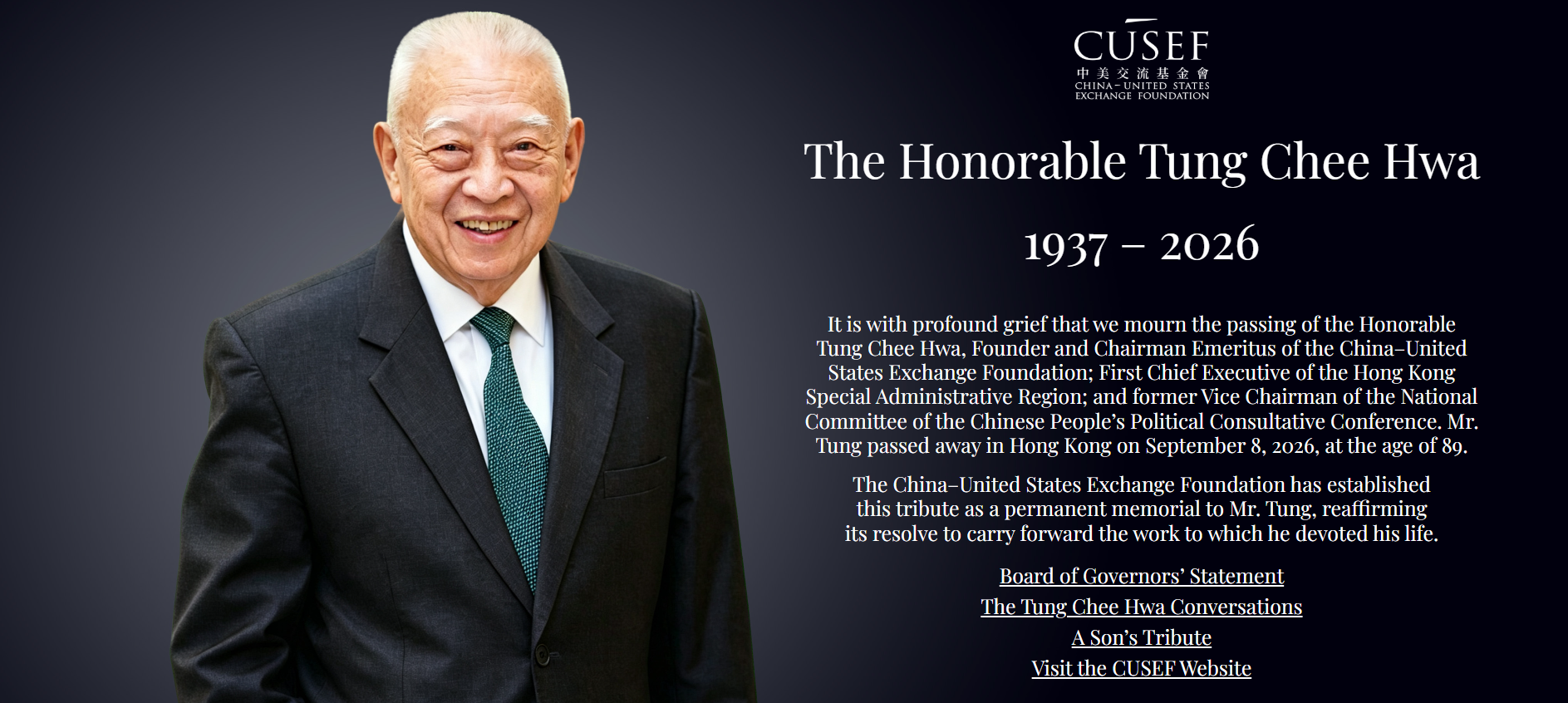
The China United States Exchange Foundation has established a permanent online tribute to its founder and chairman emeritus, Tung Chee Hwa, following the death of the former Hong Kong chief executive at the age of 89.
Tung died on Sept 8, leaving behind a public career that spanned Hong Kong politics, business and international engagement. CUSEF said the tribute was created to preserve his legacy and recognise his longstanding belief that dialogue between China, the United States and the wider international community could help promote peace, progress and prosperity.
The tribute brings together more than 100 personal reflections from people who knew Tung or worked with him during his career. Among those contributing memories are former Chinese vice premier Zeng Peiyan, former US ambassador to China Max Baucus and Nobel laureate Muhammad Yunus.
The collection offers a broad picture of Tung's public life, drawing on the recollections of political figures, business leaders, colleagues and friends from different parts of the world.
A Permanent Record of Public Service
James Chau, president of CUSEF, said the tribute reflected Tung's strong sense of responsibility and his determination to encourage communication across national and political boundaries.
“I saw firsthand Mr. Tung’s exceptional sense of duty, generosity and conviction,” Chau said in a statement released by the foundation.
He said the permanent tribute was designed not only to record Tung's years of public service but also to preserve the principles that shaped his work.
Chau described dialogue as central to Tung's outlook and said his belief in communication could continue to influence younger generations.
That emphasis is particularly closely linked to the work of CUSEF, which Tung established in 2008. The Hong Kong based nonprofit organisation was created as a platform for exchanges between people in China, the United States and other parts of the world.
For Tung, international engagement was not limited to official diplomatic meetings. CUSEF has promoted discussions involving political figures, business leaders, academics and members of civil society, with the stated aim of encouraging greater understanding between different communities.
The new tribute therefore serves two purposes. It records memories of Tung himself while also connecting his personal legacy with the organisation he founded.

More Than 100 Personal Reflections
One of the central features of the tribute is a collection of more than 100 reflections from people who encountered Tung at different stages of his career.
The contributors include prominent figures with experience in Chinese government, US diplomacy, international development and global affairs.
Former vice premier Zeng Peiyan is among those remembering Tung, as is Max Baucus, who served as US ambassador to China. Muhammad Yunus, the Bangladeshi economist and Nobel laureate, is also included in the collection.
Their accounts provide different perspectives on a man who moved between business, government and international affairs over several decades.
Tung became the first chief executive of the Hong Kong Special Administrative Region after the city's return to Chinese sovereignty in 1997. His tenure placed him at the centre of Hong Kong's transition into the post handover era and brought him into regular contact with governments, businesses and institutions around the world.
His later work through CUSEF allowed him to continue focusing on international exchange after leaving office.
The tribute reflects that broader career rather than concentrating solely on his years in government.
Public Invited to Share Memories
CUSEF has also opened the tribute to members of the public, allowing people to submit their own memories and reflections of Tung.
That feature gives the memorial a wider dimension. Instead of functioning solely as an institutional record, the page provides space for people who knew Tung personally or encountered his work to contribute their own accounts.
The online collection also includes several archival materials connected with Tung and CUSEF.
Among them is a 2019 interview with Chau examining relations between China and the United States. The page also carries a statement issued by the CUSEF Board of Governors after Tung's death.
Another item is a speech delivered by CUSEF Vice Chairman Andy Tung at the China Institute of America Centennial Gala in June 2026. The event honoured Tung and recognised his contribution to international exchange and public service.
Together, these materials create a record that extends beyond individual condolences. They place Tung's public work within the history of CUSEF and its efforts to encourage communication between people from different countries.
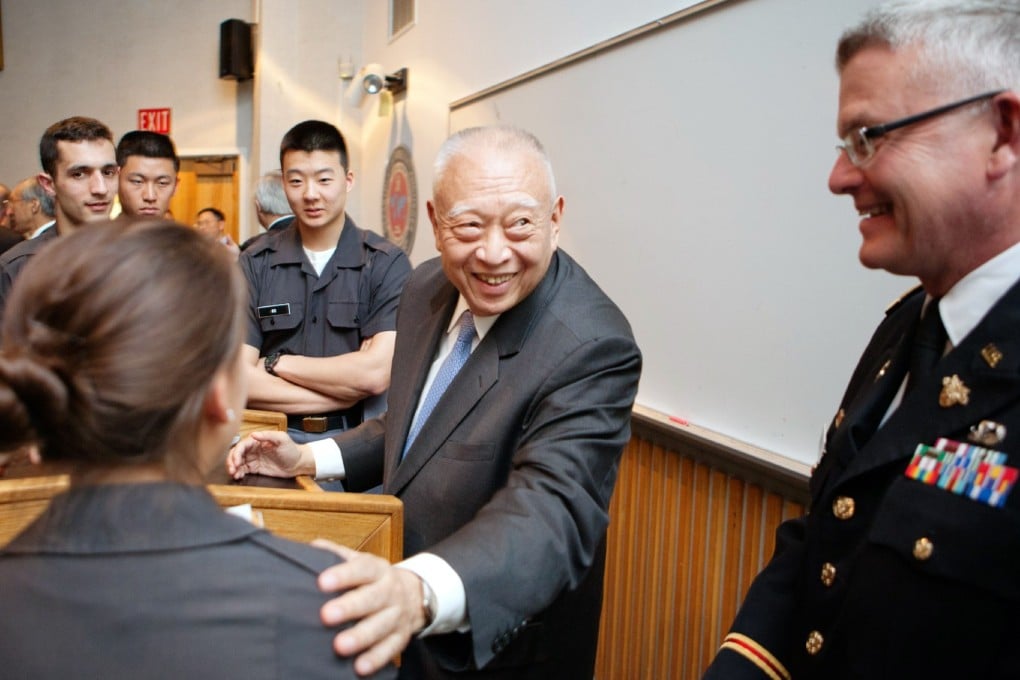
Tung's Work After Hong Kong's Handover
Tung's political career was closely associated with the early years of the Hong Kong Special Administrative Region.
As the city's first chief executive, he governed during a period when Hong Kong was adjusting to its new constitutional and political arrangements following the 1997 handover.
His public service later gave way to a different form of international engagement. Through CUSEF, Tung continued to promote exchanges involving China, the United States and other parts of the world.
The foundation's stated mission centres on open dialogue, mutual learning and shared responsibility. Its work is based on the idea that sustained contact can help build trust and a better understanding of different perspectives.
Those principles are now central to the tribute created in Tung's memory.
Rather than simply documenting dates and positions, CUSEF is using the memorial to preserve accounts from people who interacted with Tung and to keep public attention on the ideas he promoted.
A Legacy Built Around Dialogue
The foundation said Tung was a lifelong advocate for dialogue and understanding, both between China and the United States and among the wider international community.
That message runs through the material collected on the tribute page.
For CUSEF, the memorial is also an attempt to pass those ideas to a younger generation. Chau said Tung's example could encourage others to continue working towards the causes to which he devoted much of his later life.
The emphasis on younger generations is significant because CUSEF was established with a long term mission rather than as a vehicle for a single political initiative. Its activities have sought to create opportunities for people from different countries to meet, exchange views and develop a better understanding of one another.
Tung's death has therefore prompted the organisation to look back at its founder while also considering how his approach to international relations can continue to shape its work.
An Online Memorial Open to the Public
The permanent tribute is now available through the CUSEF website. Visitors can read the recollections collected by the foundation, view archival material and submit their own memories of Tung.
The page provides a lasting public record of a former Hong Kong chief executive whose career extended well beyond government office.
For those who worked with Tung, the collection offers an opportunity to record personal experiences. For younger readers who did not witness his years in public life, it provides a way to understand his role through the accounts of people who knew him.
CUSEF's decision to preserve those voices also reflects the central idea that shaped Tung's work after leaving Hong Kong's highest political office: meaningful relationships are built through sustained communication.
The foundation has invited the public to add to that record.
What memories of Tung Chee Hwa, his public service or his work promoting international dialogue should be preserved for the next generation?