

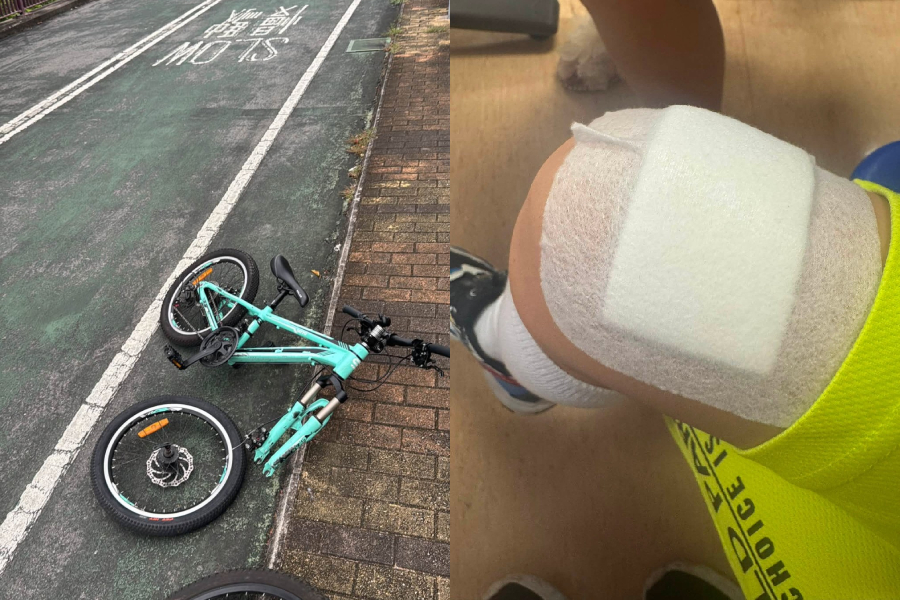
A dispute over a seven year old boy’s bicycle accident in Tseung Kwan O has turned into a heated online argument, with his father demanding HK$3,000 after the bicycle’s front wheel came loose during a downhill ride and the rental shop disputing whether a maintenance problem caused the crash.
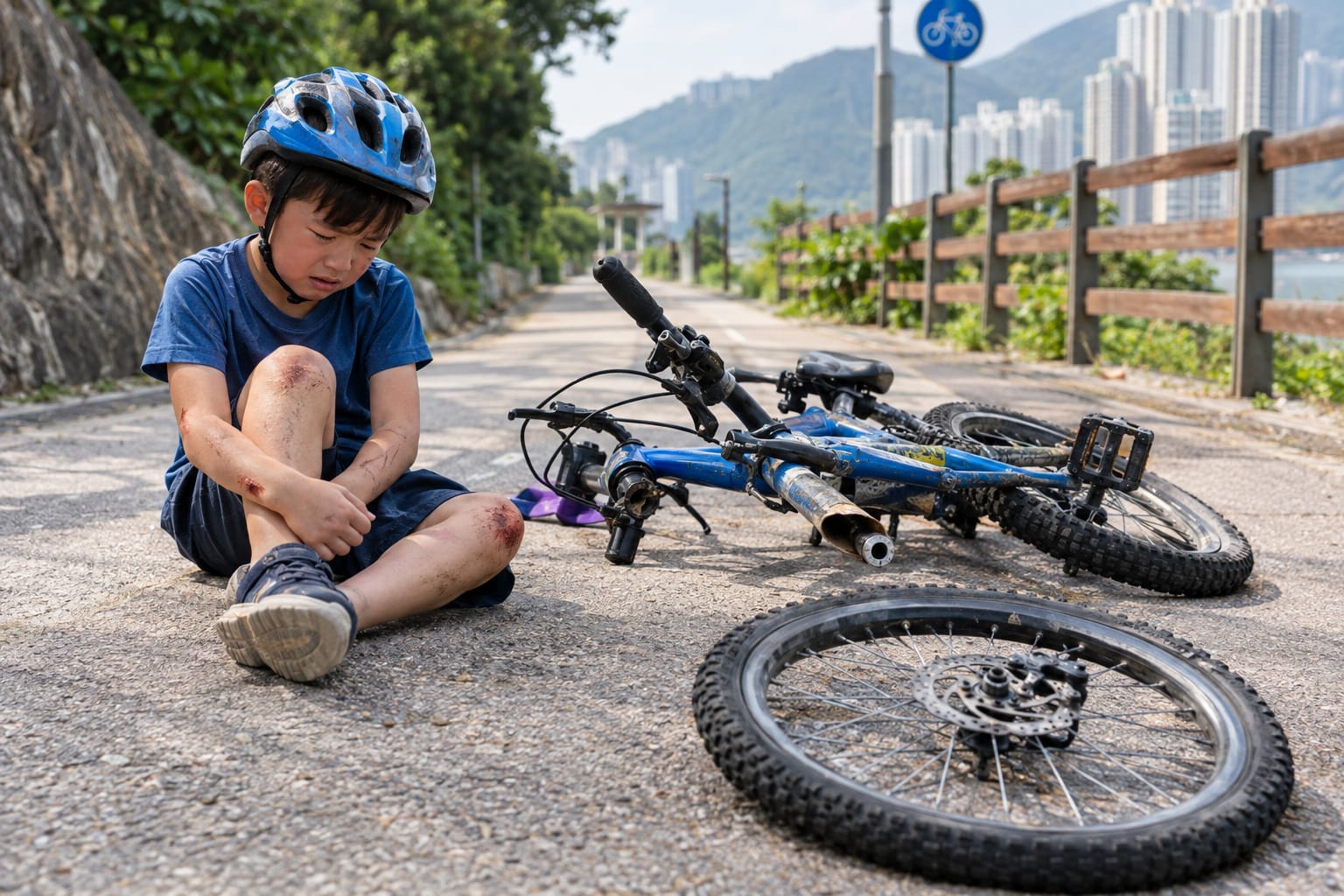
The disagreement began after the boy’s father posted about the incident online on Sunday, accusing Beverly Cycle of failing to properly maintain the bicycle. He said his son was riding downhill when the front wheel suddenly detached, sending the child onto the ground.
According to the father, the seven year old suffered grazes to his chest, hands and legs. He described the incident as potentially life threatening, saying the boy could have suffered much more serious injuries had the circumstances been different.
The father said he rejected an offer from the rental shop to reinstall the bicycle wheel after the accident. He argued that his son had narrowly avoided a much worse outcome and that simply putting the wheel back on did not address his concerns about the bicycle’s condition.
The dispute escalated after the boy received medical attention.
Father says shop changed its attitude
The father said the shop owner initially agreed to follow up after the boy had been examined at hospital. He claimed, however, that the tone changed when the owner’s wife later contacted him and accused him of asking for an excessive amount of compensation.
The father said subsequent hospital examinations found that his son had suffered only minor injuries. He claimed the shop then sought compensation from him for damage to the rental bicycle and reported the incident to police.
That response prompted the father to make the dispute public. He warned other people renting bicycles in the area to pay close attention to the condition of their bikes before setting off.
His account quickly attracted attention online, where the incident developed into a wider debate about responsibility when a rented bicycle is involved in an accident.
The central question was straightforward but difficult to settle without examining the bicycle and reconstructing exactly how the crash happened: did a defective or poorly maintained wheel cause the accident, or did the wheel come off because of the impact?
Shop owner disputes father’s version
Lui, the owner of Beverly Cycle, rejected the accusation when speaking to Sing Tao Daily, The Standard’s sister publication.
He said the father and his son had already been riding for about an hour before the accident was reported. In Lui’s view, the condition of the bicycle offered an important clue.
The bicycle’s front fork was badly bent, he said. That damage suggested to him that the bicycle had suffered a forceful impact rather than simply losing its wheel because of a maintenance problem.
Lui also offered a different account of how the crash may have occurred.
He said the cycling trail was crowded at the time and believed the boy may have applied the front brake too hard while travelling downhill. A sudden application of the front brake can cause the front of a bicycle to pitch forward, particularly when the bicycle is moving downhill.
Lui said such a movement could have sent the bicycle over its front end, with the wheel then coming loose when the bike struck the ground.
The shop therefore disputes the suggestion that the detached wheel was necessarily the cause of the accident. Its position is that the wheel may instead have come off as a result of the crash.
That distinction is at the heart of the dispute because the condition of the wheel before the accident would be central to determining whether the rental company had failed in its responsibility to provide a safe bicycle.
HK$3,000 compensation claim questioned
Lui said he reached the scene about 10 minutes after receiving the report of the accident.
He claimed the boy appeared to be walking normally when he arrived and had suffered only minor grazes. Lui also said the father asked for HK$3,000 in compensation but did not provide medical receipts to support the amount being sought.
The shop owner also questioned the decision to take the child first to a private hospital in Kowloon City and later to Queen Elizabeth Hospital.
The father, however, viewed the situation differently. From his perspective, the seriousness of the incident could not be judged simply by looking at the child after the fall. The fact that the boy escaped with minor injuries did not, in his view, remove the concerns raised by a bicycle wheel coming loose while travelling downhill.
The competing accounts have left several details unresolved, including the precise condition of the wheel before the accident, how the wheel detached, whether the bicycle had been inspected before it was rented and whether the boy’s braking technique contributed to the crash.
No independent technical assessment of the bicycle has been reported.
Police report adds another layer to dispute
Lui said he and his business partner decided to report the case to police in order to protect the interests of both sides.
The decision followed the disagreement over compensation and responsibility for the damaged bicycle.
A police report does not by itself establish who was responsible for the accident. It does, however, provide a formal record of the dispute and could become relevant if either side later pursues a legal claim.
For the father, the police involvement came after what he described as an unsuccessful attempt to resolve the matter with the rental shop. For the business, the report was presented as a way to protect itself after facing allegations about bicycle safety and a compensation demand.
The dispute has therefore moved beyond a simple disagreement between a customer and a rental operator. It now involves competing accounts of the accident, questions about bicycle maintenance and riding technique, and disagreement over what constitutes reasonable compensation for minor injuries.
Online debate divides cyclists and parents
The incident has also exposed a sharp divide among people commenting online.
Some users sided with the father and criticised the rental shop for what they saw as an attempt to shift responsibility onto an injured child. They argued that bicycle rental businesses have a duty to make sure their equipment is safe before handing it to customers.
Others defended the shop and questioned whether the detached wheel should automatically be treated as evidence of poor maintenance.
Cycling enthusiasts pointed to the mechanics of downhill braking, arguing that using the front brake too aggressively can cause a bicycle to pitch forward. If the bicycle then hits the ground heavily, the force of the impact could damage the fork and cause the front wheel or other components to detach.
The disagreement illustrates why determining responsibility from social media accounts alone can be difficult. A photograph of a damaged bicycle may show what happened after a crash, but it does not necessarily establish what caused the crash in the first place.
The same is true of the boy’s injuries. Minor physical injuries do not prove that the bicycle was safe, but they also do not establish that a mechanical fault caused the accident.
What happens next?
At the centre of the dispute is a question that could affect both bicycle rental operators and customers: who should bear responsibility when a rented bicycle crashes and a component comes loose?
For rental businesses, the case reinforces the importance of checking bicycles before they are handed to customers and keeping clear maintenance records. For riders, particularly children, it also shows why basic knowledge of braking techniques and safe downhill riding matters.
The HK$3,000 dispute may ultimately depend on evidence rather than online opinion. The condition of the bicycle before the accident, maintenance records, medical documentation, witness accounts and any police findings could all help establish what happened.
For parents renting bicycles for children, the immediate lesson is practical: check the brakes, wheels, tyres and steering before riding, and ask the rental operator to correct any problem before leaving the shop.
Would you rent a bicycle for a child without first carrying out your own safety check?