

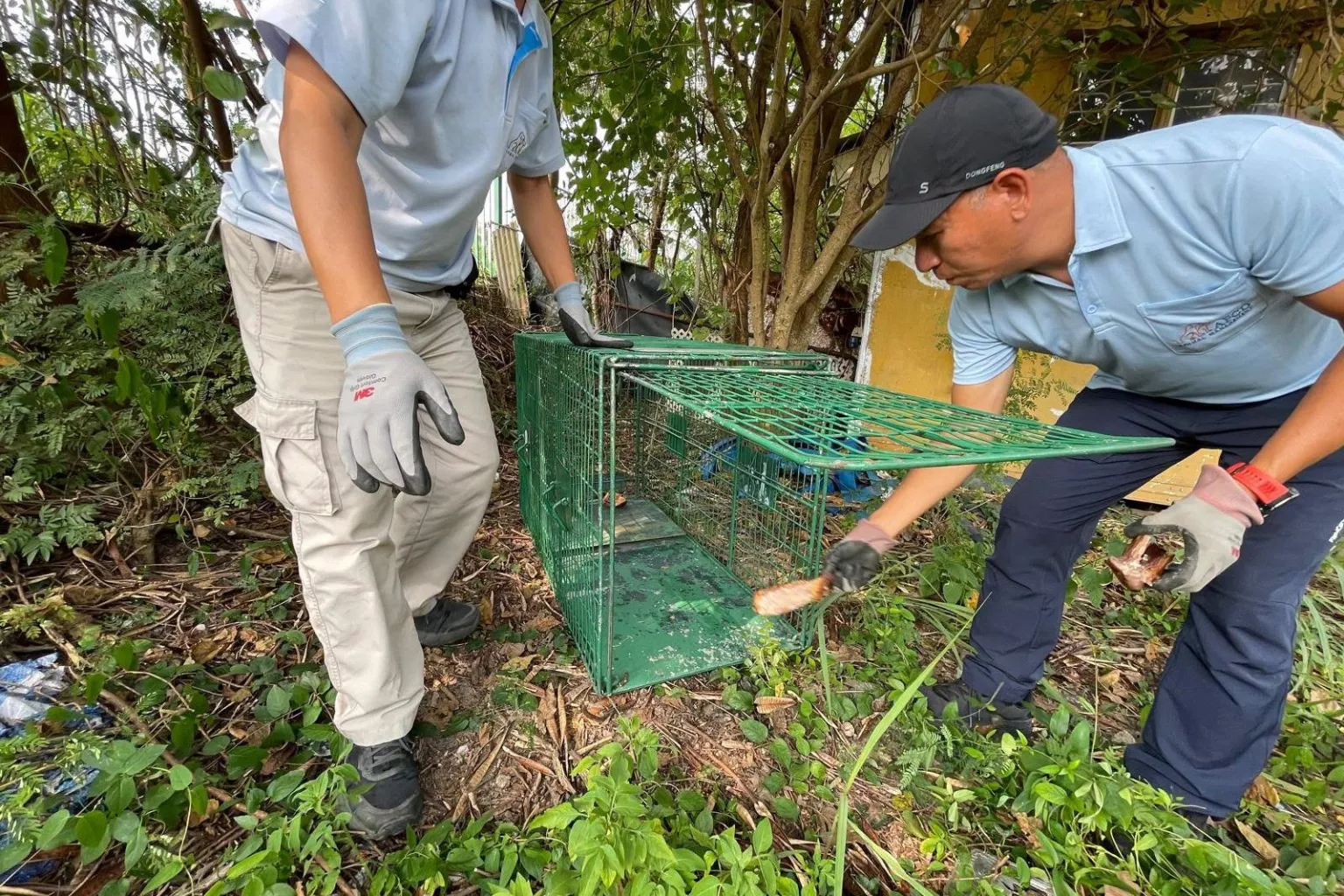
Hong Kong authorities have rejected claims that stray dogs captured during a Yuen Long operation will automatically be euthanised four days after being caught, saying the period is instead part of a statutory process for identifying owners and assessing the animals.
The Agriculture, Fisheries and Conservation Department said on Thursday that eight stray dogs had been captured during a five day operation carried out jointly with police in Yuen Long following a suspected dog attack that killed a 27 year old woman last week. Three of the dogs had microchips, but their licences had expired, according to the department.
The operation has brought renewed attention to how Hong Kong handles stray and abandoned dogs, particularly after several serious incidents involving animals in recent weeks. It has also exposed a disagreement between authorities and animal welfare campaigners over what should happen to dogs that are captured but cannot immediately be returned to an owner.
Eight dogs captured during Yuen Long operation
The AFCD said its staff and police officers conducted the operation over five days in response to the suspected fatal attack in Yuen Long.
The 27 year old woman died after suffering multiple lacerations to her head, neck, arms and legs. The incident prompted authorities to step up efforts to locate and capture unattended dogs in the area.
The latest operation also carried a risk for the personnel involved. The AFCD said a frontline staff member was bitten on the hand by a dog on Wednesday and was receiving hospital treatment. The staff member was in stable condition, according to the department.
Among the eight dogs caught during the operation, three were microchipped. Their licences had expired, meaning authorities were able to identify registered keepers but found that the animals were not covered by valid licences.
One registered keeper has been charged with failing to hold a valid dog licence and failing to keep a dog under proper control in a public place.
The keeper was reportedly animal rights activist Kent Luk, founder of Paws Guardian Rescue Shelter. Luk has previously said he is the registered keeper of nearly 4,000 dogs, most of them strays rescued by his organisation from the streets.

Activist challenges government approach
Luk raised concerns about the fate of captured dogs during a radio programme, where he urged authorities not to carry out what he described as “convenience culling.”
He claimed that dogs captured by the authorities could be put down four days after being caught and called for a review of the city's Rabies Ordinance.
Luk argued that euthanasia should be limited to animals suffering from serious disease. His comments came as authorities were carrying out the Yuen Long operation following the fatal attack.
The AFCD disputed his interpretation of the four day period.
“The four day period stipulated by law is simply the statutory timeframe required for the AFCD to make enquiries and locate the keepers,” the department said in a statement.
The department said the statutory period should not be understood as an automatic deadline for euthanising a captured animal.
What happens after a dog is captured
According to the AFCD, captured dogs undergo several checks before authorities determine their next step.
Officials scan the animals for microchips and check licensing information. If a registered owner can be identified, authorities contact that person as part of the process.
Dogs whose keepers cannot be traced are kept under observation at Animal Management Centres, the department said.
The authorities also assess the animals' health and temperament. Dogs considered healthy and gentle can be transferred to partner animal welfare organisations, where they may undergo sterilisation before being offered for rehoming.
The department said it would not release dogs without keepers back into the community because of potential public safety concerns.
The process can take considerably longer than four days. According to the AFCD, transferring an animal to a partner organisation can take weeks or even months, depending on its health, temperament and the capacity of the organisation receiving it.
That distinction is at the centre of the dispute. The four day period referred to by Luk concerns the statutory process for making enquiries and locating owners, while the department says the eventual outcome for an individual dog depends on a separate assessment.
Authorities reject release of ownerless dogs
The AFCD also defended its decision not to release ownerless dogs back into the community, even when the animals have been sterilised.
The department said Hong Kong's high density and urban environment mean that ownerless dogs can continue to present public safety concerns.
That position differs from the approach promoted by some animal welfare campaigners, including Luk, who have advocated a trap, neuter and release strategy, commonly known as TNR, for managing stray animals.
Under a TNR approach, animals are captured, sterilised and then returned to the area from which they were taken. Supporters argue that sterilisation can reduce reproduction and help manage stray populations without routinely removing animals from the streets.
The government has taken a more restrictive position on releasing ownerless dogs into the community.
The AFCD said registered dog owners have a responsibility to care for their animals throughout their lives and stressed that abandoning a dog is an offence.
The issue of abandonment has gained additional attention following a series of dog related incidents in Hong Kong.

Government considers tougher penalties
Authorities are considering heavier fines for people who abandon pets following the recent attacks.
The debate has expanded beyond the immediate question of what should happen to captured stray dogs. It also concerns the responsibilities of people who own animals and the measures available when dogs are left unattended or abandoned.
Last month, a large dog reportedly identified as a Spanish mastiff killed two smaller pet dogs in separate incidents in Yuen Long.
The incidents have contributed to concerns about dog control and enforcement in the district, while animal welfare advocates have warned against treating breed alone as an indicator of dangerous behaviour.
Owners and professionals have argued that canine aggression can have multiple causes, including early experiences, socialisation, living conditions, the surrounding environment and misunderstandings between dogs and people.
That view has added another layer to the public discussion over how authorities should respond after serious attacks. The question is not only whether an animal belongs to a particular breed or group, but also how it was raised, managed and controlled.
Debate over stray dogs continues
The latest dispute reflects a wider tension between public safety requirements and animal welfare concerns.
For authorities, the fatal Yuen Long attack and other recent incidents have increased pressure to identify dogs that may pose risks and prevent unattended animals from remaining in public areas.
For animal welfare groups, the concern is whether enforcement measures could result in healthy animals being removed or euthanised unnecessarily.
The AFCD's account sets out a process that begins with identification and owner tracing rather than automatic removal. Captured dogs are checked for microchips and licences, while animals without traceable keepers can remain under observation before authorities consider transfer to welfare organisations.
The department also made clear that rehoming depends on available space and the suitability of each animal. Even when a dog is healthy, finding a partner organisation capable of taking it in may take weeks or months.
For dog owners, the department's message is equally direct. A licence does not remove the obligation to control an animal in public, and abandoning a dog can result in legal consequences.
As Hong Kong reviews its response to recent attacks and considers tougher penalties for abandonment, the treatment of captured stray dogs will remain closely tied to two practical questions: how authorities can protect people from dangerous animals and how healthy dogs can be assessed and managed without unnecessary harm.
Do you think Hong Kong's current system strikes the right balance between public safety, responsible ownership and animal welfare?