


New online channel for medical disputes
Hong Kong has launched its first dedicated online platform for resolving healthcare disputes, offering patients and medical professionals a new avenue to settle conflicts without immediately resorting to lengthy legal proceedings.
The upgraded website of the Healthcare Dispute Resolution Centre (HDRC) was officially launched on Friday as part of an effort to make medical dispute resolution more accessible, efficient and confidential.
The platform is designed to connect patients and healthcare providers with mediation and arbitration services online, potentially reducing the time, cost and administrative burden associated with conventional dispute resolution.
Its operators said the initiative also has longer term ambitions. They hope to extend the service beyond Hong Kong to handle cross border healthcare disputes and eventually provide services to users in other parts of the world.
Cross border services planned for Greater Bay Area
The HDRC has established strategic cooperation with the Hong Kong International Mediation Centre (HKIMC) and eBRAM, two Hong Kong based international online dispute resolution service providers.
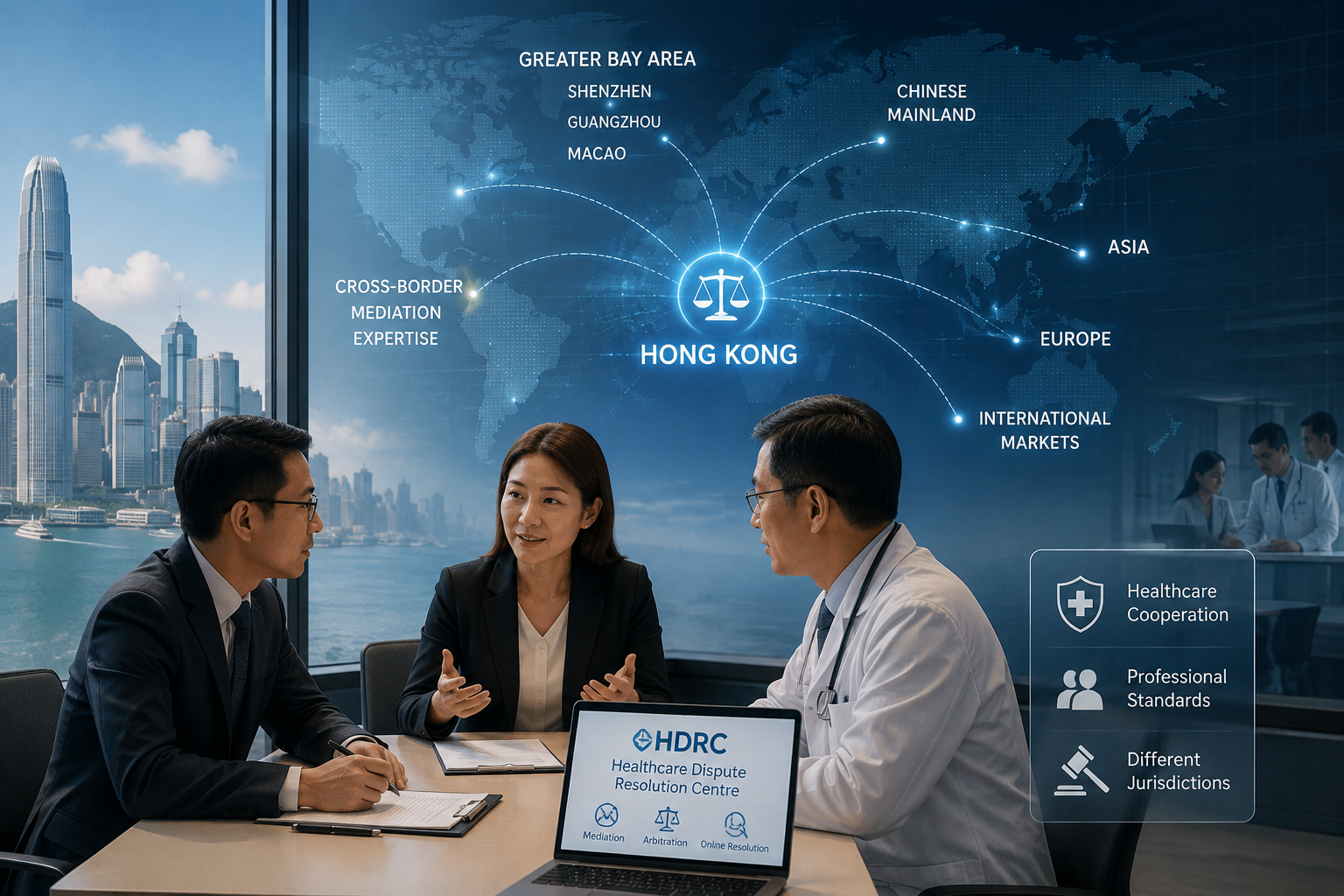
Under the collaboration, the three organisations will work together to provide confidential mediation and arbitration services for patients and medical service providers involved in disputes across the Guangdong Hong Kong Macao Greater Bay Area.
The initiative could become particularly relevant as healthcare cooperation expands across the region and patients increasingly access medical services outside their home jurisdictions.
Cross border medical disputes can be complicated by differences in professional standards, regulations and legal procedures. An online platform could provide a common channel through which patients and healthcare providers can seek assistance without necessarily having to be physically present in the same location.
Thousands of medical complaints handled
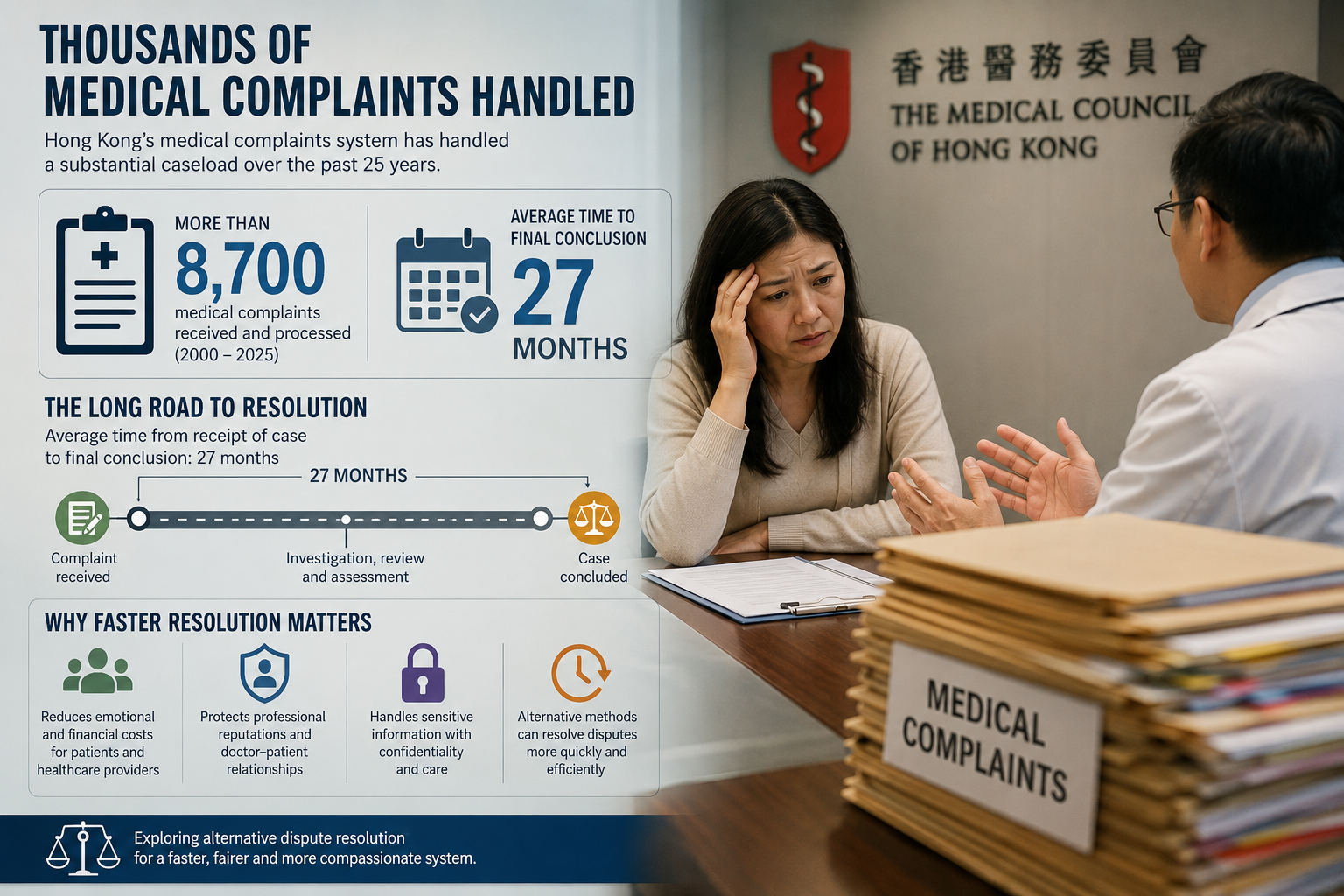
The initiative comes against the backdrop of a substantial caseload handled by Hong Kong's medical complaints system.
According to government data, the Medical Council of Hong Kong received and processed more than 8,700 medical complaints between 2000 and 2025. The average period from the receipt of a case to its final conclusion was 27 months.
The figures highlight the lengthy nature of formal medical complaint procedures and the potential value of alternative methods that can address disagreements at an earlier stage.
For patients, medical disputes can involve highly sensitive personal information as well as complicated questions about treatment, diagnosis and professional responsibility. For healthcare providers, disputes can affect professional relationships and reputations.
A mechanism that allows disagreements to be addressed more quickly could potentially reduce the financial and emotional costs associated with prolonged disputes.
Platform aims to ease doctor patient tensions
At the launch ceremony, HDRC Chairman Samuel Kwok Po yin said the new platform represented a new channel of communication between healthcare providers and patients.
Medical disputes can easily become prolonged once they develop into litigation, consuming significant time and public resources while placing further strain on relationships between doctors and patients, Kwok said.
He said the new service was intended to help resolve disagreements before they become more deeply entrenched.
"By leveraging expertise of medical and legal professionals, and eBRAM's legal technology," the platform can help reduce the impact of disputes on doctor patient relationships and contribute to the harmonious operation of the healthcare system, Kwok said.
The online nature of the service is also expected to make the dispute resolution process more convenient for people who may otherwise face difficulties attending multiple meetings or hearings in person.
Mediation seen as alternative to lengthy litigation
HKIMC Chairman Francis Law Wai hung said healthcare disputes were often particularly challenging because they involved complex medical and professional issues.
Mediation can help the parties communicate more effectively and understand the concerns of the other side, reducing the risk that an initial disagreement develops into a more complicated and prolonged conflict, Law said.
Mediation provides an alternative to an adversarial legal process by allowing both sides to discuss their concerns with the assistance of an independent mediator.
Arbitration provides a more formal route, in which an arbitrator considers the dispute and makes a decision according to the terms agreed by the parties.
The two approaches can therefore give patients and healthcare providers alternatives to immediately pursuing court proceedings.
Hong Kong expertise to reach wider markets
Law also pointed to Hong Kong's established mediation framework as an advantage for the city as it seeks to broaden its role in online dispute resolution.
He said the new platform could help extend Hong Kong's expertise in mediation beyond the city, including to other parts of the Greater Bay Area, the Chinese mainland and eventually international markets.
The cross border dimension could become increasingly important as healthcare services and professional cooperation become more closely connected across the Greater Bay Area.
Patients may receive medical services outside their home jurisdiction, while healthcare institutions and professionals increasingly participate in regional cooperation. Disagreements arising from such arrangements can present additional challenges because they may involve different jurisdictions, professional standards and administrative procedures.
Former health chief backs new mechanism
Ko Wing man, a member of Hong Kong's Executive Council and the city's former health chief, welcomed the development, saying there had long been a need for a mechanism capable of helping to ease tensions between doctors and patients.
"We have long hoped for such a mechanism to emerge," Ko said.
He said the medical sector had made sustained efforts to improve relations between healthcare professionals and patients, but the ability of any individual organisation or person to resolve disputes was inevitably limited.
The partnership with two established mediation institutions could therefore give the initiative greater capacity to address disputes and contribute to better doctor patient relationships as well as wider social harmony, Ko said.
HDRC seeks broader role in dispute resolution
The HDRC was established in 2024 as a local nonprofit organisation dedicated to resolving healthcare disputes through mediation or arbitration.
The centre's new online service adds a technology component to those established approaches.
By incorporating eBRAM's legal technology and working with professional mediators as well as legal and medical experts, the centre aims to create a platform capable of handling disputes in a secure and confidential environment.
The launch also reflects a broader move towards digitalising professional and legal services in Hong Kong.
For the healthcare sector, the effectiveness of the new platform will ultimately depend on whether patients and healthcare providers are willing to use mediation and arbitration as alternatives to formal complaints and litigation.
The lengthy average time required to conclude medical complaints shows the challenges faced by existing mechanisms. A faster dispute resolution process could potentially reduce costs for the parties involved while allowing healthcare professionals and patients to move forward without years of uncertainty.
However, the platform is not intended to replace existing regulatory or legal channels. Rather, it provides another option for parties seeking to resolve disagreements through negotiation, mediation or arbitration.
The HDRC's long term vision extends beyond handling disputes within Hong Kong. With the cooperation of HKIMC and eBRAM, it hopes to develop the platform into a regional and international service, strengthening Hong Kong's position as a centre for dispute resolution.
For patients and healthcare providers, the immediate significance is more practical: disputes that might once have required repeated face to face meetings or lengthy proceedings now have a dedicated online channel for resolution.
As the service develops, its ability to resolve cases efficiently while maintaining confidentiality and public confidence will be key to determining whether the new model can become a lasting part of Hong Kong's healthcare dispute resolution system.