

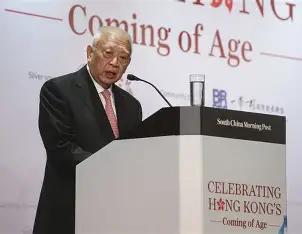
Hong Kong’s First Chief Executive Dies
Former Hong Kong Chief Executive Tung Chee hwa has died at the age of 89, marking the passing of a political figure whose career was closely tied to one of the most important periods in the city’s modern history.
Tung died peacefully on September 8, 2026, with members of his family by his side, according to a statement issued by his office.
The announcement described Tung as a former Vice Chairman of the National Committee of the Chinese People’s Political Consultative Conference and the first Chief Executive of the Hong Kong Special Administrative Region.
His office said he devoted himself wholeheartedly to his country and remembered him as an upright and incorruptible public figure who cared deeply about national affairs.
“Tung Chee hwa passed away peacefully on September 8, 2026, with his family by his side,” his office said in the statement.
The statement praised his commitment to public service and said his spirit and contributions would remain in the hearts of those who remembered him.
A Defining Figure in Hong Kong’s Post Handover Era
Tung occupied a unique place in Hong Kong’s political history as the city’s first Chief Executive following the return of Hong Kong to Chinese sovereignty in 1997.
His appointment placed him at the centre of the transition from British colonial administration to the establishment of the Hong Kong Special Administrative Region. As the first person to lead the new administration, Tung was responsible for overseeing a government entering an entirely new constitutional and political era.
The position carried enormous responsibility. Hong Kong had entered a new chapter under the framework established for the Special Administrative Region, while maintaining its role as an international financial centre and one of Asia’s most important commercial cities.
Tung became a central figure during those early years, leading the government through a period of political adjustment and economic uncertainty.
His tenure coincided with major challenges for Hong Kong, including the Asian financial crisis, which placed significant pressure on regional economies shortly after the handover.
As Chief Executive, Tung faced the difficult task of managing the administration while responding to economic concerns and public expectations during a period of historic change.

A Career That Extended Beyond the Chief Executive’s Office
Tung's public career did not end with his time as Hong Kong's Chief Executive.
He later served as a Vice Chairman of the National Committee of the Chinese People’s Political Consultative Conference, one of the country’s leading political advisory bodies.
The role kept him involved in national public affairs and reflected his continued connection with political and public life after leaving the Chief Executive's office.
His office's statement placed particular emphasis on his dedication to the country and his approach to public service.
It said Tung was upright and incorruptible and devoted himself wholeheartedly throughout his life.
For decades, Tung remained a familiar figure in discussions about Hong Kong’s political development, China’s relationship with the city and the changes that followed the 1997 handover.
His career covered a period in which Hong Kong underwent some of the biggest institutional and political changes in its history.
Leading Hong Kong Through Change
As the first Chief Executive of the Hong Kong Special Administrative Region, Tung held a position no one had occupied before him.
There was no previous post handover administration to follow. His government had to establish the working practices of the new system while managing the everyday responsibilities of running a major international city.
The early years after 1997 brought difficult conditions. The Asian financial crisis caused economic disruption across the region and Hong Kong was not immune to the consequences.
Property values came under pressure, businesses faced uncertainty and many residents experienced growing concerns about the economy.
Tung's administration therefore faced challenges on several fronts. It had to maintain confidence in Hong Kong’s economy while overseeing the first years of the city’s new political order.
His time in office also brought intense public debate over government policies and the direction of Hong Kong.
As with any leader during a period of major change, his decisions attracted both support and criticism. Yet his place in history remained clear. Tung was the first person to serve as Chief Executive after the establishment of the Hong Kong Special Administrative Region.
That distinction made him one of the most important figures associated with the city’s transition after 1997.
A Life Remembered for Public Service
The announcement of Tung's death drew attention once again to a career that stretched across business, Hong Kong public life and national political service.
His office said he remained committed to his country and devoted his efforts to public responsibilities.
The statement also stressed his personal character, describing him as upright and incorruptible.
Those words formed the central message of the announcement issued after his death.
“He cared deeply for his country and devoted himself wholeheartedly,” the statement said.
It added that his noble spirit would continue to live in the memories of those who knew him and those who remembered his years of service.
Tung died with his family beside him, bringing to an end the life of a man who stood at the centre of Hong Kong's transition into a new political era.
A Place Secured in Hong Kong History
Tung Chee hwa's legacy will remain closely connected to his position as Hong Kong's first Chief Executive after the 1997 handover.
His years in office unfolded during a difficult and important period for the city. The government was adapting to a new political structure while facing economic pressure and changing public expectations.
His later work as Vice Chairman of the National Committee of the Chinese People’s Political Consultative Conference extended his public service beyond Hong Kong and into national affairs.
The statement issued by his office made clear how his family and colleagues wanted him to be remembered: as a man who served his country, carried out his responsibilities with commitment and maintained the principles they described as upright and incorruptible.
Tung's death on September 8, 2026, closes the life of the first man to lead Hong Kong as Chief Executive under the Hong Kong Special Administrative Region.
His name will remain tied to the beginning of that era and to the years that followed one of the most significant political transitions in the city's history.
How do you think Tung Chee hwa’s role as Hong Kong’s first Chief Executive after 1997 will be remembered in the city’s history?