

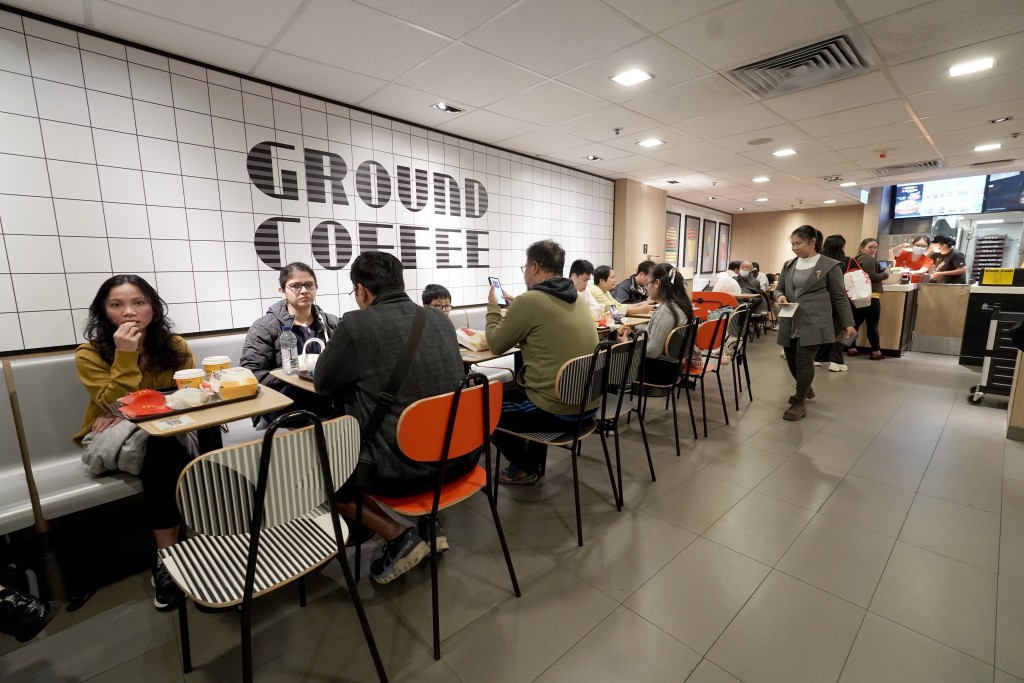
A dispute over a seat at a crowded McDonald’s inside a Hong Kong MTR station has triggered a heated online debate after a mainland Chinese tourist said she was met with a mocking response when she politely asked whether a chair was available.
The visitor later described the encounter on Xiaohongshu, saying she was surprised by the woman’s reaction and questioned why a simple request for clarification had turned into an uncomfortable confrontation.
The incident has since drawn comments from people on both sides of the discussion, with some expressing sympathy for the tourist while others pointing to Hong Kong’s long standing practice of sharing tables in busy fast food restaurants.
Crowded restaurant leaves few seats available
The incident reportedly happened during a busy period when the McDonald’s outlet was filled with customers. Finding an empty table was difficult, with most seats occupied by diners eating or waiting for their food.
While looking around the restaurant, the tourist noticed what appeared to be an available place along a row of seats. The table itself was clear. There were no food trays, drinks or other belongings covering the space.
One chair, however, had a small handbag on it.
A woman was sitting nearby and using her mobile phone. From the tourist’s perspective, it was not immediately clear whether the handbag meant the chair was occupied or had simply been placed there while the woman used the table.
Rather than assuming she could take the seat, the tourist approached the woman and asked whether it was available.
The question, according to the tourist’s account, received a response she found unexpectedly hostile.

Tourist says response was mocking
The visitor said the woman appeared surprised that she had even asked about the seat. She described the woman as smirking before responding in accented Mandarin that the chair was clearly occupied because there was a bag on it.
For the tourist, the issue was not simply whether the chair was available. She said she had asked because she wanted to avoid taking someone else’s place without permission.
The response left her confused and embarrassed.
A question that could have been answered with a simple “no” instead became an exchange that the tourist considered unnecessarily condescending. She later wrote about the experience online, saying people should not feel obliged to accept rude treatment when they have approached someone politely.
Rather than continue the exchange inside the crowded restaurant, the tourist chose to walk away.
That decision appears to have prevented the disagreement from escalating, but the experience stayed with her. She later shared the story on Xiaohongshu, where it attracted considerable attention from other users.
Online reaction quickly divided
The post prompted a wave of comments, with many users siding with the tourist.
Some argued that she had done nothing wrong by asking whether the chair was occupied. In their view, an occupied seat should be clearly communicated without turning a routine question into a confrontation.
Several commenters also questioned why the tourist felt the need to apologise before leaving.
Others took a more measured position. They suggested that misunderstandings over seats are common in crowded restaurants and that the simplest response is often to accept that the chair is unavailable and find another place.
A number of users said they had experienced similar moments in busy eateries, where a seemingly ordinary interaction became uncomfortable because of a person’s tone or attitude.
For those commenters, the problem was less about the chair itself and more about how strangers communicate when space is limited.
Table sharing is common in Hong Kong
The discussion also brought attention to an aspect of Hong Kong dining culture that may not be immediately familiar to visitors.
In crowded fast food restaurants, customers commonly share tables with strangers when space is available. A person sitting at one end of a large table does not necessarily mean the remaining chairs are reserved exclusively for that individual.
Frequent customers said empty seats are often used by other diners, particularly during lunch and dinner rushes when restaurants become heavily congested.
This practice can create uncertainty for visitors who are unfamiliar with local habits.
A chair with a handbag, shopping bag or another personal item may be understood by some diners as being reserved. Others may see it as a temporary way of holding a place and expect the person nearby to explain if the seat is unavailable.
That difference in expectations can easily lead to misunderstandings.
In this case, commenters familiar with Hong Kong’s fast food culture suggested that the tourist may simply have encountered someone who was unwilling to share the available space.
They argued that there was nothing unusual about asking before sitting down. At the same time, they noted that the woman had the right to keep the chair for herself if she was waiting for someone or intended to use it.
The disagreement, therefore, appears to have centred less on the right to occupy the chair and more on the manner in which the answer was delivered.
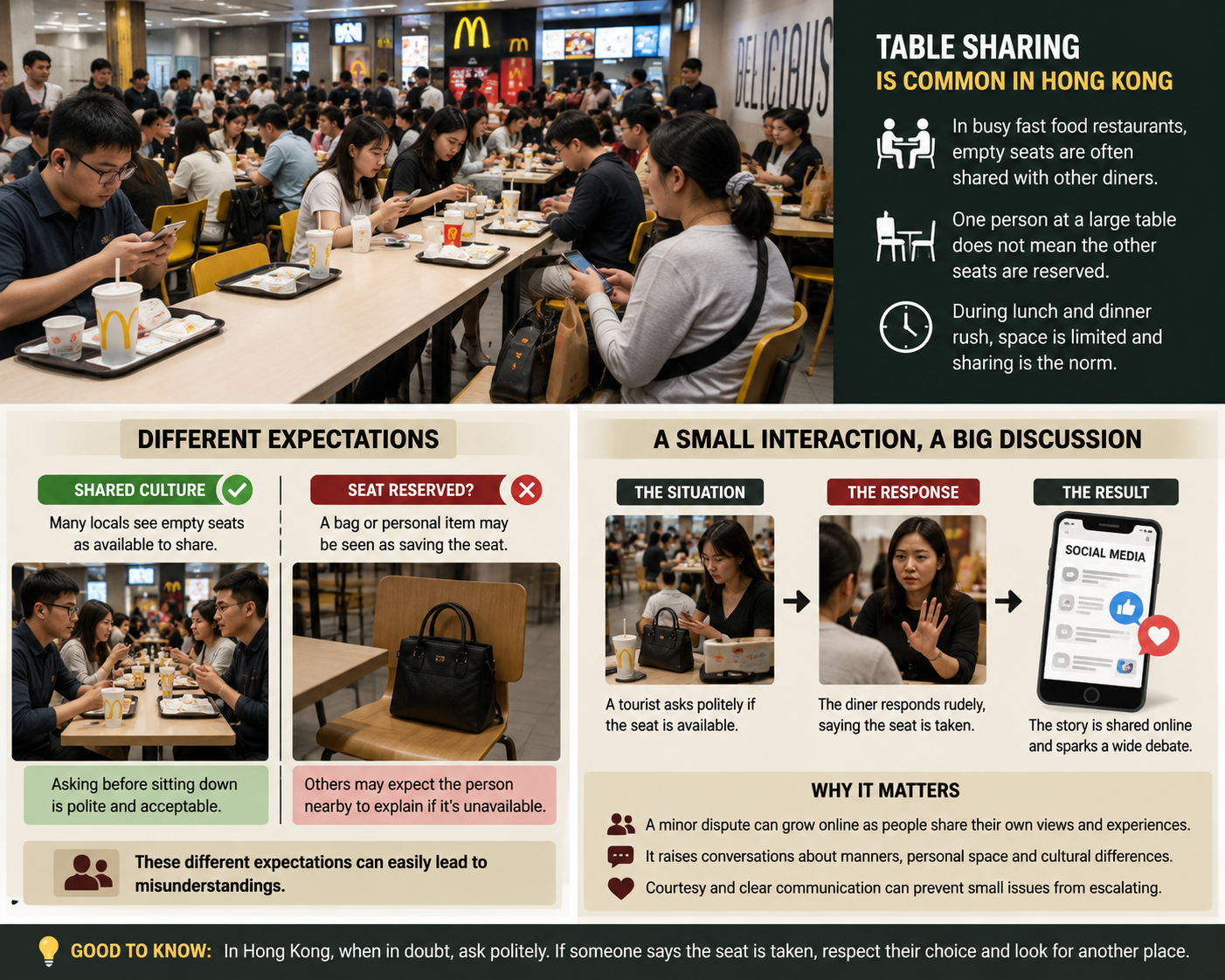
Why small disputes can become major online stories
The incident also illustrates how minor disagreements in public places can quickly become much larger conversations once they reach social media.
A short interaction inside a fast food restaurant can take on a different meaning when retold online. Readers who were not present must rely on the account of the person involved, while commenters often bring their own experiences and assumptions into the discussion.
In this case, the tourist’s account prompted a wider conversation about manners, personal space and differences in everyday behaviour between visitors and local residents.
The fact that the visitor was from mainland China and the incident occurred in Hong Kong added another layer to the discussion.
Some comments focused on the behaviour of the individual involved rather than where either person came from. Others used the story to discuss differences in expectations surrounding public spaces and dining etiquette.
However, the available account does not establish that the incident reflects a broader attitude among Hong Kong residents or mainland visitors. It describes one encounter between two individuals in a crowded restaurant.
That distinction matters.
Busy fast food outlets are places where people often have limited time, little personal space and few available seats. Under those conditions, even a small misunderstanding can become uncomfortable.
A question that could have ended differently
The tourist’s decision to ask before taking the seat was, by her account, an attempt to avoid exactly that kind of misunderstanding.
Had the woman simply replied that the chair was occupied, the exchange would probably have ended within seconds. The tourist could have continued looking for another seat, while the woman could have returned to her phone.
Instead, the tone of the response became the focus of the encounter.
That is why the story resonated with so many commenters. For some readers, the episode was a reminder that basic courtesy costs little, particularly when dealing with strangers in a crowded public place.
For others, it was simply an example of the small frustrations that occur when people compete for limited space.
The debate also serves as a reminder for visitors to Hong Kong that dining customs may differ from those in other places. In busy restaurants, a seat may not always be obviously available, even when a table appears empty. Asking first is generally the safest approach, particularly when another person’s belongings are involved.
In this case, the tourist did exactly that.
The chair remained occupied, but the disagreement that followed turned a routine question about a seat into a much larger conversation about courtesy, shared public space and the expectations people bring with them when travelling.