

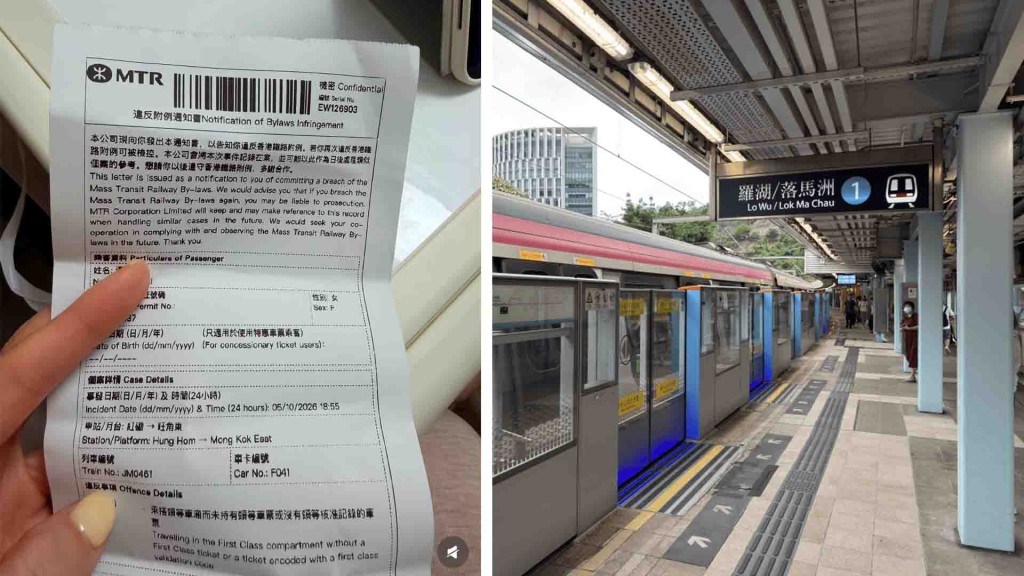
A mainland postgraduate student has questioned the handling of a first-class ticket inspection on Hong Kong’s East Rail Line after claiming she was told that presenting a Hong Kong identity card could result in a HK$1,000 penalty, while showing a mainland travel permit led to a written warning instead.
The incident occurred while the student was travelling from Hung Hom to Mong Kok East in a first-class carriage. According to her account, her Octopus card failed to confirm the required first-class status during the journey, prompting an inspection by MTR staff.
The student later described the encounter on social media, raising concerns about whether passengers can receive different treatment depending on the identity document they present during a ticket inspection.
The MTR Corporation has rejected the suggestion that a passenger’s background or type of identity document determines whether they receive a warning, surcharge or other follow-up action.
Student says she was asked for another identity document
According to the student, she initially planned to present her Hong Kong identity card when MTR staff checked her ticket.
She claimed, however, that staff told her registering the identity card would result in a HK$1,000 fine. She said staff then asked whether she had a mainland travel permit.
The student subsequently presented the requested permit. After staff checked her details, she said she was not given the HK$1,000 penalty she had expected based on the earlier explanation. Instead, she received a written warning under a notice of bylaw contravention.
The difference between the two outcomes prompted her to question why the type of identification document appeared to affect the process.
Her account focused on the apparent contrast between what she believed would happen if she used her Hong Kong identity card and what actually happened after she presented her mainland travel permit.
The MTR has since provided an explanation for why staff requested additional documentation during the inspection.
MTR says document checks are used to verify records
The railway operator said its ticketing enforcement system is intended to protect passengers who pay the correct fare and that it takes fairness in the process seriously.
According to the MTR, the staff member requested additional documentation because of the issue date of the identity document that had initially been presented.
The purpose, the company said, was to determine whether there was any previous fare-evasion record associated with the passenger.
The MTR said the additional check did not mean the passenger was being treated differently because she was a mainland student or because of the particular identity document she held.
After the passenger’s records were checked and staff confirmed that she had no previous fare-evasion record, the MTR said they followed established procedures and issued a written warning.
The passenger was also reminded that a surcharge would apply if a similar incident occurred again.
The explanation means that, according to the MTR, the warning was connected to the outcome of the record check rather than the passenger’s nationality, background or choice of identification document.
MTR denies different treatment based on identity
The MTR said its handling of the case was consistent with its usual procedures for ticket inspections.
It said requesting additional documents during an inspection can be necessary when staff need to verify a passenger’s record. The company stressed that the request should not be interpreted as evidence that passengers using different identity documents automatically face different penalties.
The operator also said a passenger’s background or the type of identity document they present is never a factor in deciding whether a warning, surcharge or other follow-up action should be issued.
That point addresses the central concern raised by the student, whose social media account suggested that the process appeared to produce different consequences depending on which document she used.
The MTR’s explanation instead places the emphasis on the passenger’s existing record and the circumstances identified during the inspection.
Why the warning was issued instead of a surcharge
The MTR said the student had no previous fare-evasion record after staff carried out the additional verification.
On that basis, staff issued a written warning under the applicable bylaw procedure rather than imposing the surcharge associated with a repeat incident.
The company said the passenger was informed that a surcharge would apply if the same type of violation happened again.
This distinction is significant because it suggests the outcome was based on the passenger’s record rather than simply on the document she produced.
The MTR did not say that presenting a mainland travel permit automatically qualifies a passenger for a warning. Rather, its explanation indicates that staff used the additional document to establish the passenger’s record before deciding how to proceed.
The case therefore centres on the interpretation of the inspection process and the communication between the passenger and MTR staff, rather than on a stated difference in enforcement rules for different identity documents.
MTR regrets the misunderstanding
The railway operator expressed regret that the passenger misunderstood the way her case was handled.
At the same time, it explained that detailed discussions are generally not appropriate while ticket inspections are taking place.
Ticket checks are carried out during train journeys and can involve the verification of passenger information, ticket status and previous records. The MTR said its staff follow established procedures when dealing with such cases.
The company’s position is that the staff member’s request for another document was part of that verification process.
The incident nevertheless shows how a lack of explanation during an inspection can leave passengers uncertain about why a particular document is requested or why one enforcement outcome follows another.
For passengers, the distinction between a warning and a surcharge can also be significant, particularly when they believe the outcome may have been connected to the identification document they presented.
What passengers should understand
The MTR’s clarification is that passengers are not subject to different enforcement outcomes simply because they are mainland residents, Hong Kong residents or holders of different identity documents.
Instead, the company says its staff may request additional documentation when they need to verify a passenger’s previous fare-evasion record.
In this case, the MTR said the passenger had no previous record and therefore received a written warning. She was also told that a surcharge would apply if the situation happened again.
The student’s original account and the MTR’s response differ mainly in how the interaction was understood. The student believed the discussion about her Hong Kong identity card suggested that the document could determine whether she faced a HK$1,000 fine. The MTR says the additional document request was made to complete a record check and that the eventual outcome was based on established procedures.
For passengers using first-class facilities on the East Rail Line, the practical lesson is straightforward: ensure the Octopus card or other valid ticket arrangement confirms the required first-class status before travelling, and ask for clarification if staff request additional documentation during an inspection.
Have you experienced confusion over MTR ticket inspections or first-class travel rules?