

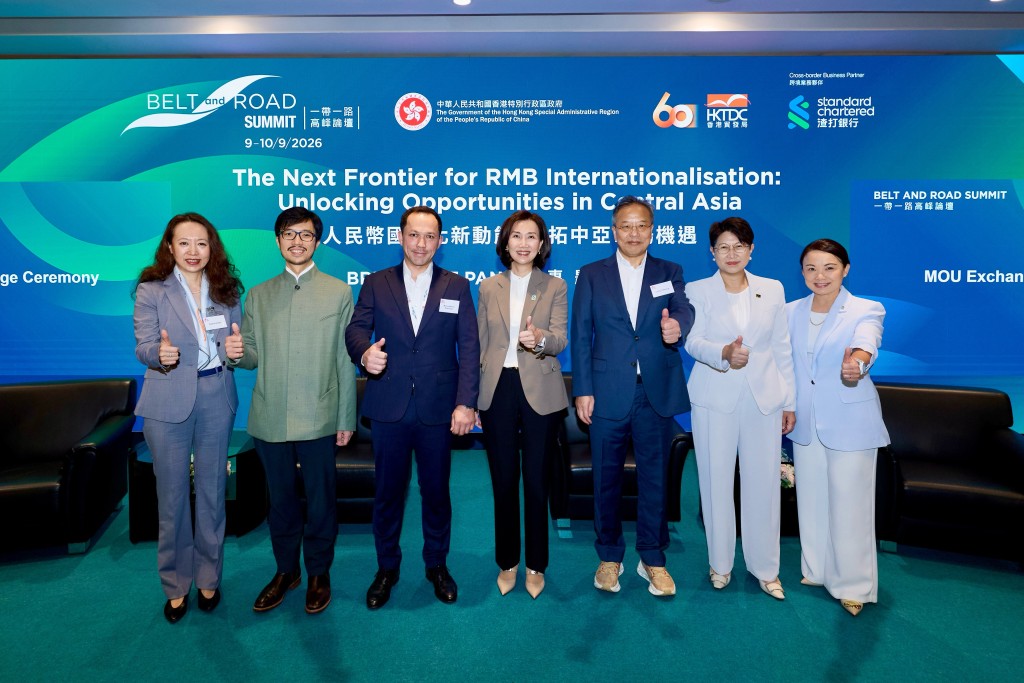
Standard Chartered has strengthened its business links between Hong Kong, Central Asia and mainland China by signing two memorandums of understanding with Uzbekistan’s state owned Asakabank and Shanghai SUS Environment, a company specialising in waste to energy technology and environmental services.
The agreements were signed on Thursday during the 11th Belt and Road Summit, adding fresh commercial links to a corridor that Hong Kong authorities and financial institutions have been seeking to develop across Central Asia. The arrangements are expected to support businesses operating across borders through services covering cash management, foreign exchange, risk management, financing, debt capital markets and environmental, social and governance advisory.
For Standard Chartered, the agreements extend a broader push to connect Hong Kong companies with emerging opportunities in Central Asian markets. The bank said the latest deals build on the momentum generated by a government led Hong Kong business delegation that travelled to Central Asia in June.
Focus on Uzbekistan and regional finance
The memorandum with Asakabank places Standard Chartered alongside one of Uzbekistan’s state owned banking institutions at a time when the Central Asian economy is seeking stronger international commercial and financial connections.
The agreement provides a framework for cooperation between the two banks and reflects the growing demand for financial services that can support companies operating across multiple markets. Businesses entering or expanding in Central Asia often require more than conventional lending. They need access to foreign exchange, liquidity management, financing structures and tools to manage the risks associated with cross border transactions.
Standard Chartered’s international network gives the bank a role in connecting those requirements with Hong Kong’s financial system. For companies based in Hong Kong, stronger banking links can make it easier to explore trade, investment and infrastructure opportunities in Central Asia while managing payments and financial exposure across different currencies and jurisdictions.
The second memorandum, signed with Shanghai SUS Environment, broadens the scope beyond traditional financial services.
Shanghai SUS Environment provides waste to energy technology and environmental services, linking the banking agreement to a sector that is becoming increasingly relevant as cities and economies seek ways to manage growing volumes of waste while improving energy efficiency.
The partnership could create additional opportunities for financing and advisory services around environmental projects, particularly those requiring substantial upfront investment and long term financial planning.

Hong Kong Central Asia trade continues to grow
Standard Chartered said merchandise trade between Hong Kong and Central Asia exceeded US$324 million, equivalent to about HK$2.53 billion, in 2025.
The figure represented a 27 percent increase compared with 2020, according to the bank. That rise points to a broader expansion in commercial activity between Hong Kong and economies across Central Asia, although the overall value of trade remains relatively modest compared with Hong Kong’s larger trading relationships.
The bank sees the region as an increasingly important growth corridor for Hong Kong businesses. Central Asia’s geographic position, natural resources, infrastructure requirements and expanding links with China have increased its importance in regional trade and investment discussions.
For Hong Kong, the opportunity is not limited to merchandise exports and imports. Financial services can provide another channel for economic cooperation, particularly when companies require financing, currency management or assistance with international transactions.
Standard Chartered’s latest agreements therefore fit into a wider strategy aimed at using Hong Kong’s financial capabilities to support companies pursuing business opportunities beyond the city.
Belt and Road markets gain importance
The agreements also form part of the wider commercial activity surrounding the Belt and Road framework.
Standard Chartered said Hong Kong’s merchandise trade with ASEAN, the Middle East and Central Asia had increased by an average of nearly 10 percent a year over the past five years.
The figures cover several regions with different economic structures and growth patterns, but together they illustrate the expanding trade relationships between Hong Kong and markets positioned along major Belt and Road routes.
ASEAN has become one of Hong Kong’s major regional economic partners, while the Middle East has attracted growing attention from businesses and investors seeking opportunities in energy, infrastructure, technology and financial services. Central Asia represents another part of that wider network, with countries such as Uzbekistan seeking greater international investment and commercial engagement.
For banks, these changing trade patterns create demand for financial products that can support companies as they move money, manage currencies, raise capital and assess risks in unfamiliar markets.
Standard Chartered has maintained a broad international presence and has positioned its Hong Kong operations as a bridge between businesses in Asia and markets farther afield.
Financing and ESG advisory among key areas
The scope of the new cooperation extends beyond ordinary banking transactions.
Standard Chartered said the Hong Kong Central Asia corridor would cover cash management, foreign exchange and risk management, as well as financing, debt capital markets and ESG advisory.
Cash management can help companies control incoming and outgoing payments across different markets, while foreign exchange services become increasingly important when businesses trade in multiple currencies. Risk management can help companies address exposure to currency movements and other uncertainties associated with international operations.
Financing and debt capital markets services provide another layer of support, particularly for larger companies and projects requiring significant amounts of capital.
The inclusion of ESG advisory is also notable in the agreement with Shanghai SUS Environment. Waste to energy projects sit at the intersection of infrastructure, environmental management and energy production. Such projects can require complex funding arrangements and long investment periods, making financial structuring and sustainability considerations part of the same commercial discussion.
Hong Kong seeks a wider international role
Mary Huen, chief executive for Hong Kong and Greater China and North Asia at Standard Chartered, said continued policy support and stronger cross border connectivity would help Hong Kong reinforce its position as a gateway for business and investment.
She also pointed to Hong Kong’s role in the internationalisation of the yuan.
That role has become an important part of the city’s financial strategy as companies across Asia increase their use of the Chinese currency for trade and investment. Hong Kong already serves as a major offshore yuan centre, providing financial infrastructure for companies and investors seeking to conduct transactions in the currency outside mainland China.
Greater economic engagement with Central Asia could give Hong Kong another avenue through which to support yuan based transactions and investment flows.
The expansion of trade routes does not automatically translate into major financial activity. Companies still need reliable banking relationships, predictable regulatory arrangements and efficient cross border payment systems. The ability to provide those services will influence how quickly commercial links develop.
A growing corridor for Hong Kong businesses
The latest agreements come as Hong Kong continues to encourage companies to look beyond traditional markets.
Central Asia offers a different set of opportunities from the city’s established trading relationships. Its economies include major producers of energy and natural resources, while governments are investing in transport, utilities, urban development and environmental infrastructure.
Uzbekistan, in particular, has pursued economic reforms and sought greater foreign investment. Stronger links with international banks can help businesses assess and finance projects in the country while giving financial institutions a clearer channel into its expanding commercial economy.
For Hong Kong companies, the challenge is often not identifying potential opportunities but finding practical ways to finance and manage them. That is where financial institutions such as Standard Chartered can play a direct role.
The two memorandums signed at the Belt and Road Summit do not by themselves guarantee new projects or investment flows. They establish a framework for cooperation. The real measure of their value will be whether that framework leads to more financing, trade transactions, investment and environmental projects connecting Hong Kong with Central Asia and mainland China.
With merchandise trade between Hong Kong and Central Asia already rising and regional governments seeking deeper international links, the next step is for businesses to turn those connections into concrete commercial activity.
For Hong Kong companies considering expansion into Central Asia, the question is now straightforward: Which trade, investment or infrastructure opportunities can these new financial links help turn into real projects?