

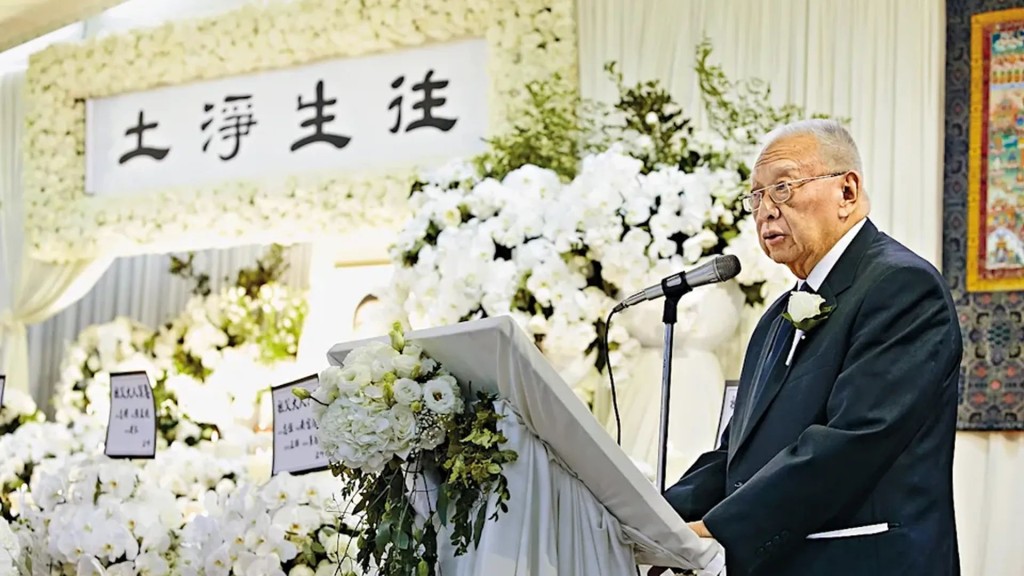
Tung Chee-hwa, Hong Kong’s first chief executive after the 1997 handover, died on September 8 at the age of 89, setting the stage for a funeral that could carry significance well beyond a private farewell. His death has also raised a question that Hong Kong has confronted only a handful of times since the establishment of the Special Administrative Region: will Beijing grant him the kind of state funeral honours previously given to senior Hong Kong figures such as Ann Tse-kai and Henry Fok Ying-tung? (RTHK News)
Tung died peacefully with family members around him, according to a statement from his office. He served as chief executive from 1997 until his resignation in 2005, becoming the first person to lead Hong Kong under Chinese sovereignty. He later remained active in national politics as a vice chairman of the National Committee of the Chinese People’s Political Consultative Conference, a position that gave him the rank associated with a national-level political figure. (RTHK News)
The circumstances of his death have therefore prompted attention not only to his political record but also to how Beijing may choose to commemorate him.
A rare honour in Hong Kong
State funerals are unusual in Hong Kong. Since the 1997 handover, only a small number of prominent figures have received funeral arrangements carrying the kind of national recognition generally associated with a state funeral.
Ann Tse-kai was among the earliest and most prominent examples.
Ann, who settled in Hong Kong in 1949, built a career in business and public affairs. He was involved in the textile industry and helped establish companies including South China Bleaching and Dyeing Factory, Soco Textiles and Winner Textiles. His corporate roles also extended to major Hong Kong institutions, including Shaw Brothers, TVB, Shanghai Commercial Bank and Hutchison Whampoa.
His political importance grew as Hong Kong approached the handover. Ann served as deputy director of the Basic Law Drafting Committee and director of the Basic Law Consultative Committee, putting him directly into the political process that shaped the territory's constitutional arrangements after 1997.
He was also a vice chairman of the CPPCC National Committee, a position that carried state leadership status. When he died in June 2000 at the age of 88, senior officials from Beijing travelled to Hong Kong for his funeral. (People's Daily Online)
The scale of the ceremony reflected his standing. Representatives of China's central government attended, while then Chief Executive Tung Chee-hwa himself served among the pallbearers. Ann's coffin was covered with the national flag of the People's Republic of China. (People's Daily Online)
The funeral became an important precedent for the way Beijing could honour a Hong Kong figure with national standing.

Henry Fok’s funeral set another precedent
Six years later, Henry Fok Ying-tung received similarly high-level recognition.
Fok was one of Hong Kong's best-known businessmen and philanthropists and served as a vice chairman of the CPPCC National Committee through the eighth, ninth and tenth terms. His relationship with mainland China stretched back decades and became an important part of his public reputation.
During the Korean War period in the 1950s, Fok was associated with efforts to supply China despite the international blockade. Later, following the beginning of China's reform and opening-up, he became one of the Hong Kong businessmen who moved early into mainland investment.
His business interests were not limited to the mainland. In Hong Kong, he was associated with changes in property sales practices, including the development of selling flats before completion and allowing buyers to make payments by instalment.
One of his most notable mainland projects was the White Swan Hotel in Guangzhou. Fok invested HK$200 million in the project in 1979, and the hotel became China's first joint-venture five-star hotel. National leaders visited the property several times. (The Standard)
When Fok died in Beijing in October 2006, his coffin was returned to Hong Kong on a chartered flight with the Chinese national flag draped over it. A memorial service had already been held in Beijing, attended by senior state leaders. (South China Morning Post)
His funeral in Hong Kong was conducted with the involvement of both central government and SAR officials. A police escort accompanied the hearse, while representatives of the central government later removed and folded the national flag covering his coffin before presenting it to his family. (China Daily)
Tung himself was among the ten pallbearers at Fok's funeral, meaning that a man now at the centre of speculation about state funeral honours once played a direct role in one of Hong Kong's most prominent political funerals.

Tung’s own place in Hong Kong history
Tung's case is different from both Ann's and Fok's because his political office was arguably the most senior ever held by a Hong Kong resident after the handover.
On July 1, 1997, Tung became the first chief executive of the Hong Kong Special Administrative Region. His administration inherited a city undergoing a historic political transition while also facing severe economic and social pressures.
His eight years in office included the Asian financial crisis, the bird flu outbreak and the SARS epidemic. His administration also faced mounting public dissatisfaction over housing, economic conditions and political reform. (AP News)
The most consequential confrontation came in 2003, when his administration attempted to introduce legislation under Article 23 of the Basic Law covering offences including treason and sedition. The proposal triggered a huge public demonstration, with hundreds of thousands of people taking to the streets. The legislation was eventually shelved. (Reuters)
Tung resigned in 2005, citing health reasons, but his political career did not end with his departure from Government House. He subsequently became a vice chairman of the CPPCC National Committee and remained a prominent supporter of Beijing's policies in Hong Kong.
His later years saw him increasingly associated with efforts to strengthen ties between Hong Kong and mainland China. He backed Beijing's approach to national security and political reform, including the changes introduced after the 2019 unrest. (Reuters)
That political record means his funeral will inevitably carry a political dimension, regardless of the formal arrangements eventually announced.
Does Tung qualify for a state funeral?
There is no publicly defined checklist that automatically guarantees a state funeral to a former Hong Kong chief executive.
The precedent instead points to a combination of factors: national political standing, service to China, contributions to Hong Kong and the individual's relationship with the central government.
Ann Tse-kai held a senior CPPCC position and played a significant role in the constitutional arrangements surrounding the handover. Henry Fok held a comparable national political rank and was celebrated for decades of involvement in China's development.
Tung held the same broad national political standing after leaving the chief executive's office, but his case carries an additional distinction. He was the first chief executive of the post colonial Hong Kong government.
His funeral could therefore become a measure of how Beijing wishes to present his historical role.
If the central government grants him state funeral honours, the ceremony could draw senior officials from Beijing and Hong Kong and potentially include national symbols similar to those seen at the funerals of Ann and Fok.
If it does not, the decision would also be significant, given Tung's unique position in Hong Kong's political history.
For now, the focus is on what arrangements will be announced for the former chief executive. His death closes the life of a man who stood at the centre of Hong Kong's transition from British rule to Chinese sovereignty and then remained active in Beijing's political system for more than two decades.
The question facing Hong Kong now is straightforward: will Tung Chee-hwa become the next Hong Kong figure to receive a state funeral, and what would that honour say about how his legacy is viewed today?