

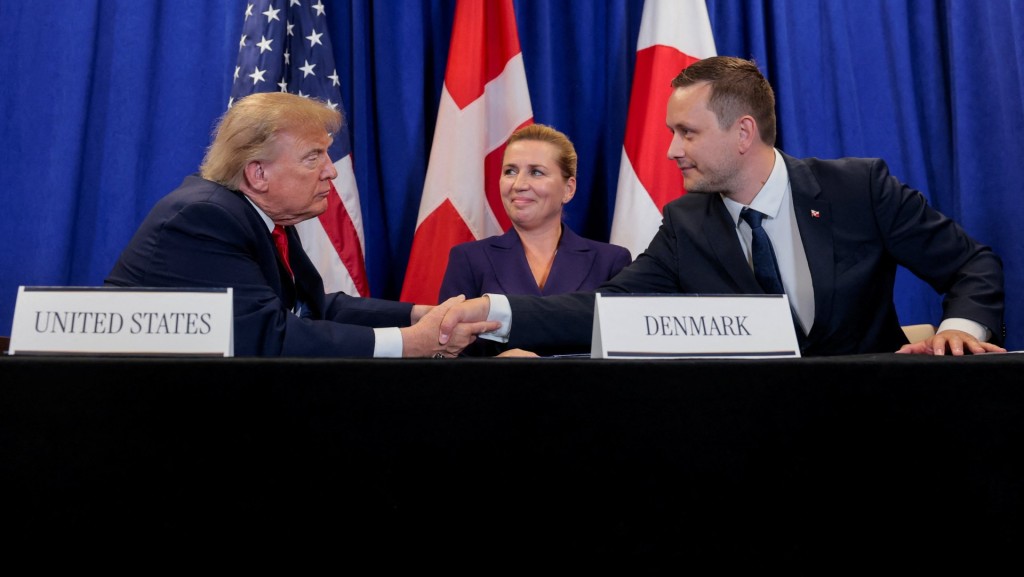
US President Donald Trump, Danish Prime Minister Mette Frederiksen and Greenland Prime Minister Jens Frederik Nielsen signed a new security agreement Tuesday that will expand the US military presence on Greenland while leaving the Arctic island under Danish control.
The agreement, signed during the United Nations General Assembly in New York, ends months of diplomatic tension over Trump's repeated demands for greater US control of Greenland. It does not transfer sovereignty to Washington, but it gives the United States wider military access and permits new defence facilities on the strategically located island.
The deal also allows Washington to establish a missile defence system known as “Golden Dome” in Greenland. The agreement amends a 1951 defence treaty that has governed the US military presence on the island and does not include an end date.
For Denmark and Greenland, the agreement preserves the existing political arrangement while addressing US concerns about Arctic security. For Washington, it creates a framework for expanding military infrastructure in a region where Russia and China have increased their strategic attention.
New US Defence Sites Planned
The agreement permits the United States to establish defence areas at Narsarsuaq in southern Greenland and Mestersvig on the eastern coast.
Narsarsuaq was once a major US military facility during the Cold War. The United States closed the base in the 1950s, and the nearby population has since fallen to only a few dozen people.
Mestersvig is currently associated with Denmark's Sirius Dog Sled Patrol, a special forces unit that operates in Greenland's remote northeast.
Trump said in his address to the UN General Assembly that the United States would begin developing a larger military presence and build two major bases.
The agreement also allows Washington to modernise and expand its existing activities at Pituffik Space Base in northwestern Greenland. The facility, formerly known as Thule Air Base, supports missile warning, missile defence and space surveillance operations for the United States and NATO.
The planned expansion would represent the largest increase in US military infrastructure on Greenland since the Cold War.
At the height of the Cold War, the United States operated 17 military installations on the island and had more than 10,000 personnel there. Today, the US presence is concentrated at Pituffik.

Greenland Remains Under Danish Control
The agreement does not make Greenland a US territory.
Greenland is a self governing territory within the Kingdom of Denmark. It has its own government and parliament and has long pursued greater autonomy, while Denmark retains responsibility for areas including defence and foreign policy.
Trump had repeatedly argued that the United States needed to control Greenland because of its location and the growing presence of Russia and China in the Arctic. His earlier statements about potentially using economic or military pressure to acquire the island created serious tension with Denmark, which is a NATO ally.
Greenlandic leaders rejected the idea of becoming part of the United States.
The new agreement instead gives Washington expanded military access while recognising Greenland's existing political status. Greenland's prime minister, Jens Frederik Nielsen, said the deal strengthens NATO's role in the Arctic.
“We believe that it is vital to keep NATO strong, also in the Arctic, where the alliance has a key role to play,” Nielsen said.
Danish Prime Minister Mette Frederiksen described the agreement as one that could “last forever” and said it respected Greenland's right to self determination.

Wider US Access Across Greenland
The agreement gives US forces broad access to Greenland and its surrounding waters.
According to the published terms, Washington can seek additional defence areas in the future, although further sites would require agreement between the parties. The accord also provides broad military mobility, including access beneath the sea.
The agreement prevents countries outside NATO from establishing their own military installations in Greenland. It also restricts persistent military deployments by non NATO states unless the signatories agree otherwise.
The restrictions reflect the strategic importance of Greenland's position between North America and Europe.
The island sits close to major Arctic shipping routes and occupies a position near the shortest geographical route between North America and Europe. Its location also makes it important for missile warning and surveillance systems.
The Arctic is becoming more accessible as sea ice declines, opening shipping routes and increasing attention to its mineral resources and potential energy supplies. Greenland also contains deposits of minerals that are of interest to governments and companies seeking resources needed for advanced technologies.
Investment Restrictions Included
The agreement is not limited to military matters.
Its provisions also restrict foreign investment in sensitive sectors, including critical infrastructure and resource extraction. Investors from countries outside NATO, NATO partner states and the European Union face restrictions where they could gain control or significant influence over sensitive activities.
The provisions are designed to limit the ability of countries viewed as strategic competitors to establish a significant economic or military foothold in Greenland.
The United States has increasingly focused on reducing the possibility of Chinese or Russian influence in strategically important parts of the Arctic. Moscow, meanwhile, has expanded its military and economic interests across its own Arctic territory.
Russia said Tuesday that the new agreement was a matter for the countries involved. Kremlin spokesman Dmitry Peskov said cooperation between Moscow and Washington in the Arctic was not currently on the agenda.

Months of Tension Preceded the Agreement
The agreement follows a diplomatic dispute that began well before the signing ceremony.
Trump first publicly expressed interest in buying Greenland during his first presidential term in 2019. He revived the issue before returning to office, arguing that US control of the island was necessary for national security.
Greenlandic leaders repeatedly rejected the idea that the territory was for sale.
The dispute intensified in early 2026 when Trump refused to rule out military or economic force to obtain control of Greenland. His position alarmed Denmark and other European allies and created friction inside NATO. Denmark and Greenland subsequently entered months of negotiations with Washington in an effort to address US security concerns without transferring sovereignty.
Technical talks between the three sides began in January, according to an AP timeline. Trump continued to press for greater US control during the negotiations, while Danish and Greenlandic officials insisted that any agreement must preserve Danish sovereignty and Greenland's right to determine its own future.
By September, the negotiations had produced a proposed security framework. Trump announced the agreement shortly before the UN signing ceremony, describing it as a way to strengthen the US military position while keeping Greenland under Danish control.
Agreement Still Needs Parliamentary Approval
The deal is not the final word on its implementation.
Parliaments in Denmark and Greenland must approve the agreement before it can take full effect. The accord is also structured to remain in place if Greenland eventually becomes independent, provided it remains part of NATO and assumes Denmark's relevant rights and obligations under the agreement.
That provision is significant because Greenland's independence remains an important political issue on the island. The agreement therefore attempts to address both present security arrangements and a possible future change in Greenland's constitutional status.
The new framework gives the United States expanded military access without granting Washington ownership of the territory. It also places Greenland's Arctic security more firmly within NATO's wider defence structure.
For Greenland, Denmark and the United States, the immediate task is now implementation. Parliamentary approval, construction plans for the new defence areas and the expansion of existing facilities will determine how quickly the agreement changes the US military footprint across the Arctic island.
What impact could the new US military presence have on Greenland's security, economy and future relationship with Denmark?