

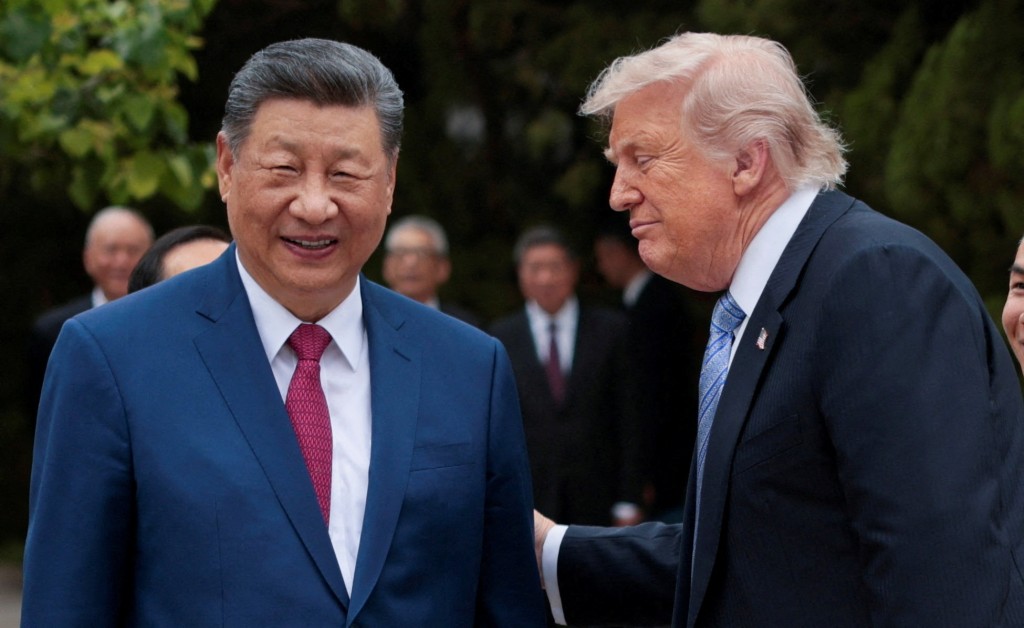
Chinese President Xi Jinping is set to arrive in Washington this week without the group of Chinese business leaders Beijing had hoped would accompany him for meetings with US President Donald Trump, according to two people familiar with the plans. The decision removes a potentially important business element from a summit already focused heavily on trade, technology, investment and economic relations between the world's two largest economies.
The development comes only days after Reuters reported that Chinese officials were working to assemble a delegation of senior corporate executives for Xi's visit. The proposed group was expected to include major Chinese companies, some of which have faced scrutiny from US authorities over national security, technology and other regulatory concerns.
It was not immediately clear why the business delegation will not travel with Xi.
One person familiar with the matter said the White House had other priorities for the visit. Another said US officials did not want Chinese companies that they believe have links to China's military to receive an official platform during Xi's trip. Both people spoke on condition of anonymity because the arrangements had not been made public.
The issue illustrates one of the central difficulties facing Washington and Beijing as they try to maintain economic ties while continuing to impose restrictions on sensitive technologies and investment. Chinese companies seeking greater access to the US market have increasingly found themselves caught between commercial opportunities and national security concerns in Washington.
Beijing had considered a major business delegation
The possibility of a Chinese corporate delegation had emerged earlier this month as officials in Beijing and Washington prepared for Xi's September 24 meeting with Trump.
Reuters reported on September 18 that companies under consideration included electric vehicle manufacturer BYD, battery producer CATL, smartphone and electric vehicle maker Xiaomi, battery company Gotion, consumer electronics manufacturer Hisense, automotive parts supplier Wanxiang Group, state owned Bank of China and agricultural conglomerate COFCO Group. The final list had not been settled at that stage.
Several of those companies have faced scrutiny in the United States.
The proposed delegation would therefore have carried significance beyond ordinary business diplomacy. Bringing senior executives from companies under US regulatory pressure could have given Beijing an opportunity to demonstrate that commercial engagement remained possible despite disagreements over technology, trade and national security.
The plan also reflected an element of reciprocity. Trump had taken US corporate leaders to Beijing during his May visit, including executives from companies that have encountered regulatory or market access problems in China. Beijing's proposed delegation was viewed by sources as a possible response to that arrangement.
However, the two governments did not appear to agree on how much space should be given to corporate engagement during Xi's visit. Beijing had also proposed a US China chief executive roundtable, but the White House rejected the idea, according to Reuters. Chinese executives were not expected to hold meetings with US think tanks or business organisations as part of the trip.
Chinese foreign ministry offers no confirmation
At a regular briefing on Wednesday, a Chinese foreign ministry spokesperson was asked whether business leaders would accompany Xi to Washington.
"I do not have the relevant information," the spokesperson said, without confirming or denying reports about the delegation.
The White House had not immediately responded to a request for comment when Reuters published its report.
The absence of a Chinese business delegation does not mean that commercial issues will be absent from the summit. Trade remains one of the principal subjects expected to dominate the meeting between Trump and Xi.
The two leaders are due to discuss the future of a trade truce reached last year, while US officials have also been seeking progress on critical minerals and other economic issues. Recent discussions between US Treasury Secretary Scott Bessent and Chinese Vice Premier He Lifeng covered trade, critical minerals and artificial intelligence, including a US proposal for a mechanism to notify each other about serious AI related safety incidents.
Washington is also seeking additional rare earth export licences for US companies, while officials have been discussing possible changes to tariffs affecting selected goods. Other unresolved issues include Chinese purchases of US agricultural products and aircraft.
US corporate leaders prepare for White House dinner
While Chinese corporate executives are not expected to accompany Xi in the planned delegation, some of America's most prominent business leaders are expected to attend a state dinner at the White House on Thursday.
The guest list is expected to include major figures from technology, finance, pharmaceuticals and manufacturing.
Among those expected are Amazon founder Jeff Bezos, Alphabet CEO Sundar Pichai, OpenAI CEO Sam Altman, Apple CEO Tim Cook, Tesla CEO Elon Musk, Nvidia CEO Jensen Huang, Pfizer CEO Albert Bourla and Meta Platforms CEO Mark Zuckerberg.
The presence of these executives places American corporate interests visibly alongside the diplomatic talks, even as the Chinese side appears set to arrive without a comparable group of business leaders.
The contrast is notable because US and Chinese companies remain deeply connected through trade, manufacturing, technology and investment, despite years of worsening strategic competition.
Artificial intelligence is one area where those tensions are particularly pronounced. Washington has imposed restrictions on the export of advanced semiconductor technology to China, while Beijing has increased regulatory pressure on foreign technology companies and sought to strengthen its domestic capabilities.
Nvidia's Huang, for example, has been closely involved in the US China technology relationship. The company has faced restrictions affecting sales of advanced AI chips to Chinese customers, while Beijing has also scrutinised Nvidia's operations in China.
Business expectations remain tied to wider negotiations
The decision over the Chinese CEO delegation comes as expectations for the summit remain focused on incremental economic agreements rather than a sweeping reset in relations.
Reuters reported earlier this week that the main question surrounding the September 24 meeting is whether Trump and Xi can signal an extension of the existing trade truce. Issues involving Taiwan and other strategic disagreements may also arise, but trade and economic relations are expected to remain central to the discussions.
For Beijing, bringing corporate leaders to Washington could have provided an opportunity to reinforce commercial ties and give major Chinese companies direct access to US policymakers and business leaders. Their absence means that responsibility for economic discussions will fall more heavily on government negotiators.
For Washington, the decision reflects the continuing sensitivity surrounding Chinese companies operating in sectors considered strategically important. The distinction between commercial activity and national security has become increasingly difficult to maintain as companies in electric vehicles, batteries, telecommunications, artificial intelligence and advanced manufacturing become part of the broader US China competition.
The state dinner will nevertheless put American executives in the same room as the Chinese president and US leadership, creating a different channel for business engagement.
Xi's visit therefore carries two contrasting messages. The White House is making room for prominent American corporate leaders, while the Chinese delegation appears likely to remain focused on government officials rather than company executives.
The outcome of the summit could determine whether that separation is temporary or becomes another feature of the increasingly complicated US China economic relationship. What concrete trade and technology agreements should businesses and investors watch for when Trump and Xi meet in Washington?