

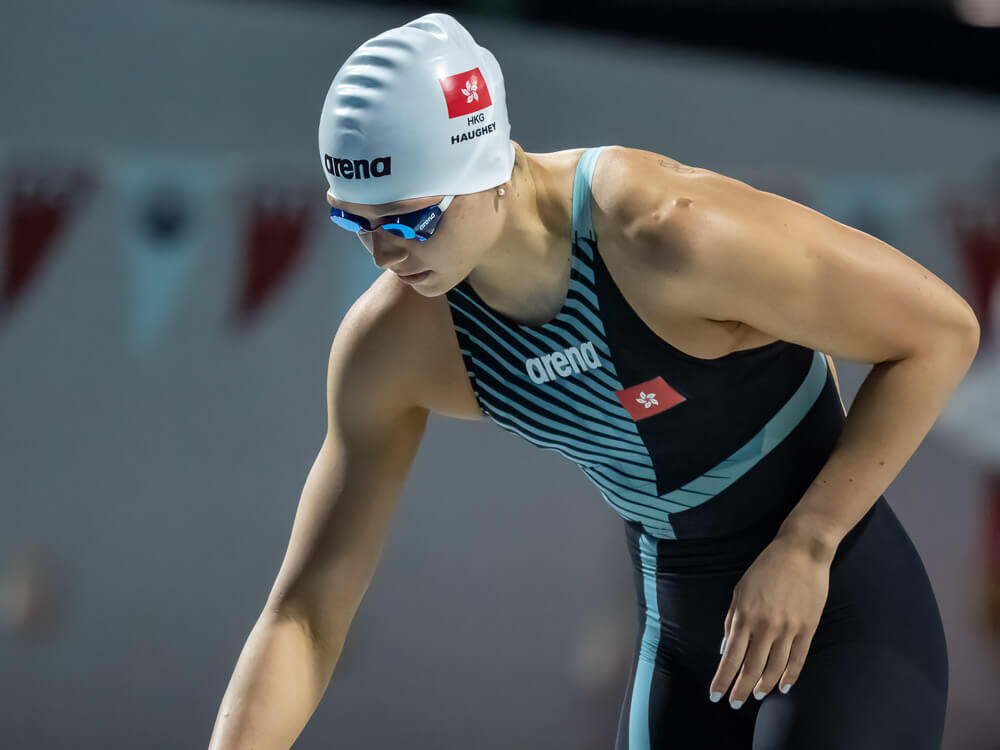
Siobhan Haughey delivered another dominant performance in the pool at the Aichi Nagoya Asian Games, successfully defending her women’s 200 metre freestyle title and giving Hong Kong its second gold medal of the competition.
The Hong Kong swimming star controlled the final from the opening 50 metres and never surrendered her lead, touching the wall in 1:54.96 to finish more than a second ahead of China’s Li Jiaping. Fellow Hong Kong swimmer Gilaine Ma also reached the final and finished fifth in 1:59.75.
Haughey takes control from the start
Haughey entered the final carrying the weight of expectation that comes with being the defending champion and the holder of both the Asian record and Asian Games record in the event.
She responded by taking control almost immediately.
The Hong Kong swimmer surged ahead during the opening 50 metres and established a 0.84 second advantage over Li Jiaping, who represented the national team. That early margin gave Haughey room to dictate the pace while the rest of the field fought to stay within striking distance.
Rather than allowing the challengers to close the gap, Haughey continued to build her advantage through the middle stages of the race.
By the time the swimmers entered the final 50 metres, she had moved more than a full body length ahead of her nearest rival. From there, the result was effectively settled. Haughey maintained her pace through the closing stretch and reached the wall first in 1:54.96.
Li finished second, more than a second behind the Hong Kong swimmer, while Ma completed a strong showing for Hong Kong by taking fifth place in 1:59.75.
For Haughey, the victory meant another Asian Games title in an event that has become closely associated with her career.
Haughey pleased despite missing target time
Speaking to television broadcasters after the race, Haughey said she was satisfied with her performance, even though the winning time was not as fast as she had hoped.
Her comments reflected the difference between chasing a personal target and securing a major championship victory. She acknowledged that the clock did not show the time she had wanted, but said she had given everything during the race and was pleased with the result.
That approach was reflected in the way she raced. Haughey did not wait for the field to develop around her. Instead, she established her position early and forced her closest competitors to respond.
The victory also adds another major result to a career in which Haughey has established herself as one of Hong Kong’s leading swimmers.
Her status as the holder of both the Asian and Asian Games records for the 200 metre freestyle had already placed her among the favourites in the event. The challenge at the Asian Games was to turn that standing into another title.
She did exactly that.
Ian Ho adds silver in the men’s 50 metre freestyle
Hong Kong’s medal haul in swimming grew further when Ian Ho claimed silver in the men’s 50 metre freestyle.
Ho entered the final after qualifying fourth fastest and faced a difficult task in one of swimming’s shortest and most explosive events. In the 50 metre freestyle, there is almost no room to recover from a slow start, with fractions of a second often separating the medal positions.
Ho did not get the fastest reaction from the starting blocks, but he quickly recovered and moved into contention.
He produced a powerful finish and stopped the clock at 21.76 seconds. That was enough for second place, just 0.10 seconds behind South Korea’s Kim Young Beom.
Kim won the gold medal in 21.66 seconds, setting a new Asian Games record in the process.
For Ho, the result had an added significance because it matched his performance from the previous Asian Games in Hangzhou. He had also won silver in the men’s 50 metre freestyle at that competition.
Two consecutive Asian Games silver medals in the same event underline Ho’s consistency on the regional stage. His latest result also gives Hong Kong another podium finish at a competition where every hundredth of a second can determine the colour of a medal.
Hong Kong swimmers deliver two medals
Haughey’s gold and Ho’s silver give Hong Kong two swimming medals from the competition and add to the city’s overall medal tally.
The performances also show the different ways in which Hong Kong’s swimmers reached the podium.
Haughey dominated her final from the opening stages and maintained a sizeable advantage through the finish. Ho, meanwhile, had to recover from a slower start before producing the speed needed to finish second in a race decided by only one tenth of a second.
Ma’s fifth place in the women’s 200 metre freestyle final further strengthened Hong Kong’s presence in the event, giving the city two finalists in a highly competitive field.
For the swimmers, the results provide a direct measure of their performances against some of Asia’s strongest competitors. For Hong Kong sport more broadly, the medals also carry a significant financial incentive under a newly revised athlete reward programme.

Gold worth HK$1 million under revised incentive scheme
Haughey’s victory will bring a HK$1 million award under the newly revised Jockey Club Athlete Incentive Awards Scheme.
The scheme, known as JCAIAS, was introduced in partnership with the Hong Kong Sports Institute and is designed to encourage sporting excellence while providing additional support to Hong Kong’s elite athletes.
The revised programme covers seven major upcoming sporting events, beginning with the Aichi Nagoya Asian Games.
Under the scheme, individual gold medallists receive HK$1 million, while individual silver medallists receive HK$500,000.
That means Haughey will receive a seven figure payout for her gold medal, while Ho will be awarded HK$500,000 for his silver.
The financial awards add another dimension to the importance of the results. For elite athletes, preparation for major international competitions involves years of training, competition and travel, making structured support programmes an important part of the wider sporting system.
The rewards also provide a clear financial recognition of medal winning performances at major events.
A strong start for Hong Kong in the pool
Haughey’s successful title defence provides one of the clearest highlights of Hong Kong’s swimming campaign at the Aichi Nagoya Asian Games.
She entered the 200 metre freestyle final as the defending champion and record holder, then backed that reputation with a race in which she established the lead early and never allowed it to disappear.
Ho followed with a silver medal of his own, matching his previous Asian Games result in the 50 metre freestyle and finishing only 0.10 seconds behind a new Asian Games record.
The two results give Hong Kong gold and silver from the pool, while Ma’s fifth place adds another strong final appearance.
Haughey may not have reached the time she had targeted, but the medal she came for is now secured. Ho has once again placed himself among Asia’s leading sprint swimmers. With the incentive scheme adding financial recognition to their results, both athletes leave the pool with medals that carry significance well beyond the final times on the scoreboard.
What other medals can Hong Kong’s swimmers deliver as the Aichi Nagoya Asian Games continue?