

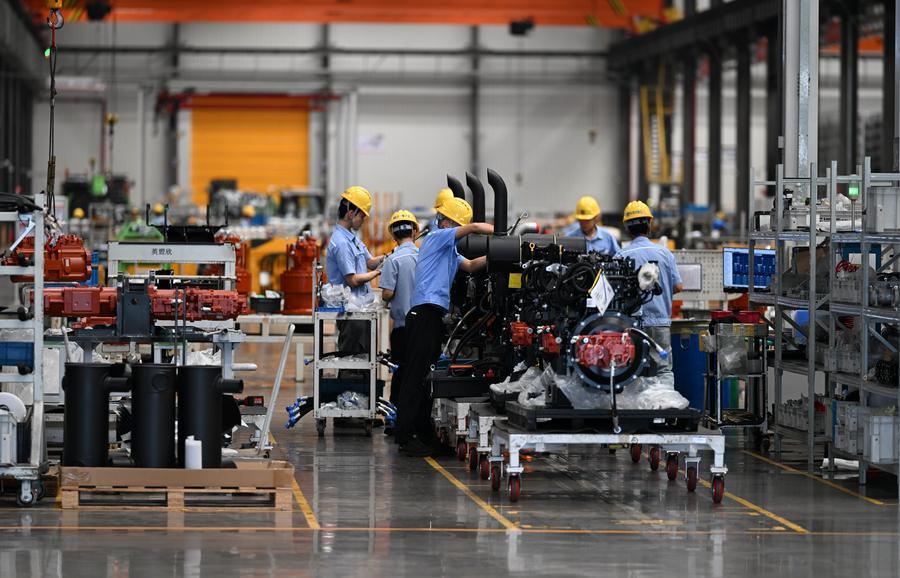
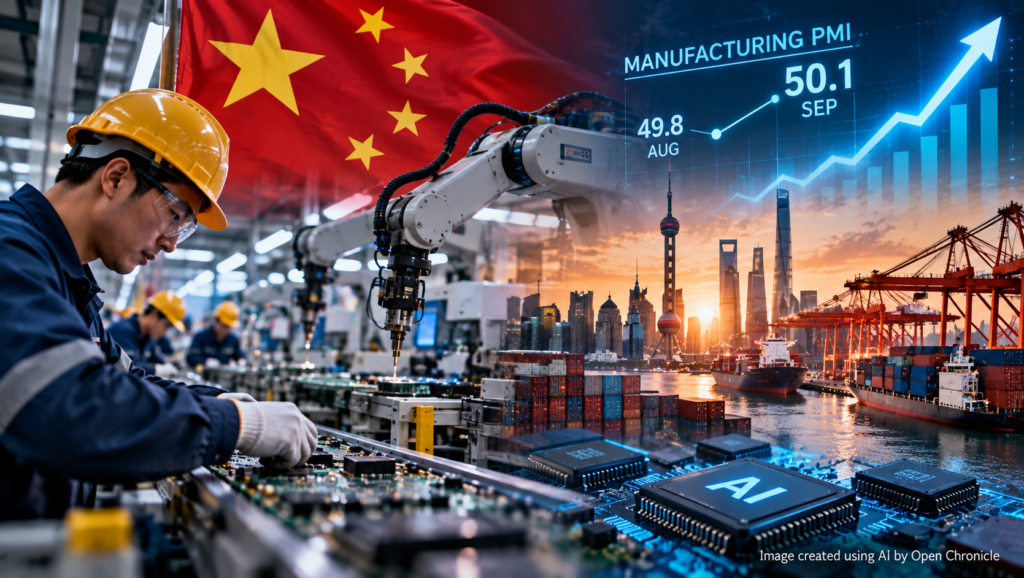
China’s factory activity returned to expansion in September, with the official manufacturing Purchasing Managers’ Index (PMI) rising to 50.1 from 49.8 in August, according to data released by the National Bureau of Statistics (NBS) on Wednesday.
The increase pushed the index above the 50 point threshold that separates expansion from contraction. It also marked a return to growth after manufacturing activity remained below the threshold for two consecutive months.
Manufacturing Activity Moves Back Into Growth
The official manufacturing PMI increased by 0.3 percentage points in September, extending the gradual improvement recorded over the previous two months.
The August reading had already risen from July, although it remained below 50. The latest increase means factory activity has now moved back into expansion territory as manufacturers increased production and demand showed signs of improvement.
Huo Lihui, chief statistician at the NBS service survey center, said the recovery reflected continued expansion in production and demand. He also pointed to stronger activity among equipment manufacturers, high tech companies and consumer goods producers.
The improvement, however, remained modest. A PMI reading only slightly above 50 indicates that manufacturing activity expanded at a limited pace rather than undergoing a sharp acceleration.
Factory Production Strengthens
Production provided the strongest support for the manufacturing PMI in September.
The production sub index climbed 1.3 percentage points to 51.7, remaining comfortably above the 50 point mark. The increase showed that factories were producing more during the month and contributed significantly to the overall improvement in manufacturing conditions.
The new orders index told a more restrained story. It slipped 0.1 percentage point to 50.5 but remained in expansion territory.
The narrow gap between production and new orders suggests that manufacturers increased output while new demand grew only slightly. Sustained growth will depend partly on whether stronger production is followed by a broader increase in orders.
High Tech and Equipment Manufacturing Remain Strong
China’s high tech manufacturing sector continued to record stronger activity than the overall manufacturing industry.
The sector posted a PMI of 52.5 in September, according to the NBS. Equipment manufacturing also remained in expansion, recording 51.0.
Consumer goods manufacturing registered a PMI of 50.7.
The figures show that several industries continued to grow even as the wider manufacturing sector operated close to the expansion threshold. High tech manufacturing in particular has remained an important area of industrial activity as China expands production in advanced technology and other higher value industries.

Services Return to Expansion
The improvement was not limited to factories.
China’s official non manufacturing PMI rose to 50.2 in September from 49.0 in August, returning to expansion after contracting in the previous month.
The services business activity index also increased, reaching 50.2 compared with 49.3 in August.
Services account for a major share of China's economic activity, making the return to expansion an important part of the latest PMI data. The improvement suggests that activity outside the industrial sector also strengthened during September.
Composite PMI Rises Above 50
China’s composite PMI, which combines manufacturing and non manufacturing activity, also returned to expansion.
The index rose to 50.7 in September from 49.5 in August, moving above the 50 point threshold.
The increase reflects the combined improvement in factory production, manufacturing activity and services. It provides a broader measure of business activity than the manufacturing PMI alone.
Recovery Remains Uneven
Despite the return to expansion, the September figures do not point to a broad acceleration across every part of the economy.
Manufacturing activity remained only slightly above the 50 point threshold, while new orders increased at a slower pace than production. Factory employment also remained under pressure, with the manufacturing employment index at 48.4.
The employment reading stayed below 50, indicating continued contraction in factory jobs. That contrast between stronger production and weaker employment shows that higher output has not yet translated into broader hiring.
Companies can increase production through greater use of existing capacity, improved efficiency and automation without immediately adding workers.
Private Survey Shows Stronger Factory Activity
A separate private sector survey offered a stronger reading for China's manufacturing sector.
The RatingDog manufacturing PMI reached 52.1 in September, according to Reuters, marking a five month high.
The private survey and the official PMI cover different groups of companies and therefore should not be treated as identical measures. The RatingDog survey places greater emphasis on smaller and export oriented manufacturers, while the official NBS survey covers a broader group of businesses.
The difference between the two readings nevertheless shows that conditions varied across China's manufacturing sector during September.
Government Measures Target Economic Growth
The latest PMI figures come as Chinese policymakers continue introducing measures to support economic activity.
Beijing announced additional economic support measures on September 29, including expanded financing support for technology companies, farms, small businesses and private enterprises. The government also announced measures aimed at supporting the property market.
The policy steps come as authorities seek to strengthen domestic demand while maintaining industrial production and investment.
Manufacturing has remained an important part of China's economic strategy, particularly in sectors involving advanced technology, equipment and industrial production.
What the September PMI Means for China
The September data provide several signs of improvement. Factory production accelerated, manufacturing returned to expansion, high tech and equipment industries remained above 50, and services also moved back into growth.
But other figures show that the recovery remains limited. New orders were only slightly above the expansion threshold, while factory employment continued to contract.
The next PMI readings will therefore be closely watched for evidence that stronger production is translating into sustained demand across the wider economy.
For now, China's September figures show an economy that has regained modest momentum after two months of manufacturing contraction, with technology related industries and services providing important support.
Will stronger factory production lead to wider growth in demand and employment during the final months of 2026?