

Hong Kong’s growing esports calendar is creating demand far beyond sold-out arenas, with tournaments driving new opportunities for gaming hardware, desk setups, equipment procurement and cross-border manufacturing across the Greater Bay Area.
The trend was visible in February when the LCK Cup finals made their debut at Hong Kong’s Kai Tak Arena. Around 20,000 fans attended across two days, giving the city a major esports event at a venue better known for large-scale entertainment and sporting occasions.
Another major tournament is scheduled for November, when BLAST returns to AsiaWorld-Expo. Eight elite teams are expected to compete for a US$1.1 million prize pool.
Those events bring international players and spectators to Hong Kong, but their commercial impact reaches well beyond ticket sales. Every major competition needs computers, monitors, keyboards, mice, headsets, chairs, controllers, networking equipment and other specialist hardware. Organisers also need production equipment and venue infrastructure capable of supporting high-level competitive gaming.
That demand is creating a closer connection between Hong Kong’s events industry and the manufacturing centres across the Greater Bay Area.
Esports demand moves into the supply chain
The Greater Bay Area has become one of the world's most concentrated manufacturing regions for electronics and computer peripherals. The Shenzhen, Dongguan and Huizhou corridor combines product development, engineering, manufacturing and supply-chain services within a relatively compact geographic area.
The region is particularly significant for PC gaming hardware. According to figures cited in the source material, manufacturers in the area account for more than half of global keyboard and mouse original equipment manufacturing output and more than 70% of game controller shipments.
That manufacturing base gives esports organisers, retailers and international buyers access to a broad network of suppliers. Instead of sourcing individual components from widely separated markets, buyers can work with manufacturers operating within the same wider production ecosystem.
Dongguan illustrates the scale of the industry. In 2024, its esports-related sector reached RMB34.2 billion and included 733 enterprises, according to the figures provided.
Huizhou has also expanded its electronics manufacturing capabilities. Its factories produce products across several gaming categories, including gaming monitors, mechanical keyboards and gaming headsets.
Shenzhen adds another layer to the supply chain. The city has a large concentration of technology companies, engineers and product designers, creating an environment where new gaming accessories and PC peripherals can move from concept to commercial production.
Hong Kong connects these manufacturing centres with international buyers. Its free-port status and established trading infrastructure allow companies to coordinate procurement, logistics and cross-border transactions while maintaining access to global markets.
For the esports sector, that creates a useful relationship. Hong Kong can host major international events while nearby manufacturing centres supply much of the equipment needed to support the industry.
The modern desk is becoming a hybrid workspace
The expansion of gaming hardware is not being driven by esports alone. A second trend is changing what consumers expect from their desks.
Hybrid work has blurred the traditional separation between an office computer and a gaming setup. Many consumers now use the same desk for professional tasks during working hours and gaming or entertainment later in the day.
That has changed the products buyers want.
A keyboard may need to provide a comfortable typing experience for hours of office work while still offering the response and tactile feedback expected by gamers. A mouse may need separate profiles for productivity and gaming. A monitor can be expected to display documents clearly during the working day and provide high refresh rates when used for competitive games.
The result is a broader market for what is increasingly described as the “desk setup”.
The category once belonged mainly to enthusiasts who spent time selecting individual components for a highly customised gaming station. It has since moved into mainstream consumer culture, driven by social media, gaming content, remote work and the growing importance of personal workspaces.
Market projections reflect the scale of the wider shift. Data cited from Mordor Intelligence puts the global hybrid work hardware market at approximately US$28.5 billion in 2025, with the market projected to reach US$52.4 billion by 2031.
That expansion is also changing competition between established electronics manufacturers and gaming-focused companies.
Traditional peripheral brands are adding gaming products to their portfolios, while gaming companies are paying more attention to appearance, ergonomics and products that can fit naturally into home and office environments.
For manufacturers, the opportunity is no longer limited to selling a mouse designed purely for competitive gaming. A product that can move between work and play can address a much larger customer base.
Global Sources Hong Kong Shows target the growing market
Against this backdrop, the Global Sources Hong Kong Shows are positioning their October programme as a major meeting point for international buyers looking for electronics, gaming equipment and desk setup products.
The shows are scheduled to run from October 11 to 21 at AsiaWorld-Expo under the theme “Connecting Global Innovation, Enabling Sustainable Sourcing”.
The first phase, running from October 11 to 14, will focus on consumer electronics and gaming.
More than 2,100 exhibitors are expected across more than 4,000 booths. The programme includes more than 1,600 PC accessory booths and almost 500 gaming peripheral booths.
For buyers building or expanding product lines, the range covers much of the hardware associated with modern gaming and workstation setups. Products on display include high-refresh-rate monitors, multi-mode keyboards and mice, charging equipment, gaming chairs, PC cases, controllers, headsets and monitor arms.
The scale is significant because buyers can examine multiple categories during a single sourcing trip rather than arranging separate visits for individual product groups.
The exhibition will also bring together suppliers from the Greater Bay Area and other major Asian manufacturing centres.
Brands from the region scheduled to present products include Loctek, Brateck, Havit, AULA, MCHOSE, ATK, TITAN and Huntkey. Manufacturers from the Yangtze River Delta, another major centre for PC peripheral production, will also participate.
The wider exhibition will include about 1,900 additional booths covering audio-visual equipment, automotive electronics, personal transporters, photography accessories and batteries and power products.
That broader mix matters for gaming buyers because modern desk setups increasingly involve more than traditional peripherals. Power management, charging, displays, audio equipment and mounting hardware can all become part of a single procurement programme.
Curated zones offer buyers product comparisons
The size of the exhibition can also create a practical problem for buyers. Thousands of booths can make it difficult to identify products that fit specific requirements.
Organisers have therefore created dedicated areas intended to help visitors compare products and emerging technologies.
The Best of Innovation Awards Winners Showcase will bring selected products together in one location. The Future Tech Discovery Zone will give buyers another space to examine newer technologies and compare samples.
The show will also have an experiential element.
A VR Gaming Arena, presented with VR Star Space, will offer interactive titles including Star Racing and Star Cyclone. Visitors will be able to experience the technology rather than simply examine it from a display stand.
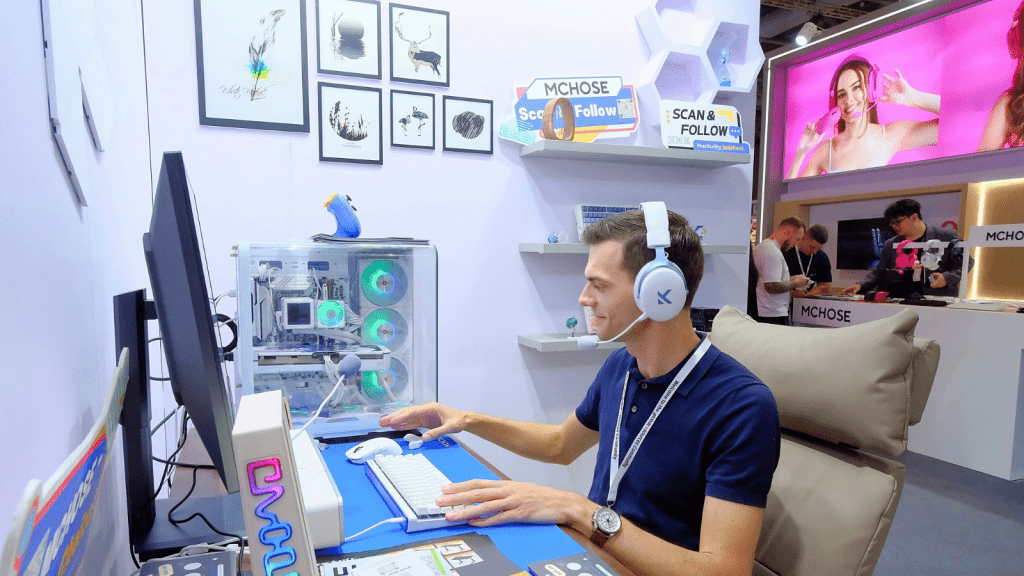
MCHOSE will operate a separate Gaming & Esports Arena where visitors can try gaming peripherals through hands-on gameplay.
These areas provide manufacturers with an opportunity to demonstrate products in conditions closer to actual use. For buyers, that can reveal differences in ergonomics, response, display quality and usability that are difficult to assess from product specifications alone.
Buyer registrations point to stronger sourcing activity
The exhibition is also reporting stronger interest from professional buyers ahead of the October event.
As of July 2026, global professional buyer pre-registrations were up 25% compared with the same period a year earlier, according to figures supplied for the event. The increase has been led by a recovery in demand from Europe and North America.
For suppliers, those markets remain important destinations for gaming hardware and consumer electronics. Higher registration numbers could therefore provide manufacturers with more opportunities to meet distributors, retailers and other professional buyers looking for new products.
The timing is also significant.
Companies planning product launches and procurement programmes for the second half of 2026 and beyond need to assess pricing, manufacturing capacity, product specifications and supply-chain options. An exhibition bringing together manufacturers across several connected categories can give buyers a concentrated opportunity to conduct those comparisons.
For Hong Kong, the development points to a broader economic role for esports.
The city can attract international tournaments, spectators and teams, but its position next to the manufacturing centres of Shenzhen, Dongguan and Huizhou creates another opportunity. The events can generate demand for the same products that the surrounding region is equipped to design and manufacture.
That connection could make esports part of a wider commercial ecosystem rather than an isolated entertainment sector.
The coming months will provide another test of that model. With BLAST scheduled to return to AsiaWorld-Expo in November and the Global Sources Hong Kong Shows bringing gaming manufacturers and international buyers together in October, Hong Kong is set to host both sides of the equation: the competitions that create demand and the sourcing activity that supplies the hardware behind them.
Can Hong Kong turn its expanding esports calendar into a larger role in the Greater Bay Area’s global gaming hardware supply chain?