


The Hong Kong Jockey Club Charities Trust has spent the past decade building a digital education pathway that takes students from basic computational thinking to artificial intelligence literacy, with programmes now reaching schools beyond Hong Kong. Its initiatives, launched as digital technology was beginning to reshape education, have grown into a network of projects involving schools, universities, teachers and education authorities in the Chinese mainland and overseas.
The Trust began this work in 2016 with CoolThink@JC, a programme designed to teach primary school students how to solve problems through coding and computational thinking. It later partnered with The Chinese University of Hong Kong to introduce AI education for junior secondary students, before launching JC GoAI in 2025 to bring AI learning into regular lessons.
Together, the programmes reflect a shift in how digital education is taught. Students are encouraged not only to use technology but also to understand how it works, develop their own digital projects and consider how emerging tools can address practical problems. Teachers, meanwhile, receive support to move beyond traditional instruction and guide students through exploration, collaboration and experimentation.
The Hong Kong Jockey Club's work also extends beyond the classroom. Its educational materials have reached schools in the Chinese mainland, Cambodia, New Zealand, Dubai and the United States, with local partners adapting the programmes to different education systems and communities.
From coding lessons to AI literacy
The Trust's digital education work began in 2016 with CoolThink@JC, one of its first large scale initiatives in the field. The programme introduced computational thinking to primary school students through coding activities and practical projects.
Computational thinking teaches students to break complicated problems into smaller parts, recognise patterns and develop logical solutions. Rather than simply following instructions on a computer, learners are encouraged to test ideas, identify mistakes and revise their work.
The approach changes the purpose of a computer lesson. Students can move from using software to creating something of their own, applying what they learn to projects connected to everyday life.
Lui Hok him, a student who participated in CoolThink@JC, described the method as a way to approach difficult tasks systematically.
“Computational thinking is about learning different problem solving techniques in class. We break a big problem down into smaller ones, which allows us to tackle it step by step in a logical and systematic way,” he said.
The programme also gives students opportunities to present their work. At the CoolThink@JC Competition in 2025, shortlisted teams displayed their app designs and ideas to the public, putting their classroom learning into practice.
In 2019, the Trust expanded its approach by partnering with The Chinese University of Hong Kong to establish the CUHK Jockey Club AI for the Future Project. The initiative introduced junior secondary students and teachers to core AI concepts and ethical questions surrounding the technology.
The two programmes addressed different stages of learning. CoolThink@JC built computational thinking skills among primary pupils, while the university partnership introduced older students to AI and its applications. Both also supported teachers in developing the confidence and knowledge needed to teach digital subjects.
The aim was not simply to prepare students to use new technology. By learning how digital systems work and considering the implications of AI, students could develop the ability to make informed decisions about technology as it becomes more common in education, work and daily life.
Government adoption extends classroom reach
The programmes gained wider institutional support in 2023, when the Hong Kong Education Bureau adopted and adapted both initiatives. Their resources were incorporated into innovation and technology learning modules used by primary and secondary schools across Hong Kong.
This marked a change in the scale of the work. What began as a programme supported by the Trust became part of broader efforts to strengthen digital education in local schools.
The next stage followed in 2025 with the launch of JC GoAI. Building on the earlier initiatives, the programme aims to integrate AI literacy into lessons for upper primary and junior secondary students, while helping teachers use AI in teaching and learning across different subjects.
The project aims to reach 300 primary and secondary schools, benefiting more than 100,000 students, 2,200 teachers and approximately 11,000 parents.
Lee Ho shun, a participant in JC GoAI, said understanding AI could help students prepare for changes in the job market.
“I believe AI will create many new career opportunities that do not exist today. If we do not learn how to harness its potential now, we may find it difficult to keep pace in the future,” he said.
The programme's focus on AI applications reflects the growing need for students to understand both the possibilities and limitations of the technology. Familiarity with AI tools can help learners explore new ways of working, but education must also equip them to think critically about the information and outputs those tools provide.
Teachers remain central to that process. The initiatives support educators in designing activities that encourage students to ask questions, work together and test ideas rather than rely solely on lectures or demonstrations.
At the launch ceremony for JC GoAI, Hong Kong Secretary for Education Christine Choi and Hong Kong Jockey Club Steward Henry Chan joined guests and students to mark the programme's introduction.

Sharing Hong Kong's experience across the Chinese mainland
The Trust's digital education work has expanded beyond Hong Kong through partnerships that allow schools to share teaching materials, training and experience.
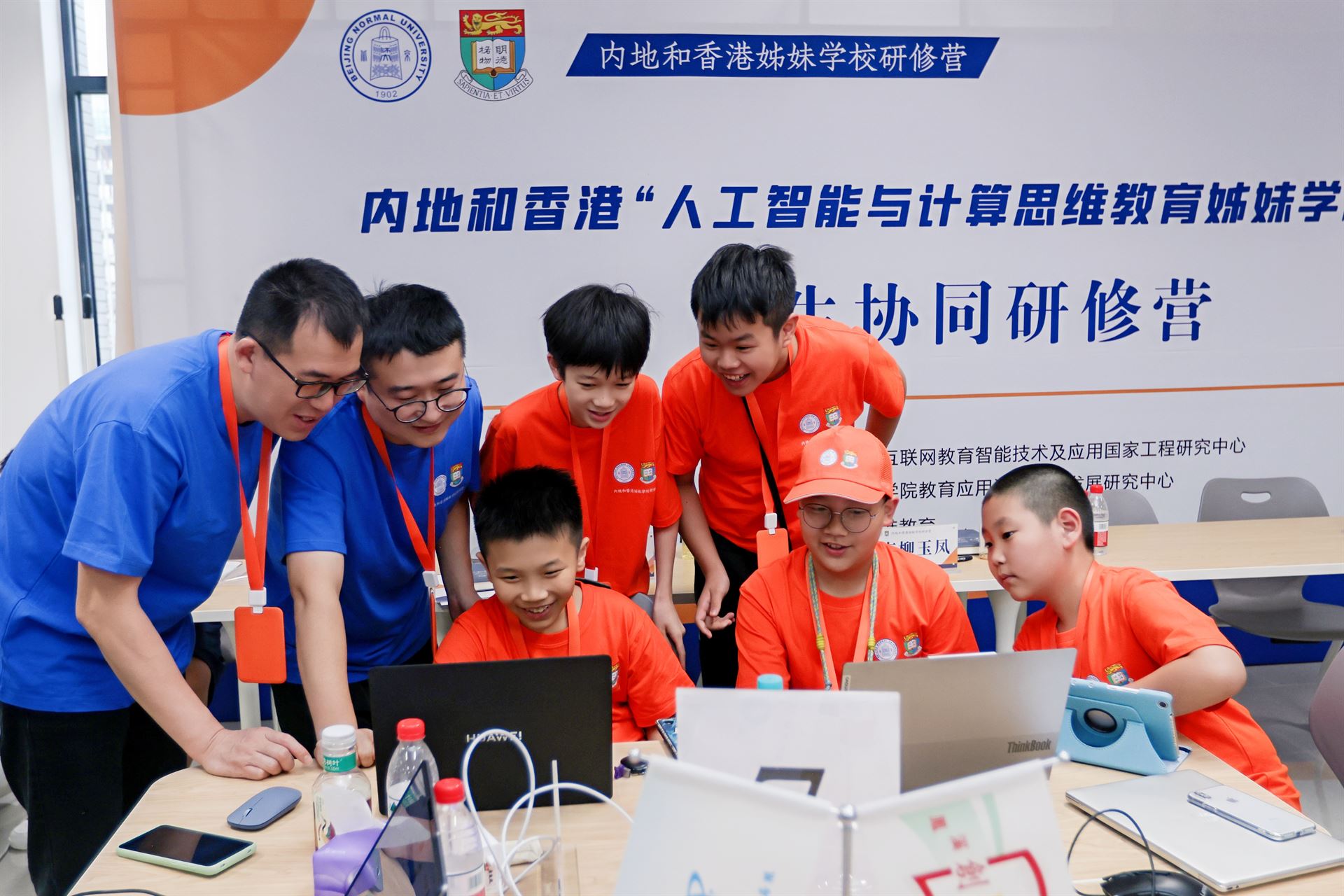
In 2025, CoolThink@JC extended into the Chinese mainland through sister school partnerships. The programme's computational thinking curriculum has been shared with primary schools across 25 provincial level administrative regions, giving teachers in different locations access to a Hong Kong developed approach.
Beijing Normal University has played a key role in the expansion by hosting conferences and teacher training camps. Networks connecting teachers across provinces and municipalities also support the exchange of classroom experience and practical teaching methods.
The model relies on collaboration rather than simply distributing a fixed curriculum. Schools can adapt the material to their local settings while retaining its central emphasis on problem solving, coding and digital creativity.
At the opening ceremony of the Global Smart Education Conference 2026, Hong Kong Jockey Club Deputy Chairman Lester Huang said the Club's commitment to digital education began a decade ago, with the aims of improving students' digital literacy and supporting equity in education.
He also said the work would extend beyond schools through Community Digital Creativity Learning Spaces, which are intended to give more young people access to digital learning opportunities and practical skills.
Before the conference opening, Huang accompanied Ren Youqun, vice minister of education of the People's Republic of China, on a visit to the Club's exhibition booth. The visit introduced the vice minister to the Trust's work in digital and AI education.
CoolThink@JC also received the Practice Innovation Prize in the Innovation Design Competition at the 2026 Global Smart Education Conference. The award recognised the programme's contribution to smart education and its efforts to equip students with skills for a technology driven future.
Cambodia partnership brings computational thinking to primary schools
The Trust has also taken CoolThink@JC to Cambodia, where local education authorities are adapting the curriculum for primary school students.
In 2025, the Trust signed a memorandum of understanding with Cambodia's Ministry of Education, Youth and Sport to introduce and adapt the programme in Cambodian primary schools. The partnership aims to strengthen students' problem solving abilities and give teachers practical ways to teach computational thinking.
At the programme's launch ceremony in Phnom Penh, Jackson Woo, a trustee of the Hong Kong Jockey Club Charities Trust, said inclusive, high quality education was among the Club's priorities. He warned that unequal access to technology could widen the digital divide, explaining that concern was one of the reasons behind CoolThink@JC.
The initiative also supports regional educational cooperation under the Belt and Road framework. The partnership has established a basis for further collaboration, including research and student exchange opportunities.
Cambodia's Ministry of Education, Youth and Sport aims to introduce the learning materials in 100 public schools between 2025 and 2028. The rollout is expected to benefit around 30,000 students, with 500 teachers receiving training to build local capacity.
Cambodia's Deputy Prime Minister and Minister of Education, Youth and Sport, Hang Chuon Naron, said the country needed to prepare its education system for the growth of AI.
He argued that education should move beyond rote memorisation towards scientific thinking and problem solving. He also expressed confidence that the curriculum could help primary school students develop creativity and become creators of digital products rather than remain technology users.
For sixth grade student Davith, the difference is already tangible.
“I used to only play games on my phone, but now I can create games by myself,” he said. “I feel truly proud and genuinely happy.”
His experience reflects the curriculum's emphasis on producing work rather than merely consuming digital content. Students in Cambodia are developing projects connected to their own lives, including Khmer language quiz games and short animations about local culture.
These assignments give pupils a way to practise computational thinking while creating something familiar to their communities. They also show how a programme developed in one education system can be adapted to another without losing its central learning goals.
Teachers learn alongside their students
The introduction of CoolThink@JC has also changed classroom practice in participating Cambodian schools.
Previously, information and communication technology lessons focused mainly on basic computer skills, including the use of word processing and spreadsheet software. Under the new curriculum, students can develop games, animations and other projects, giving them more opportunities to experiment and make decisions.
Rachana, a teacher involved in the programme, said the difference had been noticeable.
“Previously, our ICT curriculum was limited to basic Word and Excel operations and students could only create simple documents or files,” the teacher explained. “After starting the CoolThink@JC curriculum, they can now create what they want and truly enjoy learning more.”
Teachers have also taken on a different role. Rather than delivering all the information from the front of the classroom, they guide discussions, ask questions and help students refine their ideas as they work.
Hong Kong educators have supported their Cambodian counterparts through online and in person training. The exchange gives teachers opportunities to share methods, discuss challenges and learn from each other's classroom experience.
Daniel Fung, a school principal and CoolThink@JC trainer, said Cambodian teachers had shown a strong willingness to learn and exchange ideas.
He described the satisfaction of seeing teachers reach moments of understanding as they became more familiar with the programme. For educators involved in the collaboration, the benefits extend beyond the delivery of course materials to building relationships and professional confidence.
The partnership has also expanded beyond computational thinking. At the PBC 2026 forum in Hong Kong, the Trust and Cambodia's education ministry signed a separate memorandum of understanding on early childhood education and development.
The agreement, signed by Hong Kong Jockey Club Executive Director of Charities and Community Gabriel Leung and Cambodian ministry Permanent Secretary of State Kim Sethany, reaffirmed the two sides' commitment to strengthening early childhood development and improving children's future opportunities.
A learning pathway from early childhood to AI
The Trust's digital education projects form part of a broader programme spanning several stages of learning. In 2024, it launched JC CoolScience to support science, technology, engineering and mathematics education.
Taken together, the initiatives offer a progression from inquiry based exploration at kindergarten level to computational thinking in upper primary school and AI knowledge and interdisciplinary applications throughout primary and secondary education.
The aim is to give students opportunities to build on their skills as they grow, rather than treating digital education as a single subject or a one off activity. Early experiences with questioning and exploration can prepare students for coding, while computational thinking can provide a foundation for understanding more complex digital systems and AI applications.
The Trust plans to establish eight digital creativity community hubs across Hong Kong as the next phase of its work. These spaces are intended to bring digital and AI learning opportunities into local neighbourhoods, allowing young people to develop skills outside formal classroom settings.
The hubs are also expected to encourage the use of digital creativity to address community needs and provide opportunities for continued learning. Extending access beyond schools could help reach young people who have fewer opportunities to participate in technology related activities.
The Trust says it will continue to align its efforts with the National 15th Five Year Plan and Hong Kong's First Five Year Plan for Economic and Social Development, supporting the integration of education, technology and talent development.
Its funding model is also part of the wider approach. The Hong Kong Jockey Club generates economic and social value through tax contributions, charitable donations and employment, enabling its Charities Trust to support community and education initiatives.
After ten years of investment, the focus now extends beyond teaching students to use digital tools. The programmes seek to help young people question, create and apply technology responsibly, while giving teachers the training and resources to guide that process.
As the eight proposed community hubs move forward and international partnerships develop, how can schools, educators and communities work together to ensure more children gain access to meaningful digital and AI education?