

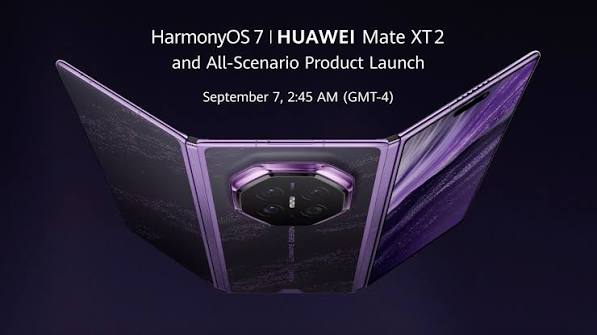
Huawei Technologies Co has unveiled its second generation tri fold smartphone, the Mate XT 2, introducing a new Kirin 9050 Pro processor as the company continues to develop its own high end semiconductor technology.
The device was launched at an event in Guangzhou on Monday, marking a significant moment for Huawei's smartphone and chip businesses. The company presented the new handset alongside its latest flagship processor, giving the Kirin brand a prominent return to a major product launch.
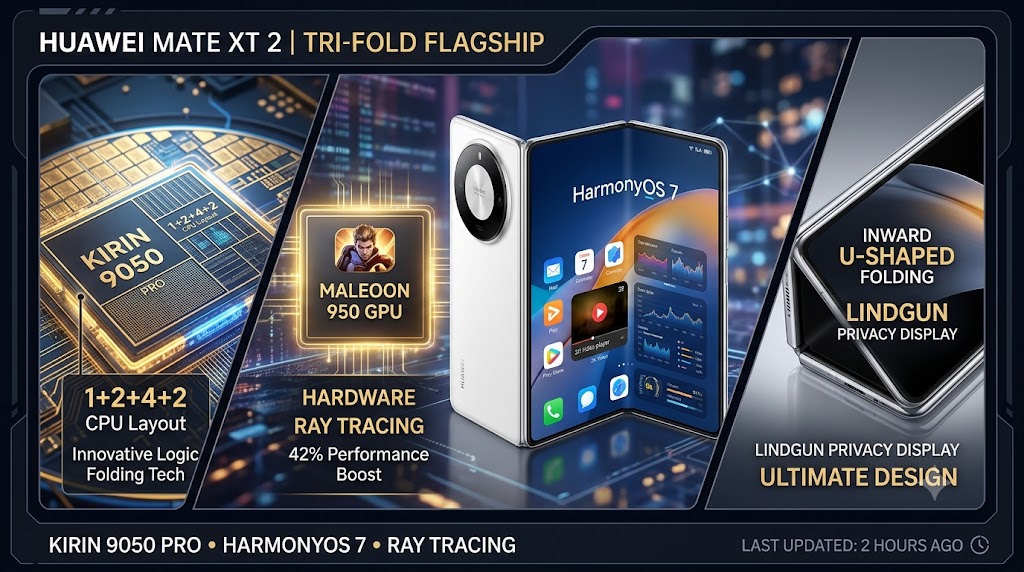
The Kirin 9050 Pro is built around what Huawei calls "logic folding" technology. The company describes the approach as a new way of arranging logic units inside a chip, placing them in layered stacks rather than relying solely on a conventional flat layout.
Huawei says the design can shorten the distance that signals need to travel within the processor. That reduction in transmission distance is intended to lower latency and improve overall computing performance.
New Architecture Inside the Kirin 9050 Pro
At the heart of Huawei's latest processor is a three dimensional approach to arranging computing components.
The company compares the structure with moving from a single storey building to a duplex. Instead of spreading logic units across one horizontal layer, the architecture stacks them vertically. Interconnect channels between the layers act much like elevators, allowing signals to move between different parts of the chip.
That physical arrangement is designed to address one of the basic challenges in semiconductor engineering: the distance data must travel between processing components.
When computing elements sit farther apart, signals have to cover longer paths. Those longer paths can contribute to latency and can make it harder to improve performance without increasing power consumption or chip complexity.
Huawei's logic folding approach seeks to reduce those distances by bringing processing elements closer together through vertical stacking.
The company says the result is shorter signal transmission paths, lower latency and higher performance.
The technology also gives Huawei another way to differentiate its processors at a time when chip architecture has become increasingly important to smartphone performance. Modern flagship phones depend on processors not only for basic computing but also for artificial intelligence tasks, graphics, photography, connectivity and power management.
A Major Return for the Kirin Brand
The Mate XT 2 launch also carries significance for Huawei's Kirin processor business.
The company said the event marks the first time it has unveiled a Kirin chip at a flagship event since the Mate 40 global launch six years ago.
That gap reflects the difficulties Huawei has faced in maintaining access to advanced semiconductor technologies and developing its own chip capabilities.
The Kirin name has long been associated with Huawei's premium smartphones. Before the company encountered restrictions that affected its access to key technologies and suppliers, Kirin processors were a central part of its strategy to compete with other major smartphone manufacturers.
The return of a new high end Kirin processor at a flagship product event therefore puts renewed attention on Huawei's semiconductor development.
Rather than treating the processor as a secondary component of the Mate XT 2, Huawei placed the Kirin 9050 Pro at the centre of the product announcement. The emphasis reflects the close relationship between the company's smartphone ambitions and its efforts to develop proprietary chip technology.
Mate XT 2 Pushes Huawei's Foldable Strategy Further
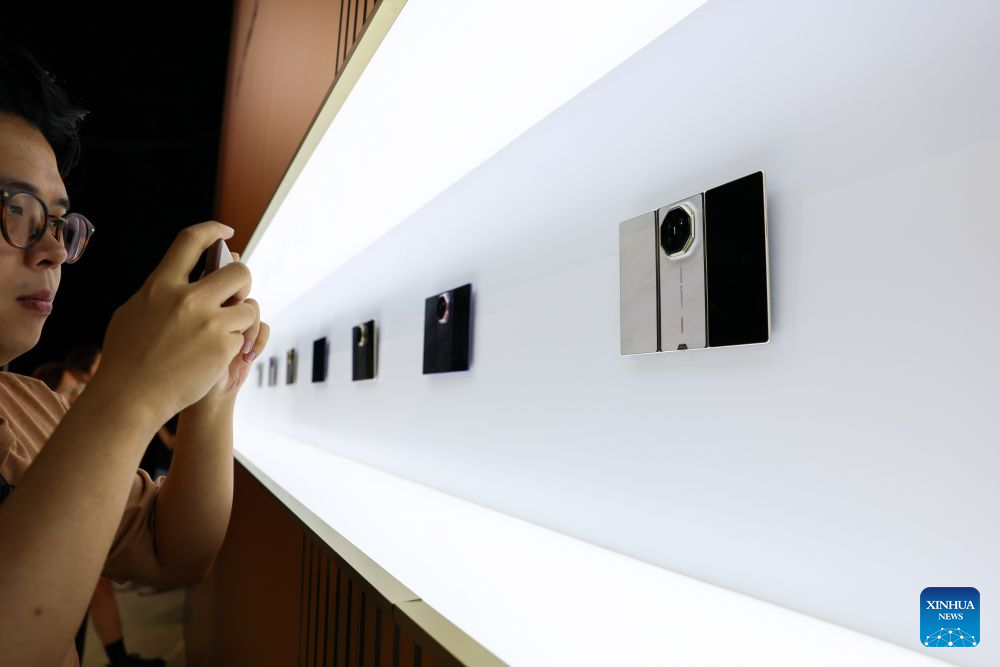
The Mate XT 2 is Huawei's second generation tri fold smartphone, extending a form factor that differs from the conventional foldable phones now sold by several manufacturers.
Most foldable smartphones use a single hinge that allows the device to open once, turning a phone sized display into a larger screen. A tri fold handset uses a more complicated folding arrangement, allowing the display to open across multiple sections.
That design creates engineering challenges involving the display, hinges, internal components, durability and software.
Huawei's decision to release a second generation tri fold model indicates that the company sees the format as more than a one off experiment.
The Mate XT 2 combines that folding design with the new Kirin 9050 Pro processor, placing two of Huawei's major areas of hardware development in the same flagship product.
For users, the appeal of a tri fold phone is the ability to carry a relatively compact device that can expand into a much larger display when opened. The format is aimed at people who want more screen space for tasks such as reading, viewing documents, watching video or handling multiple applications without carrying a conventional tablet.
The more complicated structure, however, requires manufacturers to solve problems that do not arise to the same extent with standard smartphones.
Chip Development Becomes Part of the Competition
Huawei's latest launch also illustrates how semiconductor development has become closely tied to competition in the smartphone industry.
A flagship phone is no longer judged only by its screen, camera system or physical design. The processor determines much of the experience users get from the device, including application performance, artificial intelligence capabilities, image processing and energy efficiency.
For Huawei, the processor has an additional importance because developing its own chip technology can reduce dependence on external suppliers.
The Kirin 9050 Pro therefore represents more than a specification attached to the Mate XT 2. Its architecture is part of Huawei's broader effort to advance chip design while building premium smartphones around technology developed within its own ecosystem.
The company's description of logic folding focuses particularly on the physical organisation of computing units. By stacking logic vertically and using interconnect channels between layers, Huawei aims to create shorter routes for signals moving through the processor.
The principle is straightforward, but implementing such an architecture at high performance requires sophisticated semiconductor engineering.
Huawei Expands Its Hardware Push
The launch in Guangzhou brings together several strands of Huawei's hardware strategy.
The company is advancing a relatively new smartphone form factor with its second generation tri fold device. At the same time, it is presenting a new flagship Kirin processor and promoting an architecture intended to improve the way computing units communicate inside the chip.
That combination gives the Mate XT 2 a role beyond a conventional smartphone upgrade.
The launch also puts Huawei's semiconductor work back in front of consumers and the wider technology industry at a major flagship event. The return of Kirin to such a launch after six years provides a clear indication that processor development remains an important part of the company's long term hardware plans.
Huawei's next challenge will be turning those architectural advances into measurable improvements in everyday use. Shorter signal paths and lower latency matter most when they translate into faster applications, stronger artificial intelligence performance, smoother graphics or better power efficiency.
For now, the Mate XT 2 represents Huawei's latest attempt to combine an unconventional foldable design with a processor architecture built around its own semiconductor research. The company's new Kirin 9050 Pro sits at the centre of that effort, with its vertically layered logic structure designed to make data travel shorter distances inside the chip and improve performance.