

Poland’s museums do more than display paintings, sculptures and historic objects. They tell the story of a country that was divided, occupied, devastated by war and repeatedly forced to rebuild what had been lost.
That history is visible in four museums in particular. The Princes Czartoryski Museum in Krakow preserves a masterpiece that survived uprisings, Nazi looting and wartime upheaval. The Silesian Museum in Katowice transformed the site of a former coal mine into a modern cultural centre. Krakow’s Museum of Contemporary Art, known as MOCAK, occupies part of the former Oskar Schindler factory, where the physical setting carries its own painful history.
In Warsaw, the National Museum holds paintings that served a purpose far beyond decoration. Bernardo Bellotto’s detailed views of the capital helped architects reconstruct the Old Town after much of Warsaw was destroyed during the Second World War.
Together, these institutions show how Poland has used art not simply to remember its past, but to preserve pieces of a country that war and political upheaval repeatedly threatened to erase.
Princes Czartoryski Museum: preserving a national memory
The story begins in Krakow at the Princes Czartoryski Museum, founded more than two centuries ago by Princess Izabela Czartoryska.
When Poland was divided among neighbouring powers during the partitions, the country lost its independence and much of its political identity. Czartoryska responded by collecting objects that could preserve a sense of Polish history and culture. Her museum became an act of preservation at a time when national memory itself was under pressure.
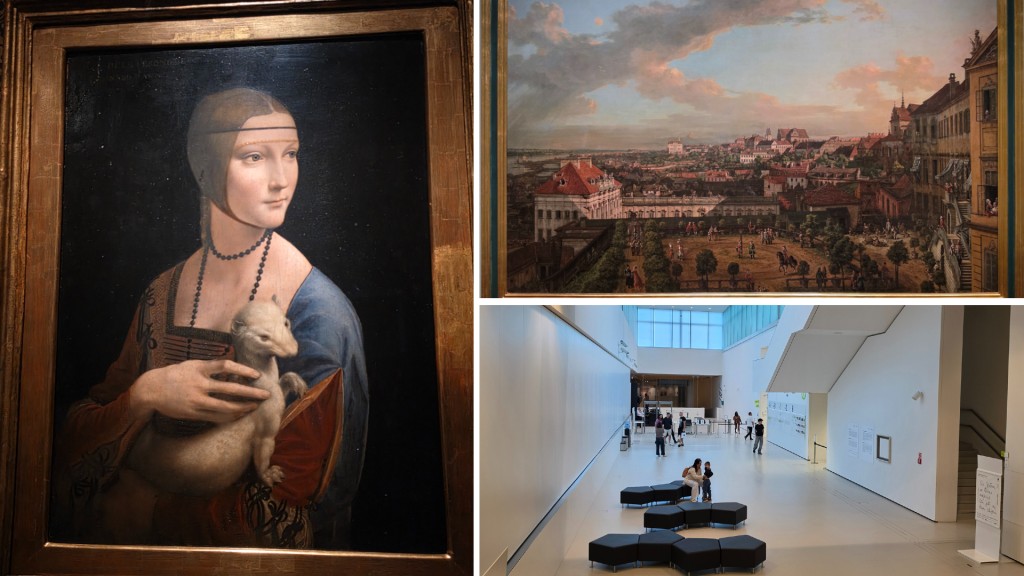
Among its greatest treasures is Leonardo da Vinci’s Lady with an Ermine, painted around 1489 or 1490.
The portrait is one of the most famous works in Poland, but its significance extends beyond Leonardo’s artistry. The painting has endured a history of its own. During the 1830 uprising, it was hidden for protection. Decades later, Nazi forces seized it during the German occupation of Poland. It eventually returned to Polish hands after the war, following its recovery by American troops.
The journey of the painting mirrors the turbulent history surrounding it. It survived because people understood that losing an artwork could mean losing part of a country's cultural record.
Silesian Museum: a coal mine becomes a cultural centre
The Silesian Museum in Katowice offers a very different story.
Founded in 1929, the museum suffered heavily during the Second World War. Nazi forces looted its collections and destroyed the institution in 1940. For decades, the museum’s history remained tied to the destruction of Poland’s cultural heritage during the occupation.
Its later rebirth took place in a setting that says much about Katowice itself.
In 2015, the museum opened its new headquarters on the former site of the “Katowice” coal mine. Instead of erasing the industrial character of the location, the museum incorporated it into its design. Exhibition spaces extend underground, while glass structures rise above the former mining site.
The result connects two parts of Silesian history: its industrial past and its cultural present.
The collection covers a wide range of Polish art, including works associated with major figures such as Jan Matejko and Zdzisław Beksiński. Visitors move through galleries built within a place once defined by coal extraction and heavy industry.
The transformation is significant. A site once associated with mining now houses paintings, exhibitions and cultural programmes. The change reflects the wider transformation of Katowice, a city that has spent recent decades developing an identity that reaches beyond coal.
MOCAK: contemporary art inside Schindler’s factory
In Krakow, the Museum of Contemporary Art, or MOCAK, offers perhaps the most direct encounter between modern art and historical memory.
The museum stands on the site of Oskar Schindler’s former enamel factory. Schindler became internationally known for helping save Jewish workers during the Holocaust, and the factory has become closely associated with Krakow’s wartime history.
MOCAK opened in 2011 and focuses on contemporary art. Its exhibitions explore subjects including memory, violence, identity and the experience of living with the consequences of history.
The setting changes the way visitors encounter the work.
A contemporary installation or painting displayed in an ordinary gallery can be considered mainly for its artistic qualities. At MOCAK, the surrounding history adds another layer. The building and its location remind visitors that the ground itself carries memories of persecution, survival and war.
One example from the museum’s collection is Jerzy Kośalka’s Good-bye Ladies and Gentlemen, created in 2004. Works such as this sit within a broader programme that encourages visitors to think about how contemporary artists respond to social and historical questions.
MOCAK does not turn history into a museum piece that belongs entirely to the past. Instead, it asks what those memories mean in the present.
National Museum in Warsaw: when paintings became a blueprint
Warsaw offers perhaps the clearest example of art becoming a practical tool for rebuilding a city.
The National Museum in Warsaw was founded in 1862 and now holds around 830,000 objects. Its collections cover centuries of art and include some of Poland’s best-known paintings.
Among the most important are the city views of Warsaw painted by Bernardo Bellotto, widely known as Canaletto, between 1770 and 1780.
Bellotto’s paintings captured streets, buildings, squares and landmarks with extraordinary detail. More than a century later, those images acquired a new purpose.
Warsaw suffered catastrophic destruction during the Second World War. Around 85 percent of the city was destroyed, leaving large sections of the historic centre in ruins.
When architects and planners began reconstructing Warsaw’s Old Town, Bellotto’s paintings provided valuable visual evidence of what the city had looked like before the destruction.
His paintings could not restore the original buildings by themselves, but they gave architects detailed references for façades, proportions, streets and architectural features. Art that had once documented everyday Warsaw became part of the evidence used to reconstruct it.
The Old Town that visitors see today therefore owes part of its appearance to paintings created in the 18th century.
The National Museum also holds Jan Matejko’s Battle of Grunwald, painted in 1878.
The enormous historical painting depicts the Polish-Lithuanian victory over the Teutonic Knights in 1410. Matejko created it while Poland remained divided among foreign powers.
The painting therefore carried a meaning that extended beyond its depiction of a medieval battle. It presented a powerful image of military success and national strength at a time when Poland had no independent state of its own.
Four museums, four ways of remembering
The four museums tell different stories, but they are connected by the way Poland has used culture to survive periods of upheaval.
In Krakow, the Princes Czartoryski Museum protected national treasures when Poland itself had been divided. In Katowice, the Silesian Museum turned a former coal mine into a major cultural institution. MOCAK placed contemporary art inside a location marked by the history of the Holocaust. In Warsaw, historic paintings helped restore a city that had been devastated by war.
None of these stories treats art as something detached from ordinary life.
Paintings were hidden because they mattered. Collections were rebuilt because cultural objects represented more than financial value. Former industrial sites were given new lives as museums and concert halls. Historical images became references for rebuilding streets and buildings.
Poland’s museums therefore offer more than a journey through art history. They show how objects, buildings and images can carry memories across generations.
A painting can preserve a face. A city view can preserve a vanished street. A museum can preserve objects that a war tried to destroy.
And when those things survive, they give the next generation something concrete from which to rebuild.
If you could visit only one of these four museums, which would you choose to experience Poland’s history through art?