

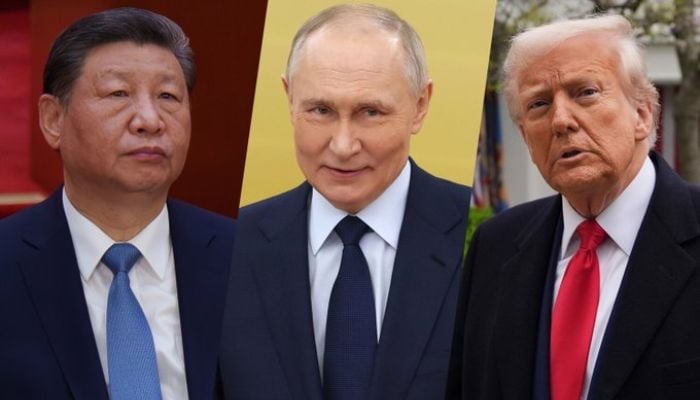
Russian President Vladimir Putin, Chinese President Xi Jinping and US President Donald Trump could meet at an Asia Pacific summit in China next month, the Kremlin said on Monday, raising the possibility of high level discussions about the war in Ukraine. However, officials have stressed that no meeting has been formally agreed and no agenda has been established.
Kremlin spokesman Dmitry Peskov confirmed that the possibility of a meeting had been mentioned because all three leaders might attend the Asia Pacific Economic Cooperation (APEC) summit in Shenzhen on November 18 and 19. He said there had been no substantive proposals or agreements concerning either the meeting or its potential agenda.
The prospect of bringing the three leaders together follows a report by The Wall Street Journal on Sunday that Putin wanted a summit with Xi and Trump to discuss the war and hoped to broker a settlement favourable to Moscow. The report cited unnamed people familiar with the discussions.
The Kremlin's response stopped short of confirming that such a gathering was being organised. Peskov said the subject had been raised only in the context of a possible meeting between leaders expected to attend the same international event.
The uncertainty leaves open whether the three presidents will hold direct talks, what issues they might discuss and whether any meeting could advance efforts to end Russia's war against Ukraine.
Kremlin confirms discussions but no agreement
The APEC summit offers a possible setting for contact between the Russian, Chinese and American presidents because all three countries belong to the regional economic forum.
Asked about the reported plans, Peskov acknowledged that a meeting had been mentioned but said no one had presented or agreed on concrete proposals.
“No substantive proposals or agreements, neither regarding the meeting itself nor its potential agenda and content, have been discussed or put forward by anyone,” he said.
His comments indicate that the possibility remains preliminary rather than a confirmed diplomatic initiative.
A meeting between Putin, Xi and Trump would bring together three leaders with significant influence over the diplomatic and strategic environment surrounding the war. Russia launched its full scale invasion of Ukraine in February 2022, while China has maintained close political and economic ties with Moscow and the United States has played a central role in international efforts to bring the conflict to an end.
However, the participation of these three powers would not resolve the central question of how to secure an agreement acceptable to Ukraine.
Kyiv has repeatedly rejected any arrangement negotiated over its head, arguing that Ukraine must have a direct role in decisions affecting its territory, security and future.
Peskov also acknowledged that limitation. He said a final settlement could not be achieved without participation from someone representing Kyiv who was prepared to accept responsibility for the outcome.
His remarks came as Ukrainian officials criticised the possibility of a meeting involving Russia, China and the United States without Ukraine at the table.
Washington says ending the war remains a priority
US Secretary of State Marco Rubio addressed the reports while visiting Uzbekistan. Asked whether a meeting between the three presidents had been finalised, Rubio said he did not know whether any arrangements had been completed.
“But the president has been clear: He would like the war in Ukraine and Russia to end,” Rubio told reporters.
His response left the door open to possible discussions without confirming that Washington had committed to the proposed gathering.
Trump has repeatedly expressed a desire to end the war and has pursued diplomatic engagement with Moscow. His approach has also drawn criticism from Ukrainian officials, who fear that negotiations could place pressure on Kyiv to accept terms that favour Russia.
The latest reports emerged after Trump waived new sanctions on Russia and reached a diesel deal with Moscow. Those developments have added to uncertainty over the direction of US policy towards the Kremlin as diplomatic contacts continue.
Trump has also renewed his criticism of Ukrainian President Volodymyr Zelensky in recent days, accusing him of not wanting to end the conflict.
Zelensky has firmly rejected that accusation.
The disagreement reflects a broader dispute over responsibility for the continuation of the war and the terms required to end it. Moscow and Washington have explored ways to pursue negotiations, but Ukraine insists that any settlement must account for its interests and security.
China, meanwhile, has not confirmed that a meeting is being planned. Foreign ministry spokeswoman Mao Ning said she had no information about the possibility of talks between the three presidents.
The absence of confirmation from Beijing adds another layer of uncertainty to the proposal.
Ukraine rejects the prospect of talks without Kyiv
Ukrainian Foreign Minister Andriy Sybiga strongly criticised the idea of Putin meeting Trump and Xi without a Ukrainian representative.
Sybiga argued that a meeting involving Ukraine, Russia and the United States could help bring the war to an end more quickly. By contrast, he warned that a gathering between Russia, China and the United States could encourage Moscow to continue its military campaign.
“A trilateral meeting between the leaders of Ukraine, the US and Russia could help end the war sooner,” Sybiga said.
“A trilateral meeting between the leaders of Russia, China and the US would do only the opposite: encourage Putin to continue this war.”
He also attacked Putin personally, writing on social media that the Russian president was “not a global leader; he is a war criminal”.
“By any pragmatic or moral measure, Putin has no place at the table with presidents Trump and Xi,” Sybiga added.
His remarks reflected Kyiv's concern that discussions among major powers could produce political pressure on Ukraine without giving its government a meaningful role in shaping the outcome.
For Ukraine, the issue extends beyond who attends a diplomatic meeting. Any agreement could determine the future of occupied territory, the country's security arrangements and the terms under which hostilities would stop.
Kyiv therefore maintains that it must participate directly in negotiations rather than depend on decisions reached by Washington, Moscow and Beijing.
The Kremlin, however, has repeatedly questioned whether Zelensky can sign a peace agreement. Putin has said he would not meet the Ukrainian president until a final peace deal was ready, while also challenging Zelensky's authority following the expiry of his five year presidential term under martial law.
Ukraine has rejected those arguments, saying Putin's refusal to meet Zelensky demonstrates that Moscow is not genuinely interested in ending the war. The Kremlin has denied that accusation.

Questions over Putin's position on a peace deal
The dispute over Zelensky's authority has complicated efforts to establish a clear path towards negotiations.
Ukraine's presidential term expired while the country remained under martial law, which was imposed following Russia's full scale invasion. Ukrainian officials have maintained that the legal framework governing martial law does not permit elections under the current conditions and that Zelensky continues to exercise presidential authority.
Putin has used the issue to question whether the Ukrainian president has the legal standing to sign a peace agreement. Kyiv considers that position an attempt to undermine its government and weaken its negotiating position.
The Kremlin's insistence that a final settlement requires a representative from Kyiv appears to acknowledge that Ukraine cannot simply be excluded from the process. However, it does not resolve the disagreement over who should represent the country or when direct talks between the two presidents should take place.
A summit involving Trump and Xi could potentially create an opportunity to discuss these disputes, but no confirmed agenda exists. Officials have not announced whether the war would be the principal subject of any meeting or whether other international and economic issues would also be discussed.
The Wall Street Journal report suggested that Putin wanted to use the proposed gathering to pursue a settlement favourable to Russia. Because the report relied on unnamed sources and the Kremlin has not confirmed any formal plan, the details of the alleged initiative remain unverified.
APEC summit could provide a diplomatic opening
The APEC summit in Shenzhen on November 18 and 19 will bring regional leaders together to discuss economic cooperation and related issues. Russia, China and the United States are all members of the organisation, making the event a potential opportunity for informal diplomatic contact.
Whether that opportunity develops into a formal meeting remains uncertain. The Kremlin has confirmed only that the possibility has been mentioned, Washington has not confirmed an arrangement, and Beijing says it has no information about the reported plan.
The political stakes would be significant if the three leaders did meet. Trump has sought to end the war, Putin is pursuing Russia's strategic objectives, and Xi leads a country whose relationship with Moscow has become increasingly important during the conflict.
Yet any diplomatic initiative that excludes Ukraine would face immediate opposition from Kyiv and questions about whether the resulting proposals could be implemented.
The Kremlin's own statement that a final settlement requires participation from Kyiv reinforces the difficulty of reaching an agreement without Ukrainian involvement.
As preparations for the November summit continue, officials have yet to confirm a meeting or outline any proposed terms. Will Trump, Putin and Xi use the APEC summit to open a path towards peace, and will Ukraine have a direct seat at the negotiating table?