

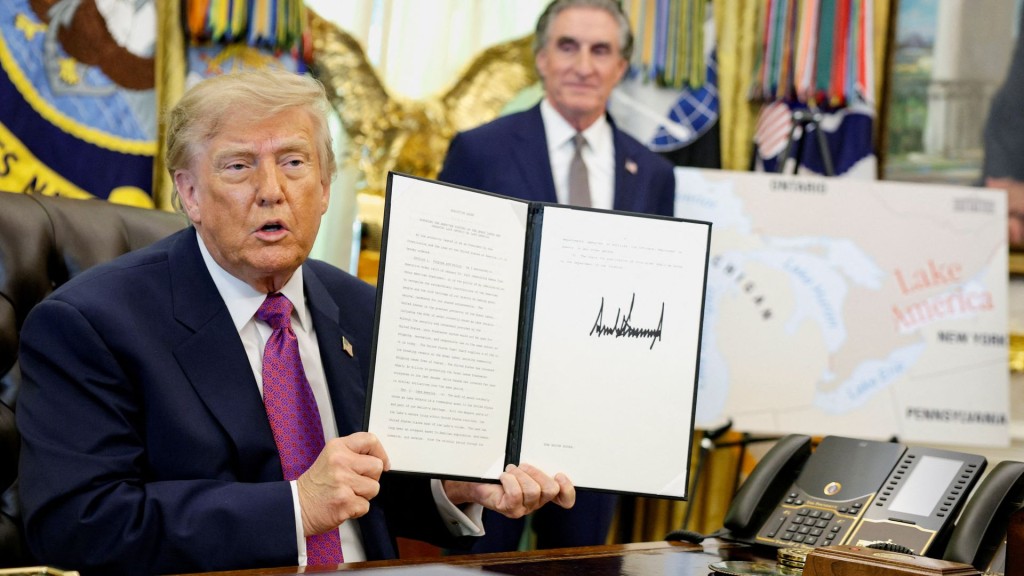
WASHINGTON — US President Donald Trump has signed an executive order directing the federal government to rename Lake Ontario as “Lake America”, escalating a growing dispute with Canada as trade negotiations between the two countries remain stalled.
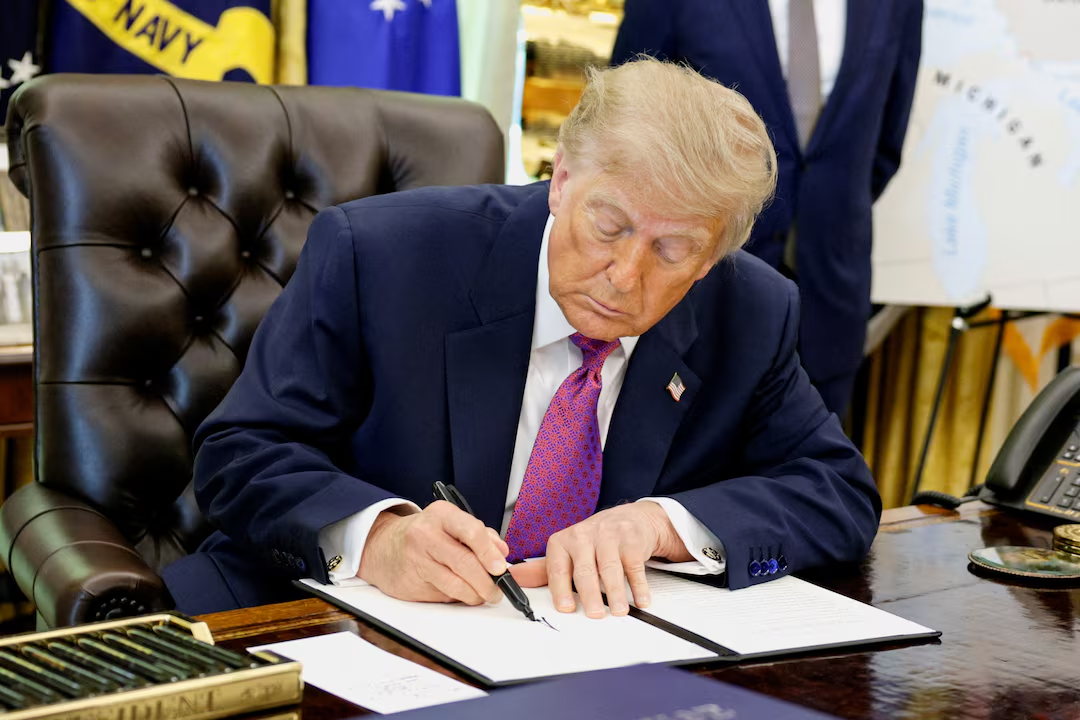
Trump signed the order on Thursday in the Oval Office, directing Interior Secretary Doug Burgum and the US Board on Geographic Names to update federal records and official references to the lake.
The order says the body of water currently known as Lake Ontario should officially be renamed Lake America in the United States. It directs the Interior Department to take the necessary steps within 30 days and update the Geographic Names Information System, the federal database used to standardise geographic names for government purposes.
The move is largely symbolic, however. While the US president can direct federal agencies to use a particular name, the order cannot require Canada, international organisations or other governments to adopt the new designation.
Lake Ontario is shared by the United States and Canada, with its southern and eastern shores bordering New York state and its northern and western shores bordering the Canadian province of Ontario.
The decision comes at a particularly sensitive moment in US Canadian relations. Trade talks between Washington and Ottawa collapsed last week after three days of negotiations, with both sides blaming the other for the breakdown.
The latest name change follows Trump's earlier efforts to alter the names of prominent geographic landmarks. In January 2025, shortly after returning to the White House for his second term, Trump ordered the Gulf of Mexico to be referred to as the “Gulf of America” in US federal use.
The president has now turned his attention to another major body of water shared with a neighbouring country.
Order follows escalating trade dispute
Trump had already raised the possibility of renaming Lake Ontario earlier this week, when he said the United States was giving serious consideration to changing its name.
In a social media post, Trump linked the proposal directly to the deteriorating trade relationship with Ontario and Canada, saying the United States did not expect to conduct as much business with Ontario in the future.
The announcement drew immediate attention because Lake Ontario is not solely a US body of water. It forms part of the Great Lakes system, a network of interconnected freshwater lakes that straddle the US Canadian border and are central to the region's economy, transportation and environment.
The lake is also part of a complex water management system involving federal and provincial or state authorities on both sides.
The White House has presented the renaming as part of a broader effort to highlight what it describes as America's historical and economic contribution to the Great Lakes.
The executive order says the United States has played a major role in protecting the Great Lakes, including through investments in freshwater conservation and the operation of icebreaking vessels that support commercial shipping.
It also points to the lake's importance to American exploration, settlement, commerce and military history.
For Canada, however, the lake remains Lake Ontario.
Canada not bound by US name change
The US government can control how federal agencies refer to geographic features within the country's official naming system, but it does not have the authority to dictate what Canada calls a shared international waterway.
That distinction was also evident during Trump's earlier campaign to rename the Gulf of Mexico.
After the United States began using “Gulf of America” in federal documents, other governments and international bodies continued to use Gulf of Mexico.
The same situation is likely to apply to Lake Ontario.
The name Lake Ontario is deeply established in Canadian government, geography, commerce and public life. The Canadian province of Ontario itself takes its name from the lake.
The order therefore creates two potentially different official usages for the same international waterway, depending on which country's institutions are referring to it.
For US federal agencies, maps and documents, the administration is instructing officials to use Lake America.
For Canada, the body of water remains Lake Ontario.
The practical effect could extend beyond government documents if private companies, mapping services and other organisations decide to follow the US designation. But the executive order itself does not compel private companies or foreign governments to adopt it.
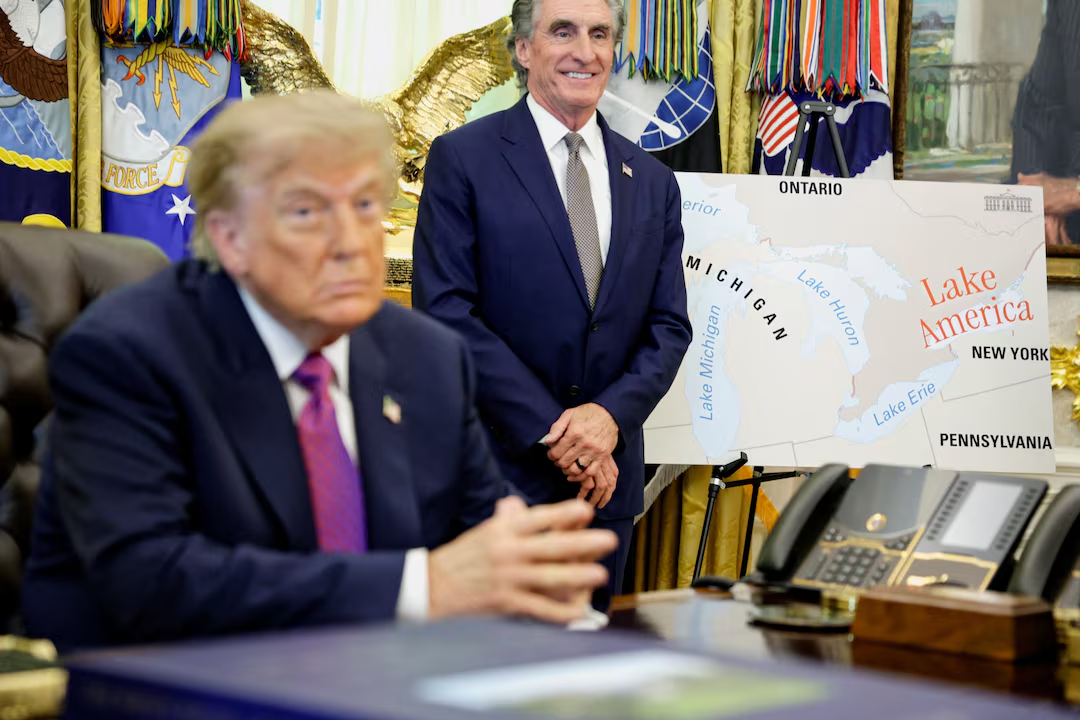
Trade talks collapse
The decision comes as Washington and Ottawa are already locked in a broader trade dispute.
Three days of intensive negotiations between the two countries broke down last week, with each side blaming the other for derailing the talks.
The collapse has added to tensions between two countries whose economies are closely integrated.
Trade between the United States and Canada supports major industries on both sides of the border, including manufacturing, agriculture, energy and automotive production.
The two countries also share one of the world's longest international borders, with millions of people and large volumes of goods moving between them every year.
Against that backdrop, the Lake Ontario name change carries significance beyond geography.
Trump has repeatedly used trade and national identity as themes in his dealings with Canada. His administration has also pursued a series of geographic renaming initiatives since the president returned to office.
Critics have questioned the timing of such measures, arguing that disputes over geographic names do little to address the economic and diplomatic problems confronting the two countries.
Supporters of Trump's approach have portrayed the renamings as expressions of American sovereignty and national identity.
A familiar strategy for Trump
The Lake Ontario order closely resembles Trump's earlier decision involving the Gulf of Mexico.
In both cases, the president has sought to impose a new name through the US federal geographic naming system, despite the geographic features being connected to other countries or international waters.
The Gulf of Mexico order also triggered a debate over whether the US government could effectively change the name of a geographic feature beyond its jurisdiction.
The answer, in practical terms, was that the administration could control federal usage but could not force other countries to follow.
That distinction is particularly relevant for Lake Ontario because Canada directly borders the lake and shares responsibility for its waters.
The new executive order acknowledges the limits of its authority. It directs US agencies to make the change but does not create a legal requirement for Canada or other parties to use the new name.
Trump has nevertheless signalled that geographic renaming could remain part of his political agenda.
During Thursday's signing, he suggested that the United States already has a gulf and now a lake named America, joking that the country might next need an ocean.
He mentioned the Atlantic and Pacific oceans as possible candidates.
The remark reinforced the perception that the Lake America order is part of a broader campaign to put an explicitly American stamp on major geographic landmarks.
Symbolic move with diplomatic consequences
Although the renaming is unlikely to change the physical management of Lake Ontario, it adds another symbolic point of friction to an already strained relationship.
The lake itself will continue to serve the same functions it has for centuries. Ships will continue to cross its waters, communities will continue to depend on it, and US and Canadian authorities will continue to cooperate on issues including navigation, environmental protection and water quality.
What changes immediately is how the US federal government refers to it.
The political consequences may prove more significant.
At a time when Washington and Ottawa are struggling to resolve major trade disagreements, even a symbolic dispute over the name of a shared natural landmark can become another source of diplomatic tension.
For Canada, refusing to adopt the US terminology would preserve the traditional name. For the Trump administration, enforcing the new name across federal agencies would reinforce its broader message about American sovereignty and national identity.
The result could be an unusual situation in which the same lake has different official names depending on which side of the border is using it.
For now, the name “Lake America” will begin appearing in US federal references as agencies implement Trump's order. In Canada, however, the lake remains Lake Ontario.
The dispute over what to call it is therefore unlikely to be settled by the executive order alone.
Instead, it has become the latest symbol of a much larger disagreement between Washington and Ottawa, one that now extends beyond tariffs and trade negotiations into questions of national identity, sovereignty and the language used to describe shared spaces.