

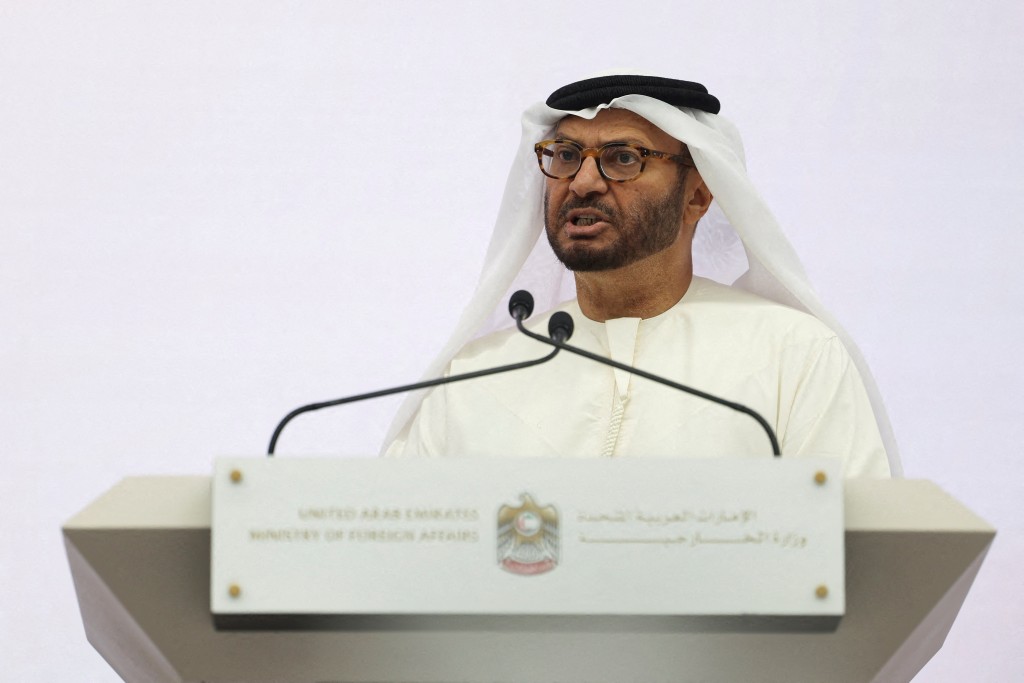
The United Arab Emirates is expanding ports, pipelines, rail links and alternative trade corridors to protect its energy exports from disruption caused by the war between the United States and Iran, a senior UAE official said on Monday.
Presidential adviser Anwar Gargash said Abu Dhabi would not allow its energy shipments, trade or wider economic activity to become dependent on the outcome of the conflict. Speaking at the Hili Forum in Abu Dhabi, he said the UAE was already developing alternative routes to reduce its exposure to instability around the Strait of Hormuz.
“Our energy exports will not be held hostage, nor will our trade and economic activity,” Gargash said.
The shift reflects growing concern across the Gulf that the conflict has exposed the risks facing economies whose energy exports and commercial shipping depend heavily on a narrow and strategically important waterway.
The UAE has been increasing port capacity along its eastern coast while working on pipelines, railway connections and alternative commercial corridors, Gargash said. The projects are intended to give the country additional options for moving oil, energy products and other goods if shipping through the Strait of Hormuz becomes restricted or unsafe.
Attacks Have Changed Gulf Security Calculations
The war has had a major impact on Gulf Arab states, with the UAE among the countries directly affected by Iranian military action.
Tehran fired missiles at the UAE and attacked oil tankers in the Strait of Hormuz, bringing the security of energy supplies and commercial shipping into sharper focus for governments across the region.
For the UAE, the attacks have reinforced a concern that has shaped its economic policy for years: dependence on a single maritime route can leave exports vulnerable to events outside the country’s control.
Gargash said relations with Iran could eventually improve, leaving room for diplomatic engagement even after the fighting ends. But he warned that rebuilding confidence would not happen quickly.
Trust between the Gulf states and Iran, he said, could take decades to restore following the attacks.
That assessment reflects the broader challenge facing Gulf governments as they attempt to maintain economic ties, protect critical infrastructure and avoid a prolonged confrontation with Tehran while also preparing for the possibility that tensions could remain high.
The UAE has already spent years developing infrastructure designed to reduce its reliance on the Strait of Hormuz. The latest expansion of ports and overland connections is intended to strengthen those options further.

Gulf States Criticised for Lack of Joint Strategy
Gargash also criticised the Gulf Arab states for failing to respond to Iran with a sufficiently coordinated strategy.
The six Gulf Cooperation Council countries share many of the same security concerns, particularly regarding missile attacks, maritime threats and the protection of energy infrastructure. Yet those shared concerns have not always translated into a common response.
Gargash said the region had struggled to turn its collective concerns into a unified strategy.
The criticism comes as Gulf governments reassess their security arrangements following months of conflict. The UAE, Saudi Arabia, Qatar, Kuwait, Bahrain and Oman all have different relationships with Tehran and different assessments of how best to manage relations with Washington.
Those differences can make a common policy difficult to achieve.
The UAE has maintained a close security relationship with the United States while also pursuing diplomatic and economic contacts with Iran. The conflict has placed pressure on that balancing approach and forced Gulf governments to consider how much protection they can realistically expect from external powers during a major regional crisis.
Gulf Officials Say US Partnership Alone Is Not Enough
Qatar’s Foreign Ministry spokesperson, Majed al Ansari, expressed a similar view at the policymakers’ forum, arguing that Gulf states should not depend entirely on their strategic relationship with Washington for security.
“We need to realise in the Gulf that having international forces in the region, having a strategic alliance with the U.S. is very important but is not enough,” al Ansari said.
He called for greater regional security capabilities and argued that Gulf countries needed to become more self sufficient in protecting themselves.
“Self sufficiency when it comes to security is the only way forward,” he said.
His comments point to a growing debate within Gulf capitals about the limits of relying on foreign military forces. American troops and military assets remain central to the security architecture of the Gulf, but officials in the region increasingly argue that national governments must have the ability to protect their own territory, infrastructure and economic interests.
Gargash made a similar argument.
He said the UAE considered its partnership with the United States essential, but the conflict had demonstrated the importance of developing national capabilities rather than assuming another country would always place Gulf security at the top of its priorities.
“Our security is our first priority. When we depend entirely on others, we cannot always assume it will be their priority,” Gargash said.

Strait of Hormuz Remains at Centre of Dispute
The Strait of Hormuz remains one of the most difficult issues in negotiations surrounding the conflict.
The waterway has traditionally carried a significant share of the world’s energy supplies, making any disruption there a concern far beyond the Gulf. According to the account presented by the UAE, Iran followed through on its threat to close the strait, disrupting energy shipments and sending energy prices sharply higher.
The economic consequences were felt internationally as markets responded to fears over reduced energy supplies and shipping disruptions.
For Gulf exporters, however, the problem is more immediate. The strait sits at the centre of their energy trade, and any prolonged restrictions can affect oil and gas shipments, insurance costs, shipping schedules and broader commercial activity.
The waterway has also become a major point of disagreement in negotiations between Washington and Tehran.
Qatar and Pakistan have been involved in efforts to mediate between the two sides, but disagreements over the status and control of the strait remain unresolved.
Iran claims that the waterway belongs to Iran and Oman, a position broadly rejected by the Gulf states.
Gargash said freedom of navigation could not become a bargaining tool in negotiations.
“Freedom of navigation is not a concession to be granted, nor a principle to be renegotiated under pressure,” he said.
He added that any lasting settlement would need credible guarantees that Gulf Arab states would not face further Iranian attacks.
UAE Looks Beyond Hormuz
The UAE’s infrastructure strategy is therefore closely tied to the security concerns created by the conflict.
Expanding eastern ports could give the country additional maritime options, while pipelines can provide alternatives to moving energy through the strait. Railway connections and other trade corridors can also help shift some commercial activity away from routes exposed to maritime disruption.
The aim is not necessarily to abandon the Strait of Hormuz. Its importance to regional and international trade makes that unrealistic. Instead, the UAE is seeking additional routes so that a crisis in one location does not bring its wider economy to a standstill.
The approach also fits into Abu Dhabi’s broader effort to strengthen its position as a regional centre for trade, logistics and energy.
The conflict has made that strategy more urgent. A country can maintain strong diplomatic relationships and invest heavily in military protection, but physical alternatives for moving goods and energy provide another layer of security when shipping routes come under threat.
Ceasefire Efforts Remain Stalled
The conflict began with US and Israeli strikes on Iran on February 28 and has continued despite diplomatic efforts to halt the fighting.
A preliminary ceasefire reached in June later unravelled, leaving negotiations stuck and prospects for a renewed peace process uncertain.
For the UAE, the immediate concern is therefore not simply when the fighting will end. It is how to protect the country’s economy if instability continues or another confrontation threatens Gulf shipping in the future.
Gargash acknowledged that relations with Iran may eventually recover, but the UAE is preparing for a security environment in which trust cannot be restored quickly.
That preparation is now being built into the country’s infrastructure plans. New port capacity, pipelines, rail connections and alternative trade corridors are intended to ensure that an attack or disruption along one route does not determine the fate of the UAE’s energy exports or wider commercial activity.
The message from Abu Dhabi is clear: future energy and trade policy will be built around having alternatives, rather than relying on a single route or assuming that outside powers will always provide the protection the Gulf needs.