

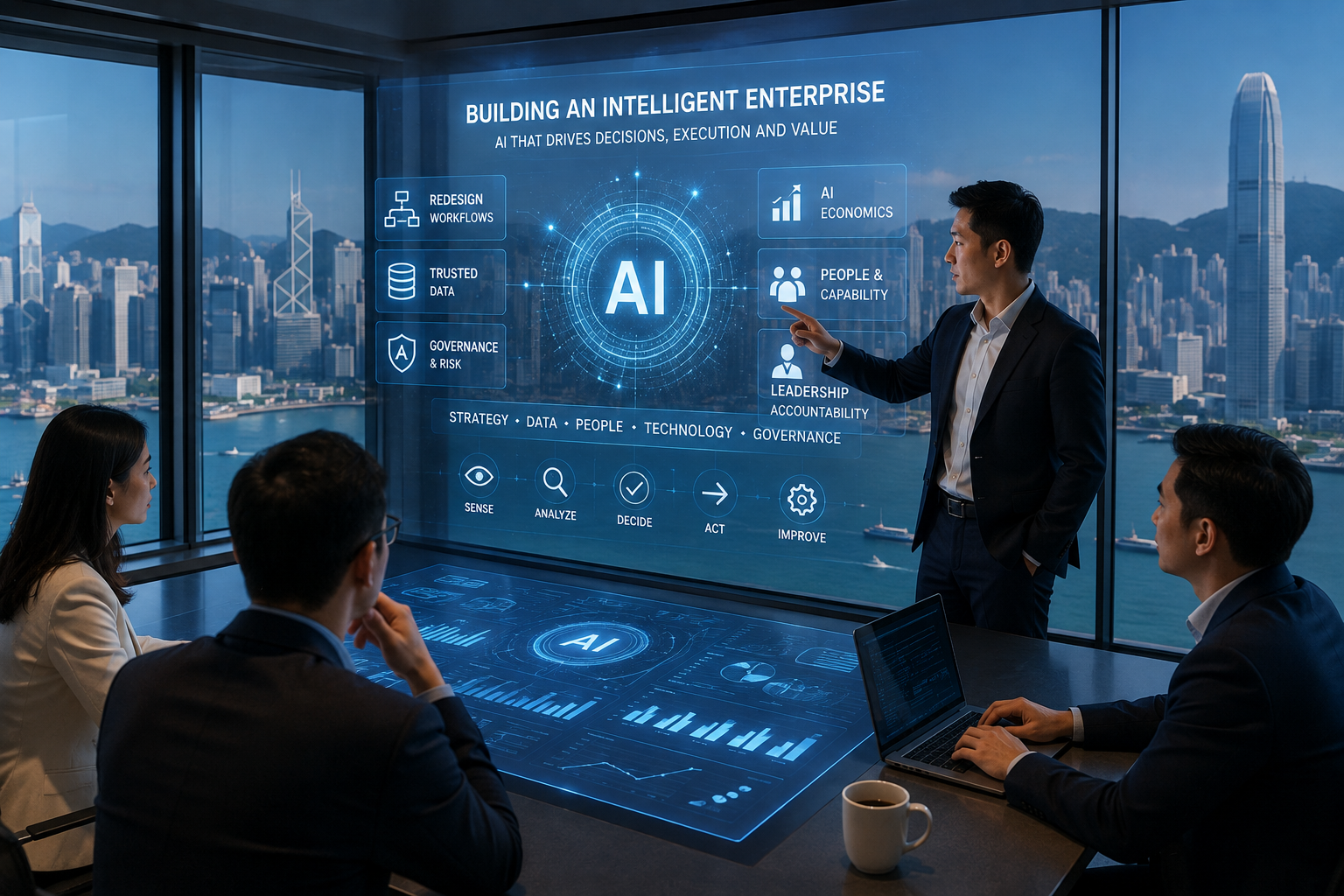
Artificial intelligence has moved rapidly from experimentation to mainstream business use. Large companies across industries have introduced chatbots, coding assistants, automated customer service systems and AI powered tools for research and productivity.
Yet adopting AI does not necessarily make a company more intelligent.
For many businesses, the technology has been added to existing processes without fundamentally changing how decisions are made, how work is organized or how different parts of the organization cooperate. The result can be impressive technology without a corresponding transformation in business performance.
The real challenge for corporate leaders is therefore no longer simply whether their companies should adopt AI. It is how the entire enterprise should be redesigned to make meaningful use of it.
This is the idea behind what can be described as artificial enterprise intelligence, or AEI.
AEI focuses on the ability of an organization to turn AI capabilities into better decisions, stronger execution and sustainable competitive advantage. It shifts attention away from individual AI tools and towards the way a company operates as a whole.
A company may have access to exactly the same AI technology as its competitors but achieve very different results. Poor data, fragmented systems, disconnected departments and unclear accountability can limit the value of even the most sophisticated AI models.
By contrast, organizations with reliable data, well designed workflows, clear governance and strong leadership can use AI to improve productivity, customer service and decision making.
AI tends to amplify the organization in which it is deployed. If an enterprise is poorly organized, AI can increase confusion and create more work. If the organization has strong processes and disciplined management, AI can amplify those strengths.
From AI tools to enterprise intelligence
The first major wave of corporate AI adoption has focused heavily on tools such as large language models, copilots, chat interfaces and personal productivity assistants.
These technologies can deliver real benefits. Employees can draft documents more quickly, conduct research in less time and automate some repetitive tasks. Software developers can accelerate parts of the coding process, while customer service teams can use AI to respond to routine enquiries.
But individual productivity gains should not be confused with enterprise transformation.
A company becomes more intelligent when AI is embedded into the way work is actually performed across departments and systems. That requires leaders to look beyond individual applications and examine entire workflows.
The question should not simply be where AI can be inserted into an existing process. It should be how the process itself could be redesigned if AI is capable of analyzing information, preparing recommendations, coordinating activities and taking certain actions.
That means defining clearly which tasks can be handled by AI, where human judgement remains essential, when unusual cases should be escalated and who remains responsible for the final outcome.
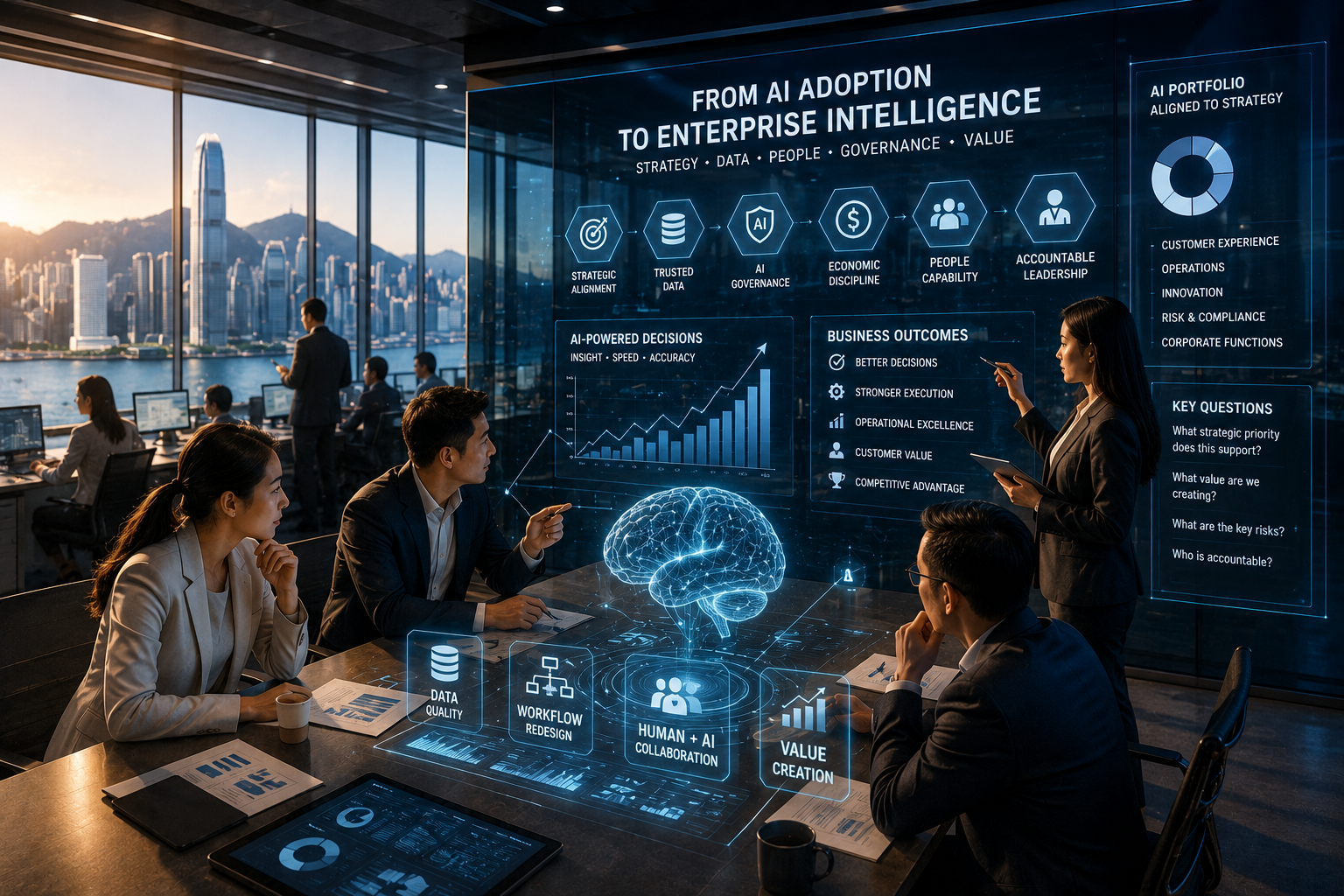
Six disciplines for building AEI
Building artificial enterprise intelligence is not a matter of purchasing a software package. It requires several connected disciplines across the organization.
Redesign work around people and machines
The most effective organizations will rethink workflows from beginning to end rather than simply adding AI to individual steps.
Leaders need to identify where machines can perform tasks independently and where employees should remain directly involved. Human judgement will continue to be particularly important when decisions involve complex circumstances, significant risks or sensitive customer outcomes.
The objective is not to replace people wherever possible. It is to create a more effective partnership between employees and intelligent systems.
Establish trusted data foundations
No organization can become genuinely intelligent if its underlying data is unreliable.
AI can make poor data even more problematic because it can process and distribute inaccurate information at enormous speed. If employees lose confidence in the information produced by AI systems, adoption can quickly lose momentum.
Companies therefore need clear ownership of important data, consistent quality standards and reliable sources of information. Privacy and cybersecurity must also be built into the foundation.
For many businesses, improving data quality may be less visible than launching a new AI application, but it can have a much greater effect on long term performance.
Treat AI governance as an enterprise responsibility
As AI becomes involved in pricing, operations, compliance, customer decisions and risk management, it becomes part of the organisation's broader control environment.
Senior management needs to understand which AI systems are being used, what information they depend on, what risks they introduce and who is responsible for them.
Companies should also be able to trace important AI assisted decisions and investigate problems when systems produce unexpected results.
Without appropriate governance, faster AI adoption can increase operational and regulatory risks as quickly as it increases productivity.
Manage AI economics
AI can appear inexpensive during a small scale pilot but become significantly more costly when deployed across an organization.
Usage based expenses, computing requirements, data management and integration costs can all increase as adoption expands.
Businesses therefore need a clear understanding of where AI spending is going and what value it is producing.
The most successful companies will not judge AI projects solely on technical performance. They will also examine whether the technology improves revenue, reduces costs, strengthens customer relationships or delivers another measurable business benefit.
AI must be both technologically capable and economically sustainable.
Build human capability alongside AI capability
Technology alone cannot transform an organization.
Employees need the knowledge and confidence to use AI effectively, while managers need to understand its strengths and limitations. Different groups require different levels of training.
Directors and senior executives need enough understanding to challenge strategy and assess risk. Frontline employees need practical skills for incorporating AI into their daily work. Technical specialists require deeper knowledge of systems, security and model performance.
Without investment in people, companies may acquire powerful technology without developing the organizational capability needed to use it properly.
Make leadership accountable
AI should ultimately be a board level issue.
It can affect capital allocation, cybersecurity, operational resilience, customer outcomes and competitive positioning. Senior leaders therefore need to take responsibility for the results of AI adoption rather than leaving the issue entirely to technology departments.
Boards do not need to manage individual AI models. They do, however, need to ask whether management has a coherent strategy.
They should ask which strategic priorities the company's AI investments support, how value is being measured, where the major risks lie and who is accountable when systems fail or deliver disappointing results.
A test for Hong Kong companies
Hong Kong businesses can use several straightforward questions to determine whether they are genuinely developing enterprise intelligence.
Has the company launched numerous AI pilots without fundamentally redesigning even two major workflows from beginning to end?
Is AI spending increasing without a clear understanding of the cost of each decision or the return generated?
Does the board receive regular updates on the number of AI projects but little information about actual business value, governance problems or strategic priorities?
If the answer to these questions is yes, the underlying problem may not be a shortage of technology. It may be a lack of enterprise readiness.
Hong Kong's position as an international business and financial centre makes this issue particularly important. Companies operating in highly competitive markets cannot rely indefinitely on isolated technology experiments. They need to determine how AI can strengthen their broader business models and improve the way their organizations operate.

The next stage of AI adoption
The debate surrounding AI often focuses on artificial general intelligence and artificial superintelligence and asks how capable machines might eventually become.
For business leaders, another question may be more immediate.
How intelligent can an enterprise become when it is deliberately designed to work effectively with AI?
That question puts the focus back on the organization rather than the technology.
The companies that succeed in the coming years may not necessarily be those with access to the most advanced AI models. They may instead be the organizations that know how to combine technology with reliable data, redesigned workflows, effective governance, disciplined investment and capable employees.
AI is becoming increasingly common across the corporate world. Access to the technology itself is therefore unlikely to remain a major source of differentiation.
The harder task is building an organization capable of using it consistently and responsibly.
That is where artificial enterprise intelligence becomes important.
The real competitive advantage will come not from simply having AI, but from reorganizing the enterprise so that AI can improve how people think, decide and act.
For corporate leaders, the transition marks a shift from experimenting with AI to building an enterprise around it.
That distinction could determine which companies merely adopt AI and which ones use it to create lasting competitive advantage.